


 INDIA ASIAN GAMES MEDAL MONITOR
·
India: 🥇 0
| 🥈 0
| 🥉 0
| Total: 0
INDIA ASIAN GAMES MEDAL MONITOR
·
India: 🥇 0
| 🥈 0
| 🥉 0
| Total: 0
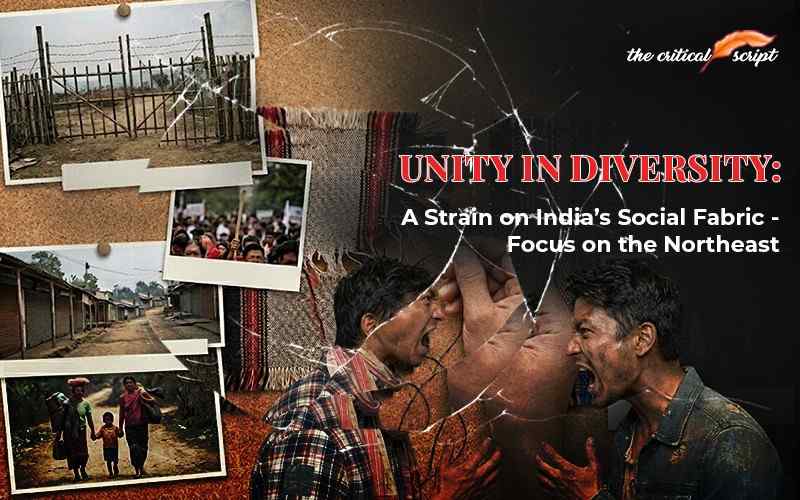
Unity in Diversity: A Strain on India’s Social Fabric - Focus on the Northeast
For decades, “unity in diversity” has been India’s defining slogan. Yet, in recent years, several developments, particularly in the Northeast, have raised difficult questions about the strength and inclusivity of this unity.
The Chakma and Hajong communities in Arunachal Pradesh, resettled decades ago after violence in the Chittagong Hill Tracts, continue to face unresolved questions of citizenship, land rights, and permanent residence certificates (PRC). Despite generations of residence, social and political acceptance remains contested, reflecting deeper anxieties over identity and demographic balance.
In Manipur, the violence that erupted on May 3, 2023, following protests over a High Court order related to Meitei inclusion in the Scheduled Tribe category, exposed how legal and policy decisions, even when well-intentioned, can inflame long-standing ethnic insecurities. The continuing Meitei–Kuki conflict has since become not just a law-and-order issue, but a humanitarian and political crisis.
Beyond Manipur, the region has witnessed historic tensions such as the Kuki–Naga conflict, rooted in competing territorial claims and ethnic self-determination, as well as periodic clashes involving Adivasi communities and indigenous groups like the Bodo and Karbi in Assam, driven by questions of land, political representation, and economic marginalisation.
What links these conflicts is not merely ethnic difference, but competition over scarce resources, uneven development, political mobilisation of identity, and unresolved historical grievances. The Indian Constitution promises equality, but in practice, access to protection, opportunity, and justice often varies across communities and regions.
India’s unity has endured not because conflicts do not exist, but because institutions, dialogue, and democratic processes have so far prevented many tensions from becoming permanent fractures. However, relying only on constitutional structure without addressing ground realities risks turning unresolved grievances into chronic instability.
The Northeast does not need symbolic slogans alone. It needs inclusive development, fair implementation of laws, sensitive handling of identity issues, and sustained political dialogue that goes beyond crisis management. Unity cannot be imposed administratively; it must be continuously negotiated through trust, justice, and participation.
If “unity in diversity” is to remain meaningful, it must be supported not just by national sentiment, but by policies that recognise difference while ensuring dignity and security for all communities.
Disclaimer: The opinions expressed in this article are those of the author's. They do not purport to reflect the opinions or views of The Critical Script or its editor.
Regional Related Posts







Newsletter!!!
Subscribe to our weekly Newsletter and stay tuned.
Related Comments