


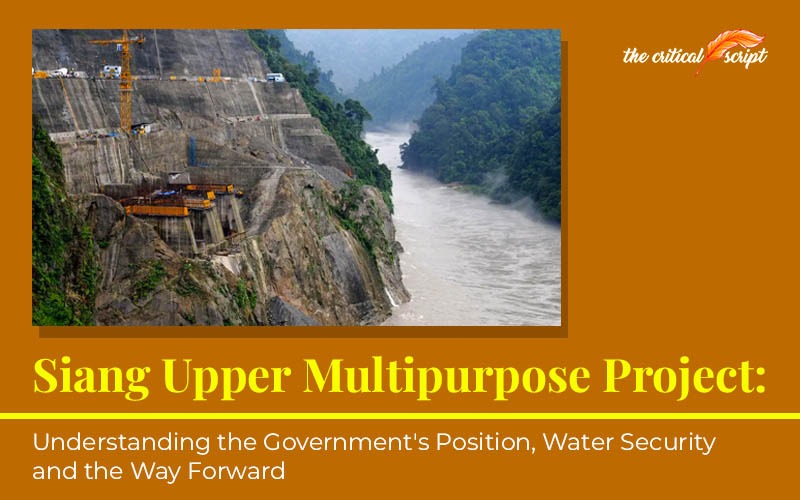
Siang Upper Multipurpose Project: Understanding the Government's Position, Water Security and the Way Forward
Arunachal
Pradesh Chief Minister Pema Khandu has clarified that no decision has been
taken to construct the proposed Siang Upper Multipurpose Project (SUMP),
emphasising that the immediate focus remains on assessing its feasibility and
exploring possible alternatives.
The proposed
project has become the subject of intense public debate in Arunachal Pradesh,
bringing questions of water security, hydropower development, environmental
protection and community interests into focus.
Amid growing
concerns among sections of the indigenous Adi community, the Chief Minister's
recent statement seeks to clarify the government's position and distinguish the
ongoing pre-feasibility process from a final decision on construction.
The clarification
comes at a critical time for the Siang region, where discussions about
development must account for both the strategic importance of the river and the
concerns of communities whose lives and livelihoods are closely connected to
it.
No Decision on Construction: Understanding the Current Stage
In his statement
on November 2, 2026, Chief Minister Pema Khandu made it clear that neither the
Government of Arunachal Pradesh nor the Union government has taken a decision
to construct the proposed dam.
According to the
Chief Minister, the immediate exercise under consideration is the preparation
of a Pre-Feasibility Report (PFR). This preliminary assessment is intended to
examine the project's viability, potential implications and possible
alternatives.
A pre-feasibility
report is an early-stage assessment. It helps establish whether a proposed
project warrants further investigation and what technical, environmental and
economic questions need to be examined. It does not, by itself, constitute
approval for construction.
The distinction is
important in the current debate. The proposal's eventual direction will depend
on further assessment, applicable legal requirements and consultation with the
people and communities concerned.
The Chief Minister
has also assured residents that their concerns regarding ancestral land, homes,
livelihoods and the Siang River will be addressed through dialogue,
transparency and meaningful public consultation.
Why Is the Siang Project Being Examined?
The proposed Siang
Upper Multipurpose Project is envisioned as a major hydropower and
water-storage initiative on the Siang River in Arunachal Pradesh. The proposal
has a planned capacity of approximately 11,200 MW.
The project was
declared a National Project by the Union government in February 2008. Its
proposed multipurpose role has since assumed greater strategic significance
amid developments involving hydropower infrastructure upstream in Tibet.
The Yarlung
Tsangpo River, which flows into India as the Siang and subsequently forms part
of the Brahmaputra river system, is central to this discussion.
China began construction
of a major hydropower project on the Yarlung Tsangpo in July 2025. This
development has heightened Indian concerns about the potential implications of
large upstream infrastructure for water flows, regional water security and
disaster preparedness.
The Arunachal
Pradesh government has cited these developments as a reason to examine possible
options for managing water-related risks and maintaining ecological flows in
the Siang and Brahmaputra rivers.
The government's
stated position is that the potential role of SUMP should be assessed
scientifically and technically rather than assumed in advance.
At the same time,
the implications of any proposed intervention would need careful examination.
The relationship between large dams, flood management, seasonal water
availability and ecological flows is complex and depends on project design,
operating arrangements and river conditions. The preparation of a feasibility
report can help examine these questions, but it cannot predetermine the
outcome.
Development and Community Interests Must Be Considered Together
The Siang River is
more than a source of water or a potential site for hydropower generation. It
is closely connected to the history, culture and livelihoods of communities
living along its course.
Sections of the
Adi community have expressed apprehension about the proposed project,
particularly the possibility of village submergence, displacement, loss of
agricultural land and forests, and disruption to traditional livelihoods.
Residents have
also raised questions about the environmental consequences of a large reservoir
in a seismically active Himalayan region.
These concerns
form an important part of the wider discussion surrounding SUMP. For people
whose homes, land and cultural heritage could be affected, clarity about the
project's possible consequences is essential.
The government has
acknowledged these apprehensions and stated that public consultation will be
central to any future decision.
The challenge is
to ensure that technical assessments and strategic considerations are
accompanied by credible information, transparent communication and meaningful
engagement with affected communities.
A development
proposal of this scale requires more than an assessment of its potential
benefits. It also requires a thorough understanding of its social,
environmental and economic costs, alongside the alternatives available.
The Role of Scientific Assessment and Public Consultation
The current
pre-feasibility process provides an opportunity to examine the proposal's
potential implications before any decision on construction is made.
A comprehensive
assessment would need to consider several important areas:
·
Hydrology and water security: Understanding seasonal
river flows, potential changes in upstream water availability and possible
flood-related risks.
·
Environmental impact: Examining effects on river
ecosystems, forests, biodiversity and downstream flows.
·
Seismic safety: Assessing geological conditions,
seismic risks and the engineering requirements associated with a major dam in
the Himalayan region.
·
Social impact: Identifying communities that could be
affected, along with potential implications for homes, land, livelihoods and
cultural heritage.
·
Economic viability: Evaluating construction costs,
potential electricity generation, long-term benefits and financial risks.
·
Alternative options: Exploring whether different project
designs or other water-management measures could address the concerns that the
project is intended to examine.
Public
consultation is equally important. Local knowledge and community perspectives
can contribute to a more complete understanding of the river basin and the
potential consequences of development.
The objective
should be to ensure that decisions are informed by credible evidence,
applicable safeguards and a clear understanding of the concerns raised by the
people of the region.
Dialogue Remains Essential Amid Protests
Opposition to SUMP
has intensified in recent months, with community organisations raising concerns
about the proposed project and the continuation of preparatory activities.
The latest
demonstrations and shutdown have reflected the depth of apprehension in parts
of the Siang region. Demands raised by protesting organisations include the
release of detained activists, withdrawal of additional security personnel and
suspension of survey activities.
The situation has
also witnessed clashes and damage to public and government-linked property,
underscoring the need to restore calm and create conditions for constructive
engagement.
The Chief Minister
has appealed to residents and community organisations to participate in
peaceful dialogue, reiterating that disagreement is a legitimate part of
democratic life.
Moving forward,
sustained communication between the administration, elected representatives,
community organisations and residents will be important in addressing
misunderstandings and clarifying the project's current status.
Disclaimer: The opinions expressed in this article are those of the author's. They do not purport to reflect the opinions or views of The Critical Script or its editor.
Regional Related Posts










Newsletter!!!
Subscribe to our weekly Newsletter and stay tuned.
Related Comments