


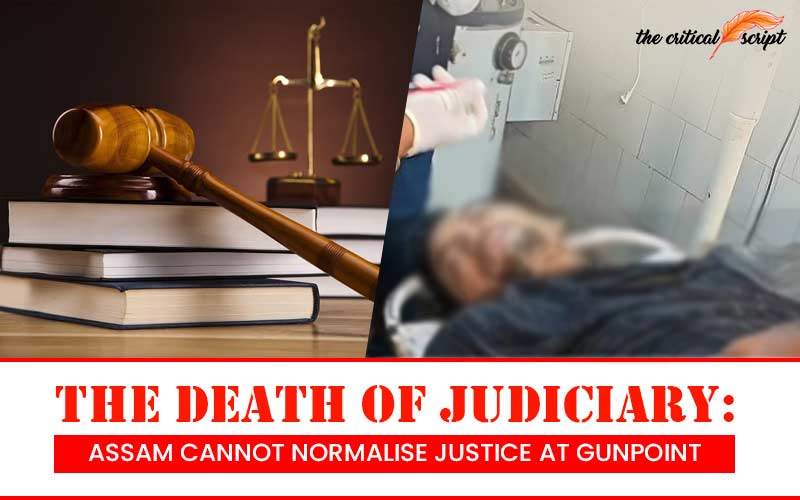
The Death of Judiciary: Assam Cannot Normalise Justice at Gunpoint
The police are entrusted with protecting the law, not replacing the courts. When encounters become public spectacles of instant justice, the danger extends far beyond the accused.
The killing of five people in the Guwahati hotel shooting was horrific. Five lives were lost, families were devastated and the perpetrators, if convicted, deserved the harshest punishment under law. There is no reason to sympathise with the brutality of such a crime.
But the death of Ghanakanta Gogoi in police firing in Sivasagar on November 4 raises a much bigger question: Who gave the police the authority to become the investigator, judge, jury and executioner?
According to the police, Gogoi allegedly attempted to snatch an investigating officer's service pistol while being transported in connection with another case. A struggle followed, and another officer opened fire, reportedly to save his colleague. That account must be independently examined. If the firing was necessary to protect an officer's life, the evidence should establish it. But an official account cannot become a substitute for an independent investigation.
And this incident cannot be viewed without looking at the sequence of police operations in Assam over the past few months.
In June, Roz Ali, accused in the Nalbari attack that killed 19-year-old Madhurjya Barman and critically injured 18-year-old Mridumudra Deka, died in police firing. Police alleged that he snatched a service rifle and fired while being taken to recover the weapon used in the crime.
In September, Ramanuj Goswami, accused of murdering and beheading his wife, Riya Talukdar Goswami, died while being transported in a police vehicle. Police said he attacked an escort constable and jumped from the moving vehicle. This was not a shooting, but another case in which an accused person died before the judicial process could conclude.
In October, Ashik Ali, an accused in the death of Gauhati University student Nimisha Thakuria, was shot in the leg during a police operation after allegedly attempting to escape custody. He survived and was taken to hospital.
And now, Ghanakanta Gogoi is dead.
These cases are not identical. They must not be casually labelled as staged encounters or treated as proof of police misconduct. But their frequency and circumstances raise legitimate questions about custodial safety, the use of firearms and the accountability mechanisms governing police operations.
Who authorises this approach?
Who sanctions these operations? Who reviews the necessity of using lethal force? Who determines whether alternatives were available? And when an accused person dies, who ensures that the police version is independently tested?
These are questions for the police leadership and the state government. They cannot be dismissed as criticism of law enforcement.
A police officer is a protector of the law, not its final authority. The police have the power to investigate, arrest, prevent crime and use necessary force in the face of an immediate threat. They do not have the power to decide guilt or administer punishment.
The distinction is fundamental. If the police can determine who deserves to die, what remains of the judiciary?
If the state can bypass the courts, why must citizens respect them?
Let us take the logic of instant justice to its most uncomfortable conclusion.
If an accused person is so despised that a trial appears unnecessary, why should the bereaved family be expected to wait for the courts? Why not nominate a family member to carry out the killing themselves? If the state can bypass judicial procedure, why should ordinary citizens be expected to respect it?
The answer is obvious. Grief does not confer the right to kill. Anger does not confer judicial authority. And the state cannot claim powers that it denies its citizens.
This is precisely why the Constitution protects due process. The Supreme Court's judgment in PUCL v. State of Maharashtra (2014) laid down safeguards for deaths in police encounters, including independent investigation and a magisterial inquiry. These are not loopholes for criminals. They are safeguards against the misuse of state power.
The victims deserve justice, not an encounter
The families of the five people killed in Guwahati deserve more than the death of the prime accused. They deserve the truth, a complete investigation, accountability for everyone involved and a judicial conclusion. Gogoi's death does not automatically answer every question surrounding the original crime.
There is no contradiction in demanding the strictest lawful punishment for a person convicted of a heinous crime while also demanding accountability from the police. We can have no sympathy for a brutal crime and still insist that the state follow the law.
In fact, the more unpopular the accused, the more important due process becomes. Otherwise, constitutional rights become conditional on public sympathy.
Assam needs strong policing, but strength cannot be measured by the number of accused persons shot or killed. It must be measured by the quality of investigations, successful prosecutions, public safety and the ability to uphold the law even under immense public pressure.
The police cannot be allowed to write the final chapter of a criminal case with a bullet.
Today, an encounter may win applause because the person killed is accused of a horrific crime. Tomorrow, the same precedent may be invoked in a case where the facts are disputed and the accused is innocent.
A democracy is not tested by how quickly it can punish those whom society despises. It is tested by whether the state respects the law when public anger demands otherwise.
We must not confuse the death of an accused person with the delivery of justice.
When the protectors of the law begin to act as its executioners, the damage is not limited to one criminal case. It strikes at the very foundation of judicial accountability. And that is the real death of judiciary.
Editorial Note -
No sympathy for the violence or the suffering inflicted on victims and their families. Their demand for justice must remain central.
No presumption of guilt. An accused person remains an accused until guilt is established through due process. Even the most disturbing allegations cannot justify abandoning the rule of law.
Disclaimer: The opinions expressed in this article are those of the author's. They do not purport to reflect the opinions or views of The Critical Script or its editor.
Regional Related Posts













Newsletter!!!
Subscribe to our weekly Newsletter and stay tuned.
Related Comments