


 INDIA ASIAN GAMES MEDAL MONITOR
·
India: 🥇 0
| 🥈 0
| 🥉 0
| Total: 0
INDIA ASIAN GAMES MEDAL MONITOR
·
India: 🥇 0
| 🥈 0
| 🥉 0
| Total: 0
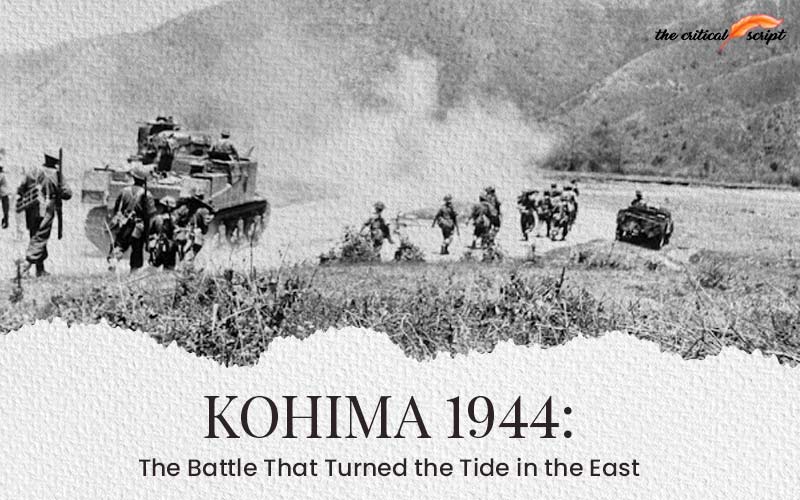
Kohima 1944: The Battle That Turned the Tide in the East
In the mist-covered hills of Nagaland, one of World War II’s fiercest battles unfolded in brutal silence, a clash of endurance, sacrifice, and survival that changed the course of the war in Asia forever.
The hills of Kohima do not immediately reveal their history. Wrapped in drifting clouds and pine-covered ridges, the Naga highlands appear calm, almost detached from the violence that once consumed them. Yet beneath this serenity lies the memory of one of the bloodiest and most decisive battles of the Second World War, a battle that military historians would later call the “Stalingrad of the East.”
In the spring of 1944, the Japanese Empire stood at the height of its wartime ambition. Having swept through Southeast Asia with astonishing speed, Japanese forces turned their attention toward India. Their objective was bold: invade British India through Burma, capture Imphal and Kohima, sever Allied supply lines, and ignite unrest against British colonial rule. What followed in the remote hills of Nagaland was not merely another wartime engagement, but a desperate struggle that would alter the trajectory of the war in Asia.
Kohima, then a small administrative town in the Naga Hills, suddenly became one of the most strategically important locations in the Allied war effort. The road that passed through Kohima linked Dimapur, the principal Allied supply base in the Northeast, with Imphal, where British and Indian troops were stationed in large numbers. If the Japanese succeeded in taking Kohima, the entire Allied position in Northeast India could collapse.
The geography itself became a combatant in the war. The steep ridges, narrow mountain paths, dense forests, and unforgiving terrain turned every advance into a deadly gamble. Troops fought not only each other, but also exhaustion, disease, monsoon rains, hunger, and isolation.
By early April 1944, Japanese troops of the 31st Division under Lieutenant General Kotoku Sato had reached the outskirts of Kohima. Facing them was a vastly outnumbered Allied force composed of British, Indian, Gurkha, Assam Regiment, and Assam Rifles personnel. Many defenders were young, exhausted, and poorly supplied. Yet retreat was impossible. Kohima had to hold.
The siege that followed was savage beyond imagination. Artillery fire tore through the hills day and night. Snipers lurked behind every ridge. Water became scarce. Food supplies dwindled. Trenches were dug so close that opposing soldiers could hear one another whispering in the dark. Men fought at distances measured not in yards, but in feet.
No image from the battle captures its horror more vividly than the famous tennis court of the Deputy Commissioner’s bungalow. What had once been a symbol of colonial leisure became the center of one of World War II’s most brutal close-quarter battles. Japanese and Allied trenches faced each other across the narrow court. Grenades flew back and forth continuously. Bayonet charges erupted with terrifying frequency. The struggle for the tennis court became symbolic of Kohima itself - intimate, merciless, and unrelenting.
Amid the chaos, Indian soldiers displayed extraordinary courage. Units from the Assam Regiment, Rajput Regiment, Punjab Regiment, and Gurkha battalions fought under relentless pressure. Their contribution to the battle remains one of the most significant yet underappreciated chapters of India’s wartime history. Alongside them stood British troops hardened by years of combat in Burma’s jungles.
Yet another story unfolded quietly behind the battle lines, the story of the Naga people. Villagers guided Allied troops through unfamiliar terrain, carried wounded soldiers across treacherous hills, delivered supplies, and gathered intelligence, often risking execution if captured by Japanese forces. Their role was indispensable. For many veterans, the loyalty and courage shown by the Nagas became one of the defining memories of the campaign.
As weeks passed, the Japanese offensive began to falter. Supply lines collapsed. Starvation spread rapidly among the invading forces. Disease and exhaustion consumed thousands. Allied reinforcements arriving from Dimapur gradually turned the tide. Supported by artillery and air power, British and Indian forces launched determined counterattacks to reclaim Kohima Ridge.
Lieutenant General Sato, eventually became deeply frustrated with Tokyo’s leadership. He believed the operation had become suicidal. In a remarkable and controversial moment, Sato effectively ignored direct orders and withdrew portions of his starving forces - one of the rare instances in Imperial Japanese military history where a commander openly defied authority during wartime.
By June 1944, the siege was effectively broken. The road between Kohima and Imphal reopened, and the Japanese invasion of India collapsed permanently. What had begun as an ambitious offensive ended in catastrophic defeat for Japan.
The cost, however, was staggering. Thousands perished in the hills around Kohima. Many died not from bullets, but from disease, starvation, and the brutal conditions of jungle warfare. Entire ridges were scarred by shellfire and human suffering.
Military historians would later recognize Kohima and Imphal as among the most important Allied victories of the war. The battles destroyed Japan’s offensive capability in the region and marked the beginning of the Allied reconquest of Burma. More importantly, they ensured that India would never become a battlefield for large-scale Japanese occupation.
Today, the Kohima War Cemetery stands upon the very ground where some of the fiercest fighting occurred. Immaculately maintained, it remains one of the most moving memorials of the Second World War. At its heart lies the famous epitaph that has since entered military history:
“When you go home, tell them of us and say,
For your tomorrow, we gave our today.”
Few words capture sacrifice with such haunting simplicity.
Decades later, the Battle of Kohima continues to occupy a unique place in global military history. It was not fought in Europe’s grand capitals or on vast desert fronts, but in remote hills far removed from the world’s attention. Yet the consequences of that battle reached far beyond Nagaland.
Kohima was more than a military victory. It was a triumph of endurance against overwhelming odds, a battle where ordinary soldiers held the line under unimaginable conditions. In those mist-covered hills of Northeast India, the course of the war in Asia was changed forever.
Disclaimer: The opinions expressed in this article are those of the author's. They do not purport to reflect the opinions or views of The Critical Script or its editor.
Regional Related Posts










Newsletter!!!
Subscribe to our weekly Newsletter and stay tuned.
Related Comments