


 INDIA ASIAN GAMES MEDAL MONITOR
·
India: 🥇 0
| 🥈 0
| 🥉 0
| Total: 0
INDIA ASIAN GAMES MEDAL MONITOR
·
India: 🥇 0
| 🥈 0
| 🥉 0
| Total: 0
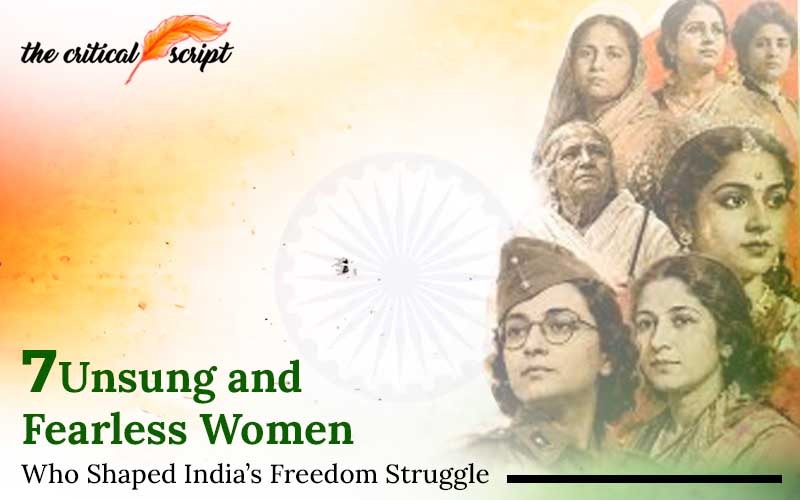
7 Unsung and Fearless Women Who Shaped India’s Freedom Struggle
India’s freedom was not won by a few celebrated leaders
alone. Across the country, women from different regions and backgrounds stood
up against colonial rule. Some led armies, some organised movements, some
marched with the national flag, and others sacrificed their lives in the
struggle for independence.
Many of their stories remain less familiar than those of the most prominent leaders of the freedom movement.
Here are seven remarkable women whose courage and sacrifice deserve to be remembered.
1. Rani Velu Nachiyar: The Queen Who Challenged the British
Known as “Veeramangai” (Brave Woman), Rani Velu Nachiyar was the queen of Sivaganga in present day Tamil Nadu.
After her husband was killed by forces associated with the British and the Nawab of Arcot, Velu Nachiyar escaped with her daughter. She spent years preparing to reclaim her kingdom and built alliances with powerful figures, including Hyder Ali.
In 1780, she launched an armed campaign against the British with the assistance of her allies and successfully regained her kingdom. The Government of India describes her as the first queen to successfully fight against the British in India.
Her story makes her one of the earliest and most remarkable women rulers to resist British expansion in India.
2. Captain Lakshmi Sahgal: Commander of the Rani of Jhansi Regiment
Captain Lakshmi Sahgal was a doctor who joined Netaji Subhas Chandra Bose’s Indian National Army during the Second World War.
She became the commander of the Rani of Jhansi Regiment, the INA’s all women military unit. She also served in the Provisional Government of Free India, popularly known as Azad Hind.
Her leadership gave women a prominent role in the armed struggle associated with the INA.
Lakshmi Sahgal’s life represented a powerful idea: women were not merely supporters of the freedom movement. They could also become its organisers, leaders and soldiers.
3. Tara Rani Srivastava: Courage in the Face of Personal Tragedy
During the Quit India Movement of 1942, Tara Rani Srivastava participated in a protest in Bihar alongside her husband.
When her husband was shot during the demonstration, she reportedly used pieces of her sari to bandage his wounds. She then continued towards the police station carrying the national flag.
When she returned, she discovered that her husband had died.
Yet she did not allow the tragedy to end her participation in the freedom movement. Her story has since become a powerful example of courage and determination in the face of personal loss.
Tara Rani’s story reminds us that bravery does not mean being untouched by grief. It means continuing to stand for what one believes in despite that grief.
4. Bhikaji Cama: A Voice for Indian Independence Abroad
Bhikaji Cama was one of the pioneering Indian nationalists who took the cause of independence to the international stage.
On 22 August 1907, at the International Socialist Congress in Stuttgart, Germany, she unfurled an early flag representing Indian independence.
The flag was not the same as the modern Indian national flag. It was an earlier design associated with the independence movement and included symbols and the words “Vande Mataram.”
Cama used her years abroad to campaign against British rule and draw international attention to India’s struggle.
Her contribution demonstrated that the fight for freedom was being carried not only through protests and movements within India, but also through international political advocacy.
5. Bhogeshwari Phukanani: Assam’s Fearless Mother
Bhogeshwari Phukanani was a prominent participant in Assam’s freedom movement and became one of the martyrs of the Quit India Movement.
She became actively involved in the movement and helped establish Congress offices in parts of Nagaon district. She had also participated in the Civil Disobedience Movement earlier.
In September 1942, during the Quit India Movement, she took part in a confrontation involving the national flag at Barhampur in Nagaon district. She was fatally injured and died from her wounds.
Bhogeshwari Phukanani remains an important symbol of Assam’s contribution to India’s freedom struggle.
6. Matangini Hazra: “Gandhi Buri”
Matangini Hazra, affectionately known as “Gandhi Buri” (Old Lady Gandhi), was a freedom fighter from Bengal who became one of the enduring symbols of courage during the Quit India Movement.
She remained actively involved in the independence movement and participated in a large procession in Tamluk on 29 September 1942.
While advancing with the national flag, she was shot by British Indian police. Accounts of her final moments describe her continuing forward with the flag despite being wounded.
She died during the confrontation, and her sacrifice became a symbol of determination and fearless resistance.
7. Tileswari Barua: The Young Martyr of Dhekiajuli
One of the most poignant stories from Assam’s freedom struggle is that of Tileswari Barua.
On 20 September 1942, during the Quit India Movement, a procession of freedom activists marched towards the police station at Dhekiajuli in Assam with the intention of hoisting the national flag.
Tileswari Barua was among those who participated in the procession.
British police opened fire on the protesters. Tileswari was shot and killed while attempting to participate in the flag hoisting effort.
Her sacrifice became part of the tragic history of the Dhekiajuli incident and remains a powerful reminder of the courage displayed by ordinary people during the freedom movement.
Their Courage, Their Sacrifice, Our Memory
These seven women came from very different circumstances.
Rani Velu Nachiyar was a queen who fought to reclaim her kingdom.
Captain Lakshmi Sahgal became a military leader in the INA.
Tara Rani Srivastava continued marching after losing her husband.
Bhikaji Cama carried India’s demand for freedom to the international stage.
Bhogeshwari Phukanani became a martyr of Assam’s Quit India Movement.
Matangini Hazra marched fearlessly during the Quit India Movement.
And Tileswari Barua became one of the young martyrs associated with the Quit India Movement in Assam.
Their methods and circumstances were different, but they shared a common determination: India should be free.
The story of India’s independence is not only the story of famous leaders. It is also the story of countless people who chose extraordinary courage when their country needed them. Their stories deserve to be remembered. Their sacrifices deserve to be honoured. And their courage deserves to be passed on to future generations.
Disclaimer: The opinions expressed in this article are those of the author's. They do not purport to reflect the opinions or views of The Critical Script or its editor.
National Related Posts





Newsletter!!!
Subscribe to our weekly Newsletter and stay tuned.
Related Comments