


 INDIA ASIAN GAMES MEDAL MONITOR
·
India: 🥇 0
| 🥈 0
| 🥉 0
| Total: 0
INDIA ASIAN GAMES MEDAL MONITOR
·
India: 🥇 0
| 🥈 0
| 🥉 0
| Total: 0
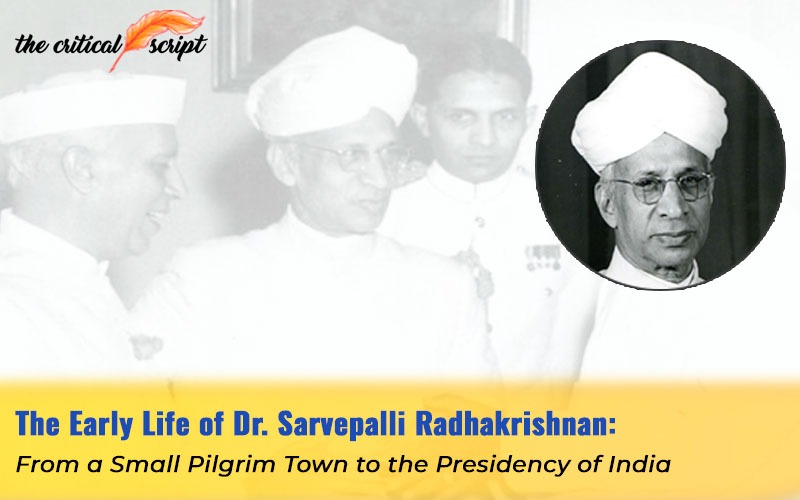
The Early Life of Dr. Sarvepalli Radhakrishnan: From a Small Pilgrim Town to the Presidency of India
Dr. Sarvepalli Radhakrishnan, who served as the second President
of India from 1962 to 1967, remains one of the most extraordinary figures in
modern Indian history - a philosopher who rose to the highest office of the
land not through politics, but through the sheer power of intellect. Before he
was a statesman, an ambassador, or a President, he was a scholarship boy from a
modest Telugu Brahmin family, whose early struggles and academic brilliance
shaped a life that would go on to bridge Eastern philosophy and Western
academia. To understand the man who gave India its Teachers' Day, one must
first understand the boy from Thiruttani.
Birth and Family Background
SarvepalliRadhakrishnan was born on 5th September 1888 in Thiruttani, a small temple town nestled in the present-day Tiruvallur district of Tamil Nadu, then part of the Madras Presidency. Thiruttani was, and remains, a pilgrim town, home to one of the six abodes of Lord Murugan, and this atmosphere of quiet religiosity and tradition would leave a lasting imprint on young Radhakrishnan's worldview.
He was born into a Telugu-speaking Niyogi Brahmin family of
modest economic means. His father, SarvepalliVeeraswami, worked as a
subordinate revenue official (a tehsildar) under a local zamindar, a position
that offered respectability but little financial comfort. His mother was
Sitamma. The family later moved to nearby Tirutani and subsequently Tirupati,
where much of Radhakrishnan's boyhood was spent in close proximity to temple
life, ritual, and orthodox Hindu practice - an upbringing that gave him an
intimate, lived understanding of Hindu philosophy long before he encountered it
as an academic subject.
Financial constraints were a constant companion in his early
years. As one of several children in the family, Radhakrishnan's education was
made possible largely through scholarships, a fact he would later reflect on
with some pride, noting that his intellectual journey was self-made rather than
a product of privilege.
Early Schooling
Radhakrishnan's formal education began close to home. He
attended a primary board school in Thiruttani, before moving to the
Hermannsburg Evangelical Lutheran Mission School in Tirupati for his secondary
education. This was a significant, formative choice; like many bright Indian
boys of his generation, his early education came through Christian missionary
institutions, which were often the best-resourced schools available in small towns,
even though they existed to spread Western and Christian values.
This exposure had a curious and lasting effect: throughout his
life, Radhakrishnan retained an interest in comparative religion, and much of
his later scholarly work was, in a sense, a considered response to Christian
missionary critiques of Hinduism, which he had absorbed and grappled with as a
student.
He proceeded to further studies at Voorhees College in Vellore,
another missionary-run institution, where he continued to build the foundation
for what would become a lifelong engagement with philosophy.
College Years at Madras Christian College
In 1904, Radhakrishnan joined the Madras Christian College, then
affiliated with the University of Madras, to pursue his higher studies. It was
here that his academic path would be permanently set; although, as he later
recounted, not entirely by choice.
Radhakrishnan did not originally set out to study philosophy. He
took it up largely because a cousin who had studied at the same college passed
down his philosophy textbooks, making it the most economical option available
to a financially constrained student. What began as a practical decision,
however, blossomed into genuine intellectual passion.
He completed his Bachelor of Arts degree in 1907 and continued
on to complete his Master of Arts in Philosophy in 1908, both at Madras
Christian College.
The Landmark Master's Thesis
Radhakrishnan's postgraduate thesis, titled "The Ethics of
the Vedanta and its Metaphysical Presuppositions," would become one of the
defining moments of his early intellectual life. At the time, Christian
missionary professors and Western scholars frequently argued that Vedanta
philosophy, being rooted in the monistic idea that the material world is
illusory (maya), could not sustain a coherent ethical framework, since if the
world is unreal, moral action within it becomes meaningless.
The young Radhakrishnan, barely in his twenties, wrote a
rigorous rebuttal to this critique, arguing that Vedanta philosophy contained a
robust and internally consistent ethical system. The thesis was well received
and was, in fact, subsequently published, a remarkable achievement for a
student, and an early sign of the intellectual confidence and rigor that would
characterize his entire career. It also reflected something deeply personal: a
young Indian scholar defending the philosophical tradition of his own
civilization against the dismissive judgments of colonial-era academia.
Marriage
In 1904, at the age of sixteen, in keeping with the common social
customs of the time, Radhakrishnan was married to Sivakamu, a distant cousin.
The couple would go on to have five daughters and a son, Sarvepalli Gopal, who
himself became a distinguished historian.
Entry into Academic Life
Radhakrishnan began his teaching career in 1909, joining the
Madras Presidency College as an Assistant Lecturer in Philosophy. It was here
that his teaching career truly took flight. Despite having, by his own
admission, limited formal training in Western philosophy compared to some of
his contemporaries, he approached his subject with tremendous energy and
originality, often staying just one step ahead of his students in reading and
preparation, a habit that pushed him to develop the deep, wide-ranging
scholarship for which he later became known.
During this period, he began contributing scholarly articles to
prestigious journals such as Mind and the International Journal of
Ethics, steadily building a reputation as a serious philosophical voice,
even from within a relatively modest teaching post in colonial India.
Rise to Academic Prominence
His growing reputation led to key academic appointments that
would elevate him from a promising young lecturer to a scholar of national and
eventually international standing:
●
In 1918, he was appointed Professor of
Philosophy at the University of Mysore.
●
In 1921, he was appointed to the prestigious
King George V Chair of Mental and Moral Science at the University of Calcutta,
a major milestone that placed him at the heart of Indian academic life.
●
His growing international reputation led to an
invitation to deliver the Upton Lectures at Manchester College, Oxford, in
1926, followed by further invitations to lecture at British and American
universities.
●
In 1931, he became the first Indian to be
appointed to the Spalding Professorship of Eastern Religions and Ethics at the
University of Oxford, a position he held for over a decade even while based
primarily in India, a testament to how highly his scholarship was regarded in
the West.
The Making of a Philosopher-Statesman
By the early 1930s, the boy from Thiruttani who once relied on
hand-me-down textbooks and scholarships had become one of the most respected
philosophers of his generation, equally at home explaining Vedanta to Oxford
dons as he was navigating the complex religious and social terrain of colonial
India. This foundation, built on financial hardship, missionary education, and
an early, defiant scholarly defense of Indian philosophical tradition, shaped
the intellectual character of the man who would go on to serve as India's
Ambassador to the Soviet Union, its first Vice President, and ultimately, from
1962 to 1967, its second President.
It is fitting that Radhakrishnan's birthday, 5th September, is
observed across India as Teachers' Day, a tribute not just to the presidency he
held, but to the decades he spent as an educator who believed, above all, that
ideas could bridge civilizations.
Sources drawn from established historical and biographical
records on the life of Dr. SarvepalliRadhakrishnan.
Disclaimer: The opinions expressed in this article are those of the author's. They do not purport to reflect the opinions or views of The Critical Script or its editor.
National Related Posts







Newsletter!!!
Subscribe to our weekly Newsletter and stay tuned.
Related Comments