


 INDIA ASIAN GAMES MEDAL MONITOR
·
India: 🥇 0
| 🥈 0
| 🥉 0
| Total: 0
INDIA ASIAN GAMES MEDAL MONITOR
·
India: 🥇 0
| 🥈 0
| 🥉 0
| Total: 0
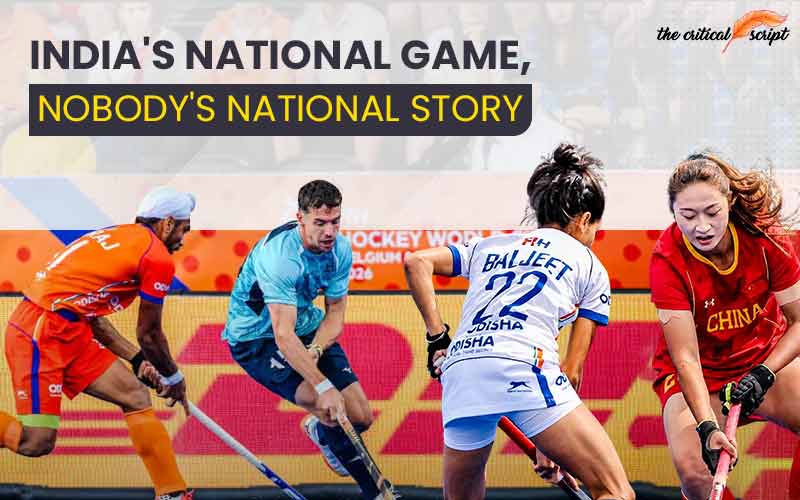
India's National Game, Nobody's National Story
How Two Hockey World Cups Are Being
Played in Silence
There
is a peculiar cruelty in the fact that India, a country that still, officially
and sentimentally, calls hockey its national game, can run live World Cup
campaigns for over a week without most of its own citizens knowing they
started. And to be precise about what's actually happening: this isn't one
tournament; it's two, running concurrently at the same venues in Belgium and
the Netherlands. The men's team has played two matches, a win over Wales, and a
heartbreak-tinged 4-2 loss to England that extended a 32-year wait for a World
Cup victory over that opponent. The women's team, meanwhile, has been quietly
brilliant: an unbeaten start, a 2-2 draw against Olympic silver medalists
China, followed by a dominant 6-1 demolition of South Africa that took them to
the top of their pool with qualification for the next round within reach. Four
results. Real drama, real history, real stakes. Almost none of it has made a
dent in the national conversation.
This
isn't a coincidence. It's a pattern, and it's worth examining honestly,
starting with an inconvenient fact that undercuts the easiest excuse for it.
There Isn't Even a
Hosting Excuse Here
It
would be one thing if India's indifference to distant sport were the issue, if
this were merely "a tournament happening somewhere else, therefore lower
salience." But that framing doesn't hold, because Indian media covers
plenty happening far from Indian soil when it's cricket: an Ashes series in
Australia gets wall-to-wall previews, ball-by-ball text commentary, and
prime-time panel debates, despite involving zero Indian interest whatsoever.
Distance is not the disqualifier; it's being treated as if it were here. The
absence of coverage for a tournament India is actively playing in,
competitively, in both the men's and women's brackets, cannot be explained by
geography. It has to be explained by priority.
The Cricket Excuse Is
Real, But It's Not the Whole Story
The
India–Sri Lanka Test series is indeed unfolding at almost the same time, and
cricket's gravitational pull on Indian sports media is not new. But
"cricket is popular" has become a lazy alibi that lets broadcasters,
newspapers, and digital platforms off the hook for a much more deliberate set
of choices: which sports get pre-match previews, which get panel discussions,
which get push notifications, and which get a single wire-copy paragraph buried
three scrolls down a sports homepage.
Cricket's
dominance isn't purely organic. It's manufactured and reinforced daily by an
ecosystem - advertisers, television rights holders, sponsors - that has every
financial incentive to keep hockey exactly where it is: present, nominally, but
never urgent.
Two Stories Being Told
Nowhere
The
frustrating part is that neither tournament is short on material and the
women's campaign, if anything, has the stronger sporting narrative right now.
Holding a higher-ranked, Olympic-medal-winning Chinese side to a draw, then
following it with a six-goal rout of South Africa, is the kind of form that
would generate days of cricket-style coverage - form-guide graphics,
"player of the match" reels, build-up pieces to the next fixture - if
it belonged to any bat-and-ball team. Instead, it has barely registered as a
footnote.
The
men's defeat to England wasn't routine either; it was historically loaded. The
team led twice, lost the plot in the second half, and walked away still without
a World Cup win over England since 1994. That is precisely the kind of storyline,
legacy, heartbreak, a three-decade curse that dominates cricket coverage when
it happens toViratKohli or Rohit Sharma. When it happens to Harmanpreet Singh,
it barely registers.
Structurally,
too, this is a significant edition: the first-ever co-hosted men's World Cup,
split across Belgium and the Netherlands, featuring sixteen nations across five
confederations in each of the men's and women's events - 72 matches in total.
There is a legitimate global spectacle here, doubled. Indian coverage has
largely reduced both tournaments to schedule-and-streaming-link service
journalism - useful, but inert. It tells you where to watch, never why
you should care, and rarely even acknowledges that there are two Indian teams
worth following, not one.
The Deeper Problem:
Selective National Memory
India
loves hockey retroactively. It resurrects the sport in moments of nostalgia -
Olympic bronze medals, biopics, anniversaries of 1975 and then lets it recede
the moment the moment passes. This is a convenient kind of patriotism: cheap to
perform, costly to sustain. A living World Cup campaign, happening in real
time, demands sustained attention. Nostalgia doesn't.
The
players bear the cost of this asymmetry most directly. They train, travel, and
compete at the highest level of their sport, knowing that unless they win a
medal or produce a viral moment, the coverage will be thin, the public
indifferent, and the endorsement economy nonexistent. Contrast that with a
bilateral T20 series that will be forgotten in a month but is treated, while it
lasts, as a matter of national importance.
What Would Actually
Change This
The
fix isn't complicated, even if the incentives make it unlikely:
● Editorial will, not audience demand, drives most
sports coverage decisions in India. Newsrooms could choose to feature hockey
prominently and let audience interest follow, rather than waiting for demand
that television economics have never allowed to form.
● Broadcasters and streaming platforms could integrate hockey into
prime-time sports bulletins instead of relegating it to a standalone, opt-in
stream that only committed fans seek out.
● Sponsors and federations could invest in storytelling,
player profiles, rivalry build-ups, the same machinery cricket uses
relentlessly to manufacture stakes even out of dead rubbers.
None
of this requires the sport to overtake cricket. It requires only that a World
Cup, while it is being played by India's own team, be treated as news.
The
tournament runs through August 30. India's men's team has matches remaining in
the pool stage; there is still time for this story to be told while it's
happening - not after.
Please
note -
India is FIFA's second-largest national audience on Instagram despite never
once qualifying for a World Cup, ahead of the US (the host) and Argentina (the
runner-up), driven mostly by fandom for Ronaldo and Messi rather than any
national team. Over 35,000 Indian creators actively posted World Cup content,
with no Indian player, match, or team to talk about - purely out of borrowed
passion, treating the tournament like a cultural moment on par with Diwali or
the IPL.
Ironically, India didn't even secure legitimate broadcast rights for the FIFA
World Cup 2026 this cycle - no domestic platform's bid met FIFA's price, partly
due to brutal midnight-to-dawn kickoff times in IST, and the coverage frenzy
happened anyway, off the back of street murals, fan clubs, and influencer
content, not television (Zee5 eventually did broadcast it).
Disclaimer: The opinions expressed in this article are those of the author's. They do not purport to reflect the opinions or views of The Critical Script or its editor.
Sports Related Posts





Newsletter!!!
Subscribe to our weekly Newsletter and stay tuned.
Related Comments