


 INDIA ASIAN GAMES MEDAL MONITOR
·
India: 🥇 0
| 🥈 0
| 🥉 0
| Total: 0
INDIA ASIAN GAMES MEDAL MONITOR
·
India: 🥇 0
| 🥈 0
| 🥉 0
| Total: 0
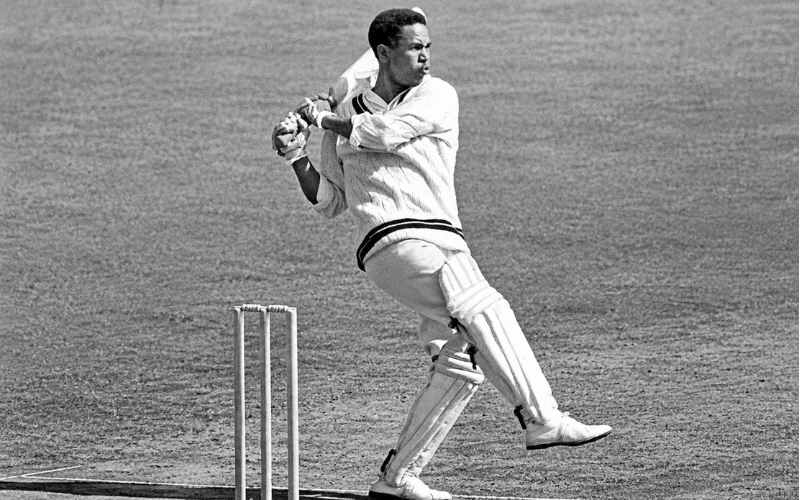
Sir Garfield Sobers (1936–2026): Farewell to Cricket's Greatest All-Rounder
There are legends in sport whose records define an era, and then there are those rare individuals whose very presence changes the way a game is understood. Sir Garfield Sobers belonged to the latter. With his passing at the age of 89, cricket has lost not merely one of its greatest players, but perhaps the most complete cricketer the sport has ever known. Tributes from across the world, from Cricket West Indies and the International Cricket Council to former players, administrators, and fans, have celebrated a man whose name became synonymous with excellence in every aspect of the game.
Born on July 28, 1936, in Bridgetown, Barbados, Garfield St Aubrun Sobers arrived on the international stage as a teenage left-arm bowler. Yet it did not take long for the cricketing world to realise it was witnessing a phenomenon unlike any before. He evolved into a batsman of breathtaking elegance and destructive power, a bowler equally capable of delivering fast-medium pace, left-arm orthodox spin, and wrist spin, and a fielder whose athleticism made him invaluable in any position on the ground. Cricket had seen outstanding batsmen, brilliant bowlers, and exceptional fielders before. Sobers was all of them rolled into one.
His greatness cannot be measured solely by statistics, remarkable though they are. In 93 Test matches for the West Indies between 1954 and 1974, Sobers scored 8,032 runs at an average of 57.78, including 26 centuries, while taking 235 wickets and holding 109 catches. His first-class record was equally extraordinary, with more than 28,000 runs and over 1,000 wickets, a combination achieved by only a handful of cricketers in history.
The innings that announced his genius came in 1958 at Sabina Park in Jamaica. At just 21 years of age, Sobers produced an unbeaten 365 against Pakistan, rewriting the record books with what was then the highest individual score in Test cricket. It was an innings remarkable not only for its scale but also for its maturity and elegance. The record stood unchallenged for 36 years until Brian Lara, another son of the Caribbean, surpassed it in 1994. It seemed fitting that the baton should pass from one West Indian genius to another.
A decade later, Sobers added another chapter to cricketing folklore. Playing for Nottinghamshire against Glamorgan in 1968, he became the first cricketer in first-class history to strike six sixes in a single over, off the bowling of Malcolm Nash. The feat has since been repeated only rarely, but it remains inseparable from Sobers' legend, symbolising his fearless approach and extraordinary range of strokeplay.
Yet statistics and milestones tell only part of the story. What truly set Sobers apart was his versatility. He was the ultimate all-rounder in the purest sense of the term. If conditions demanded pace, he could trouble batsmen with sharp seam bowling. If spin was required, he could switch effortlessly between orthodox left-arm spin and wrist spin. As a batsman, he possessed both classical technique and devastating power, equally capable of constructing marathon innings or dismantling an attack in a single session. In the field, his anticipation and athleticism made him one of the finest catchers of his generation. There has never been another cricketer who mastered every discipline of the game with such effortless brilliance.
Sobers captained the West Indies between 1965 and 1972, leading during a transformative period for Caribbean cricket. His leadership embodied the confidence and flair that would later define the dominance of West Indies cricket through the 1970s and 1980s. Although he retired before the era of Clive Lloyd's world-conquering side, many regard Sobers as the bridge between the gifted West Indies teams of the early decades and the invincible Caribbean dynasty that followed.
His influence extended well beyond the Caribbean. He became one of county cricket's most celebrated overseas professionals with Nottinghamshire, inspiring generations of English cricketers, while his exploits in Australia, India, Pakistan, and elsewhere earned admiration across the cricketing world. Wherever cricket was played, Sobers was revered—not merely as an opponent but as a master craftsman whose performances elevated the game itself.
Recognition naturally followed. He was knighted by Queen Elizabeth II in 1975 for his services to cricket, named a National Hero of Barbados in 1998, and inducted into the ICC Cricket Hall of Fame. The ICC's highest individual honour in men's cricket, awarded annually to the world's best male cricketer, proudly bears his name, the Sir Garfield Sobers Trophy, ensuring that every new generation of players is reminded of the standard he set.
Perhaps the greatest tribute came not through awards but through the words of fellow cricketers. For decades, every discussion about the greatest all-rounder in cricket history has begun and ended with Garfield Sobers. From Sir Donald Bradman to modern greats, generations have acknowledged that Sobers represented a level of completeness rarely witnessed in any sport. He became the benchmark against whom every all-rounder, from Kapil Dev and Ian Botham to Jacques Kallis, Imran Khan, Ben Stokes, and Ravindra Jadeja, has inevitably been compared.
The news of his passing prompted an outpouring of grief across continents. Cricket West Indies described the end of "a great innings," while the ICC hailed him as one of the sport's greatest icons. Tributes from India, England, Australia, and countless former players reflected not only admiration for his achievements but gratitude for the joy he brought to millions who watched him play or grew up hearing stories of his genius.
Cricket has evolved dramatically since Sobers made his debut in 1954. Formats have changed, equipment has improved, and records continue to fall. Yet some legacies remain untouched. More than half a century after his retirement, Sir Garfield Sobers continues to occupy a place that statistics alone cannot explain. He represented cricket at its most complete - a player who could change a match with bat, ball, or in the field, and whose versatility has never truly been replicated.
With Sir Garfield Sobers' passing, the world has lost a sporting icon, but cricket has gained something even more enduring: a timeless standard of excellence. Long after future generations have forgotten individual scorecards, they will continue to remember the name of the man who proved that greatness in cricket was not about mastering one discipline, but about mastering them all. That is why Sir Garfield Sobers will forever remain not just one of the greatest cricketers, but perhaps the greatest all-round cricketer the game has ever known.
Disclaimer: The opinions expressed in this article are those of the author's. They do not purport to reflect the opinions or views of The Critical Script or its editor.
Sports Related Posts












Newsletter!!!
Subscribe to our weekly Newsletter and stay tuned.
Related Comments