


 INDIA ASIAN GAMES MEDAL MONITOR
·
India: 🥇 0
| 🥈 0
| 🥉 0
| Total: 0
INDIA ASIAN GAMES MEDAL MONITOR
·
India: 🥇 0
| 🥈 0
| 🥉 0
| Total: 0
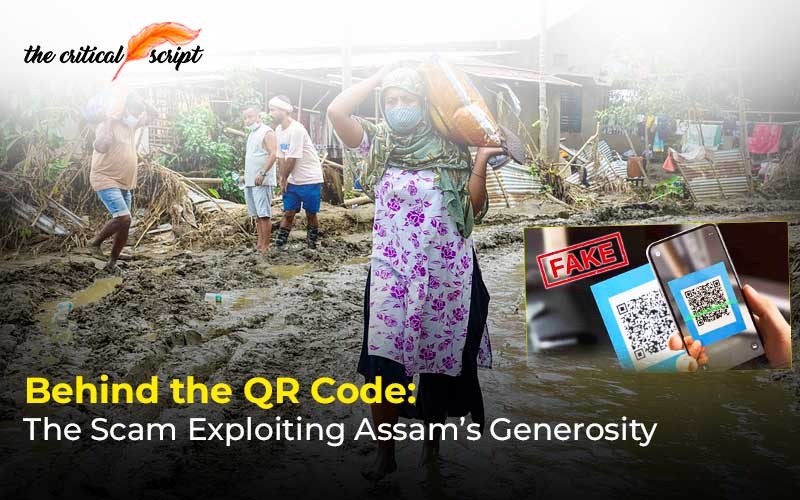
Behind the QR Code: The Scam Exploiting Assam’s Generosity
In times of disaster, people rarely ask what they will get
in return for helping. They simply want to help.
That instinct has always been one of the strongest forces in Assam's response to floods. When rivers rise, homes go underwater and families are forced to leave everything behind, ordinary citizens step forward with whatever they can offer, money, food, essential supplies or their time.
But amid the ongoing flood crisis, another concern has emerged alongside the humanitarian response: the alleged misuse of public generosity through fraudulent or unauthorised fundraising.
Recent reports say the Assam Police Criminal Investigation Department is investigating nearly 50 social media accounts suspected of collecting money in the name of flood relief. Investigators are examining digital activity and payment trails involving UPI IDs and QR codes as they seek to determine whether the fundraising was genuine and whether the money collected was actually used for relief purposes.
The methods reported are deceptively simple.
A social media post can carry photographs of flood affected areas, a message asking people to help and a QR code. A forwarded WhatsApp appeal can create a sense of urgency. Elsewhere, people may approach motorists or pedestrians with donation boxes or QR codes, claiming to collect money for flood victims.
To someone who genuinely wants to help, such an appeal can appear completely legitimate.
But the appearance of a charitable campaign does not by itself establish where the money will ultimately go.
That is what makes disaster related fundraising scams particularly troubling. They exploit empathy.
When trust becomes the target
Fraud during a disaster is not a new phenomenon. What has changed is the speed at which an appeal can reach thousands of people.
A photograph can be shared within seconds. A QR code can be circulated across multiple platforms. A social media account can appear convincing even when its connection to an organisation or relief effort has not been independently established.
The emotional nature of disaster fundraising makes the problem even more complicated.
People see suffering and want to act immediately. In that moment, few donors may think to examine who owns a UPI ID, whether a fundraising page is officially connected to the organisation it claims to represent, or whether a public collection drive has the necessary authorisation.
That is why verification has become an important part of responsible giving.
The current CID investigation is significant precisely because investigators are following the digital trail rather than simply assuming that every suspicious looking account is fraudulent. The fact that an account is under investigation does not establish guilt. Authorities still have to determine who operated the account, what was represented to donors and what happened to the money.
Not every fundraiser is a scam
This distinction is perhaps the most important one.
The emergence of suspected fraudulent campaigns should not create the impression that every online fundraiser is illegitimate.
Genuine relief efforts are also taking place. For example, the Assam Foundation of North America has publicly documented its 2026 flood relief campaign, including fundraising totals, procurement, dispatch and distribution updates, and its partnership for rehabilitation support.
There have also been direct contributions to recognised relief channels. Recent reporting said comedian Samay Raina donated ₹10 lakh to the Assam Chief Minister's Relief Fund, while other public figures have also contributed to flood relief.
The problem, therefore, is not generosity.
The problem is giving money without being certain about where it is going.
That distinction matters because widespread suspicion can create another problem. If people begin believing that every relief campaign is fraudulent, genuine organisations and, more importantly, flood affected families could suffer from reduced donations.
The answer to fraudulent fundraising should therefore not be to stop helping.
It should be to help more carefully.
Why the roadside collections have drawn attention
The government's response has also extended beyond social media.
Recent reporting says Chief Minister Himanta Biswa Sarma directed authorities to stop unauthorised public collections being carried out in the name of flood relief, including roadside appeals involving donation boxes and QR codes. The government has warned against such fundraising without proper authorisation.
The message for the public is straightforward.
A person standing beside a road with a donation box is not automatically a representative of a legitimate relief organisation.
Before contributing, donors should be able to establish who is collecting the money, which organisation they represent and whether the collection is authorised.
At the same time, an unauthorised collection should not automatically be described as a proven fraud. The legal and factual status of each case depends on what investigators establish.
That distinction is important in responsible reporting as well as responsible donating.
A QR code is not proof of authenticity
Perhaps the most important lesson from the current controversy is that technology can make a fundraising appeal look official without establishing that it actually is.
A QR code is simply a payment mechanism.
It does not independently prove that the person receiving the money is connected to the relief effort being advertised.
For donors, the safest approach is therefore to look beyond the QR code.
If a campaign claims to represent a charity or organisation, find that organisation independently and verify its official donation details. Before completing a UPI payment, check the recipient name displayed by the payment system.
If a campaign claims to represent an organisation but the payment appears to be going to an unrelated personal account, that is a reason to stop and verify.
Urgency should not replace verification.
The uncomfortable irony
There is something deeply unfortunate about fraud during a disaster.
Floods can destroy homes, livelihoods and security. Yet they can also reveal something remarkable about people: the willingness to help strangers.
Someone who has never met a flood affected family may still decide to contribute. Someone living hundreds of kilometres away may see the suffering online and feel compelled to do something.
That willingness to help is valuable.
It should not be punished by distrust.
It should be protected by transparency.
The lesson from Assam's current experience is therefore not that people should stop donating online or stop helping strangers.
The lesson is simpler:
Do not stop being generous. Become more careful about where your generosity goes.
Verify before you give
Anyone wishing to contribute to Assam's flood relief efforts can take a few simple precautions.
Donate through official government channels or established organisations whose identities and payment details can be independently verified.
Do not rely solely on a forwarded WhatsApp message, Instagram post or an isolated QR code.
Check the recipient's name before completing a UPI payment.
If someone is collecting money publicly, ask which organisation they represent and whether they have the required authorisation.
If a campaign appears suspicious, preserve the relevant information and report it to the appropriate authorities rather than spreading unverified accusations.
These steps do not make generosity difficult.
They make it safer.
The real test of a relief campaign
A flood relief campaign should ultimately be able to answer three simple questions:
Who is collecting the money?
Where will the money go?
Can that claim be independently verified?
If those answers are clear, giving becomes an act of informed compassion.
If they are not, taking a moment to verify is not a failure to help. It is part of helping responsibly.
Because Assam's flood affected families need generosity.
But they need genuine generosity.
And in a disaster where every contribution can matter, protecting public compassion from those who might exploit it may be one of the most important forms of public awareness we can build.
Disclaimer: The opinions expressed in this article are those of the author's. They do not purport to reflect the opinions or views of The Critical Script or its editor.
Regional Related Posts








Newsletter!!!
Subscribe to our weekly Newsletter and stay tuned.
Related Comments