


 INDIA ASIAN GAMES MEDAL MONITOR
·
India: 🥇 0
| 🥈 0
| 🥉 0
| Total: 0
INDIA ASIAN GAMES MEDAL MONITOR
·
India: 🥇 0
| 🥈 0
| 🥉 0
| Total: 0
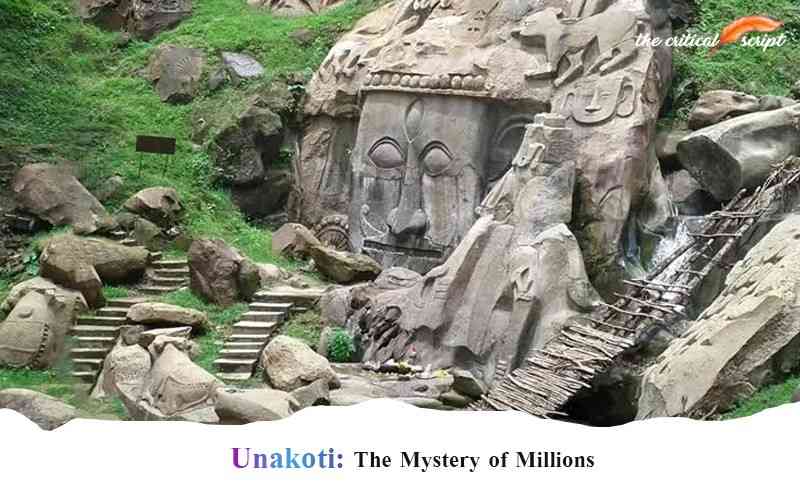
Unakoti: The Mystery of Millions
Deep within the forested hills of northern Tripura lies Unakoti, one of
India’s most extraordinary and least understood heritage sites. Neither temple
complex nor conventional archaeological ruin, Unakoti is a vast open-air
sanctuary where faith, myth, and stone converge on a monumental scale. Despite
its artistic and spiritual significance, it remains largely absent from global
narratives of ancient civilisation.
The name Unakoti literally translates to “one less than a crore” -
9,999,999, a number that hints at the legend and enigma surrounding this site.
A Landscape
Sculpted, Not Built
Unakoti is defined by gigantic rock-cut bas-reliefs, carved directly into
natural cliff faces rather than assembled as freestanding structures. Towering
images, some over 30 feet high, emerge organically from the hillside, giving
the impression that the land itself has been awakened into form.
At the centre is the colossal face of Lord Shiva, worshipped locally as UnakotiswaraKalBhairava.
Flanked by figures of Parvati, Ganesha, and a host of celestial beings, the
composition suggests not a single monument but an entire mythological universe
frozen in stone.
Unlike classical temple architecture, Unakoti defies symmetry and polish.
Its power lies in scale, rawness, and intimacy with the natural landscape.
The Legend
That Defines the Name
According to local belief, Lord Shiva once halted at Unakoti with his
entourage of one crore gods and goddesses while travelling to Kashi. At dawn,
when the others failed to awaken, Shiva continued his journey alone, turning
the rest into stone.
Thus, remained Unakoti: one less than a crore.
This legend is not folklore consigned to the past. It continues to shape
ritual practices, pilgrimage, and the spiritual imagination of the region.
History
Without Certainty
Scholars broadly date the carvings to between the 7th and 9th centuries
CE, associating them with early Shaivite traditions in eastern India. Yet
Unakoti remains historically elusive, as there are no definitive inscriptions,
no clearly identified royal patron and no consensus on whether it was created
by a single group or over generations.
The scale of the work implies collective, long-term effort, possibly
driven by community devotion rather than imperial command, an idea that
challenges dominant models of monument-building in ancient India.
A Living
Sacred Site
Unakoti is not a relic of a vanished faith. It remains a living
pilgrimage centre, especially during the annual AshokastamiMela, when thousands
gather for ritual bathing, worship, and celebration.
Here, archaeology and devotion coexist without conflict. The carvings are
not preserved behind barriers; they are touched, worshipped, and lived with.
Why Unakoti
Matters
Unakoti forces a rethinking of how heritage is defined and valued.
- It represents a non-imperial,
community-driven artistic tradition
- It demonstrates how sacred art can be
integrated into nature rather than imposed upon it
- It offers the Northeast a place in
India’s civilizational story that is ancient, indigenous, and distinct
Yet globally, Unakoti remains overshadowed by better-known sites such as
Ellora or Angkor, despite rivalling them in ambition and scale.
The Silence
Around Unakoti
Perhaps the greatest mystery of Unakoti is not how it was created, but
why it remains so little known. In an age of heritage branding and global
tourism, Unakoti stands quietly outside the spotlight, its stories passed down
more through memory than marketing.
This silence is both its vulnerability and its power.
Unakoti is not merely a monument; it is a question carved into the hills
of Tripura.
Who shaped it? Over how many generations? And why did such a vast sacred
landscape emerge far from imperial centres?
Until these questions are answered, Unakoti endures as one of India’s
most profound cultural enigmas, a reminder that some of the world’s greatest
stories remain hidden, not lost.
Disclaimer: The opinions expressed in this article are those of the author's. They do not purport to reflect the opinions or views of The Critical Script or its editor.
Regional Related Posts









Newsletter!!!
Subscribe to our weekly Newsletter and stay tuned.
Related Comments