


 INDIA ASIAN GAMES MEDAL MONITOR
·
India: 🥇 0
| 🥈 0
| 🥉 0
| Total: 0
INDIA ASIAN GAMES MEDAL MONITOR
·
India: 🥇 0
| 🥈 0
| 🥉 0
| Total: 0
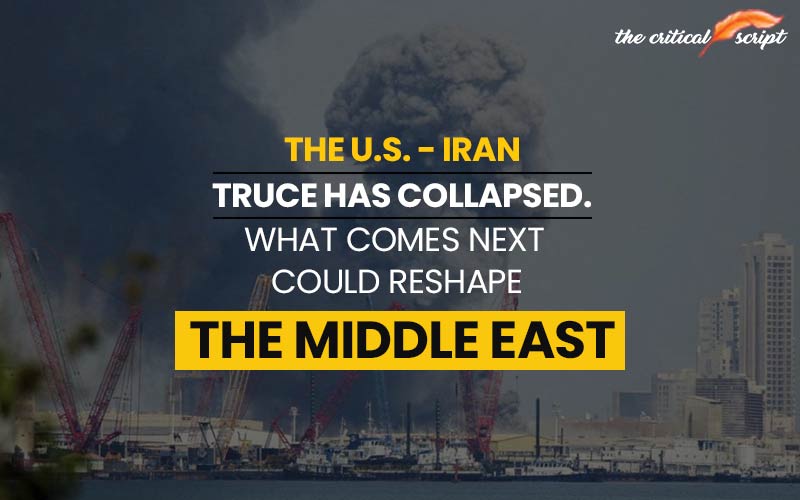
The U.S.–Iran Truce Has Collapsed. What Comes Next Could Reshape the Middle East
Barely days after hopes
emerged that diplomacy might prevent another prolonged conflict in the Middle
East, the fragile truce between the United States and Iran has effectively
collapsed. A second and larger wave of U.S. airstrikes on Tehran and other
Iranian targets has pushed the crisis into a dangerous new phase, raising fears
that the region may once again be on the brink of a wider war.
The latest escalation follows
a chain of retaliatory actions. The United States accused Iran of supporting
attacks on commercial shipping in the Strait of Hormuz, one of the world's most
strategically important maritime corridors. Washington responded with
airstrikes targeting Iranian military infrastructure, while Iran condemned the
attacks as a violation of its sovereignty and retaliated with missile and drone
strikes aimed at U.S.-linked military facilities in the Gulf. Within hours,
American forces launched an even broader military operation against targets in
Tehran, signalling that the ceasefire had effectively ended.
What makes this development
particularly alarming is not merely the exchange of fire but the collapse of
diplomacy itself. The truce was never a comprehensive peace agreement. It was a
temporary pause designed to create space for negotiations over Iran's nuclear
programme, sanctions, regional security, and maritime stability. That window
has now narrowed dramatically.
The renewed confrontation
carries consequences far beyond Washington and Tehran. The Middle East remains
deeply interconnected through political alliances, energy markets, and military
partnerships. A prolonged conflict could rapidly draw in other regional actors,
whether directly or indirectly. Countries hosting American military bases may
become targets of further retaliation, while Iran's network of allied armed
groups across Iraq, Syria, Lebanon, and Yemen could widen the battlefield.
One of the greatest
concerns is the Strait of Hormuz, through which nearly a fifth of the
world's traded oil passes. Any disruption to shipping in this narrow waterway
could trigger sharp increases in global oil prices, disrupt international
trade, and fuel inflation worldwide. The consequences would not be confined to the
Middle East; economies across Asia, Europe, and North America would feel the
impact through higher energy costs and supply chain disruptions.
The collapse of the
ceasefire also underscores a broader reality about modern conflicts. Military
action may achieve tactical objectives, but it rarely resolves the underlying
political disputes. Iran's nuclear ambitions, U.S. sanctions, regional
rivalries, and competing security interests remain unresolved. Every
retaliatory strike risks creating new grievances, making future negotiations
even more difficult.
For the international
community, the challenge is becoming increasingly urgent. The United Nations
and several regional powers have renewed calls for restraint, warning that
continued escalation could spiral into a conflict far larger than either side
may initially intend. History offers repeated examples of localized
confrontations evolving into regional crises when diplomacy fails to keep pace
with military action.
The humanitarian dimension
cannot be overlooked either. Airstrikes on densely populated urban areas
inevitably raise concerns about civilian casualties, displacement, and damage
to critical infrastructure. Even when military targets are the stated
objective, the burden of conflict is often borne by ordinary citizens whose
lives are disrupted by violence, uncertainty, and economic hardship.
The crisis also highlights
the delicate balance between deterrence and escalation. Both the United States
and Iran argue that their actions are defensive responses to aggression by the
other side. Yet each round of retaliation reinforces the other's justification
for further military action, creating a cycle that becomes increasingly
difficult to break. In such an environment, the risk of miscalculation grows
significantly. A single strike causing unexpectedly high casualties or
involving another regional actor could transform a bilateral confrontation into
a much broader conflict.
Despite the deteriorating
situation, diplomacy has not entirely disappeared. Reports indicate that
backchannel communications continue through regional mediators, suggesting that
both sides may still recognise the immense costs of a prolonged war. Whether
these diplomatic efforts can survive the current escalation remains uncertain.
The collapse of the
U.S.–Iran truce is more than the failure of a ceasefire. It is a reminder of
how fragile peace can be when deep political disputes remain unresolved. As
military operations intensify and diplomatic space shrinks, the coming days may
determine whether this crisis remains a contained confrontation or evolves into
one of the defining geopolitical conflicts of the decade. The choices made now,
on the battlefield and at the negotiating table, will shape not only the future
of U.S.–Iran relations but also the stability of the wider Middle East and the
global economy.
Disclaimer: The opinions expressed in this article are those of the author's. They do not purport to reflect the opinions or views of The Critical Script or its editor.
World Related Posts









Newsletter!!!
Subscribe to our weekly Newsletter and stay tuned.
Related Comments