


 INDIA ASIAN GAMES MEDAL MONITOR
·
India: 🥇 0
| 🥈 0
| 🥉 0
| Total: 0
INDIA ASIAN GAMES MEDAL MONITOR
·
India: 🥇 0
| 🥈 0
| 🥉 0
| Total: 0
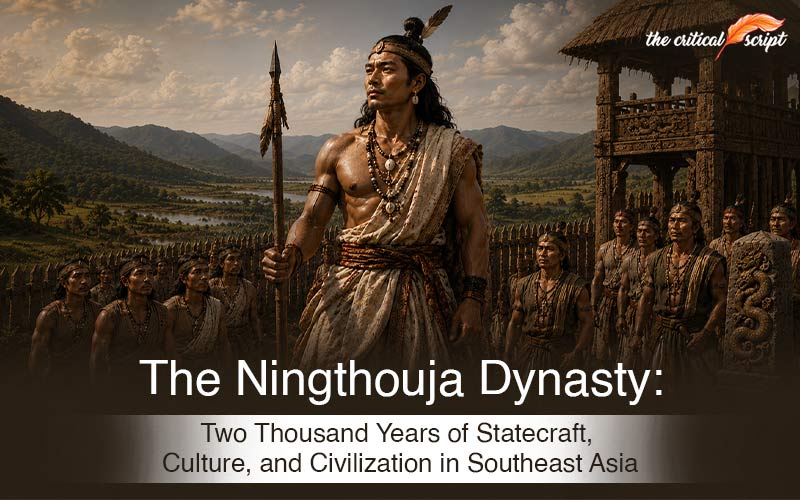
The Ningthouja Dynasty: Two Thousand Years of Statecraft, Culture, and Civilization in Southeast Asia
Among the many royal dynasties that shaped the history of Southeast Asia, few can claim a legacy as ancient and enduring as the Ningthouja Dynasty of Manipur. Known also as the Mangang Dynasty, the Ningthoujas ruled the Kingdom of Manipur for nearly two millennia, making them one of the longest-ruling dynasties in Asia.
The dynasty's history is deeply
intertwined with the story of the Meitei people, the formation of the Manipuri
state, and the development of one of Southeast Asia's most sophisticated
civilizations. Through centuries of warfare, diplomacy, cultural
transformation, and resilience, the Ningthoujas transformed a collection of competing
clans into a unified kingdom that stood at the crossroads of South and
Southeast Asia.
Their legacy survives today in
Manipur's language, traditions, dance, religion, martial arts, literature, and
historical consciousness.
The Founding of the Dynasty (33 CE)
According to the royal chronicle Cheitharol Kumbaba,
the history of the Ningthouja Dynasty begins with the coronation of
Nongda Lairen Pakhangba in 33 CE.
Pakhangba occupies a unique place in
Manipuri history and mythology. Revered both as a historical ruler and a divine
figure in Meitei cosmology, he is credited with establishing the first
organized polity in the Imphal Valley.
At the time, the valley was
inhabited by several independent clans and chiefdoms. The Ningthouja clan was
only one among many competing political groups. Pakhangba's achievement lay in
laying the foundations of centralized kingship and initiating a process of
political integration that would continue for centuries.
The early kingdom was modest in
size, but it established traditions of governance, ritual authority, and royal
legitimacy that would endure for nearly two thousand years.
The Formation of the Meitei State (33–600 CE)
The centuries following Pakhangba's
reign witnessed the gradual consolidation of Ningthouja power.
Successive rulers such as
Khuiyoi Tompok, Taothingmang, and Irengba expanded their influence across the
valley. While much of this period remains shrouded in legend and oral
tradition, historical memory suggests that the Ningthouja rulers steadily
increased their authority through alliances, warfare, and strategic marriages.
The Imphal Valley remained
politically fragmented. Powerful clans such as the Khuman, Angom, Luwang,
Moirang, and Khaba-Nganba controlled their own territories and frequently
competed for influence.
Yet the Ningthoujas gradually
emerged as the dominant political force.
During this period, the foundations
of Meitei culture also began to take shape. Indigenous religious traditions
centered on deities such as Sanamahi, Pakhangba, and Panthoibi became
integrated into royal ceremonies and state rituals.
Naothingkhong and the Era of Consolidation (663–763 CE)
One of the first historically
significant rulers of the dynasty was King Naothingkhong, who ruled during the
seventh and eighth centuries.
His reign is remembered as a period
of territorial expansion and administrative consolidation. Naothingkhong
strengthened royal authority, forged alliances with neighboring communities,
and expanded the influence of the Ningthouja state.
Under his leadership, the kingdom
began to evolve from a clan-based polity into a more organized territorial
state.
Many historians regard Naothingkhong
as one of the architects of early Manipuri state formation.
Loiyumba and the Birth of Administration (1074–1122 CE)
A major milestone in the history of
the dynasty came during the reign of King Loiyumba.
His most important contribution was
the creation of the Loiyumba Shinyen, one of the earliest known administrative
codes in the region.
The document systematically assigned
duties and responsibilities to various clans and occupational groups within
society.
The LoiyumbaShinyen regulated:
● Governance
● Agriculture
● Military obligations
● Religious functions
● Craft production
● Community services
In many respects, it functioned as a
constitutional framework for the kingdom.
Its significance cannot be overstated. While many contemporary societies relied largely on customary practices, Manipur possessed a documented administrative system that helped strengthen state institutions and social organization.
The Integration of the Valley Kingdoms (1100–1500 CE)
Between the twelfth and fifteenth
centuries, the Ningthouja rulers undertook the long process of integrating the
various principalities of the Imphal Valley.
This era witnessed:
● Strategic royal marriages.
● Political alliances.
● Diplomatic negotiations.
● Military campaigns.
Over time, formerly independent
clans such as the Khuman, Moirang, Angom, and Luwang were incorporated into the
expanding kingdom.
This process laid the foundation for
the emergence of a unified Meitei identity.
Rather than eliminating local
traditions, the Ningthouja rulers incorporated them into a broader political
framework. The kingdom became a mosaic of cultures united under a common
monarchy.
It was during this period that many
of the social, cultural, and political institutions associated with Manipur
began to take their mature form.
King Kyamba and the Opening to the Outside World (1467–1508)
The reign of King Kyamba marked a
turning point in the kingdom's external relations.
Kyamba strengthened diplomatic ties
with neighboring Shan states and expanded Manipur's regional influence.
One of the most famous events
associated with his reign was the gift of a sacred Vishnu idol from the Kingdom
of Pong (a Shan state in present-day Myanmar).
This event introduced important
Hindu influences into the kingdom while maintaining the predominance of
indigenous Meitei beliefs.
Kyamba's reign demonstrated
Manipur's growing integration into the wider political and cultural networks of
Southeast Asia.
Khagemba and the Golden Age (1597–1652)
By the time King Khagemba ascended
the throne, the foundations of a strong centralized kingdom had already been
established.
Khagemba elevated Manipur into a
major regional power.
His reign witnessed:
● Military victories against external threats.
● Administrative reforms.
● Expansion of trade.
● Strengthening of royal authority.
The king earned the title
"Khagemba," meaning "Conqueror of the Chinese," after
successfully repelling foreign incursions.
His reign is often regarded as the
beginning of a golden age in Manipuri history.
The Vaishnavite Transformation
The eighteenth century brought one
of the most profound cultural transformations in the kingdom's history.
Under King Pamheiba (GaribNiwaz), Vaishnavism
became the dominant religious influence at court.
Rather than completely replacing
indigenous traditions, Vaishnavism merged with existing Meitei beliefs,
creating a unique cultural synthesis.
This period saw the flourishing of:
● Manipuri classical dance.
● RasLeela traditions.
● Vaishnavite literature.
● Temple architecture.
● Religious music.
These traditions remain central to
Manipuri identity today.
The Seven Years' Devastation (1819–1826)
The greatest crisis faced by the
dynasty came during the Burmese invasions known as the Seven Years' Devastation.
For seven years, the kingdom
suffered occupation, depopulation, and widespread destruction.
Thousands fled to neighboring
regions.
Agriculture collapsed.
Political institutions were severely
weakened.
Yet despite the devastation, the
dynasty survived.
The eventual restoration of the
kingdom remains one of the most remarkable examples of resilience in Southeast
Asia history.
The Anglo-Manipur War of 1891
The nineteenth century brought
increasing British influence into the region.
Tensions culminated in the
Anglo-Manipur War of 1891.
Manipuri forces fought bravely
against the British Empire despite overwhelming odds.
Leaders such as Tikendrajit Singh
became enduring symbols of resistance and patriotism.
Although the kingdom lost the war,
the courage displayed by its defenders became an integral part of Manipuri
historical memory.
The End of Royal Rule
Following India's independence,
Manipur briefly functioned as a constitutional monarchy.
In 1949, Maharaja Bodhchandra Singh
signed the Merger Agreement, integrating Manipur into the Indian Union.
This formally ended nearly two
thousand years of Ningthouja rule.
Legacy of the Ningthouja Dynasty
The significance of the Ningthouja
Dynasty extends far beyond political history.
Its legacy includes:
● The creation of the Manipuri state.
● The evolution of Meitei identity.
● The preservation of the Cheitharol Kumbaba.
● The development of Manipuri classical dance.
● The growth of literature and scholarship.
● The preservation of Sanamahism.
● The promotion of martial traditions such as Thang-Ta.
Few dynasties in Southeast Asia's
history have exercised such a sustained influence over the cultural and
political life of a region.
The story of the Ningthouja Dynasty
is the story of Manipur itself.
For nearly two thousand years, its
rulers guided a kingdom through state formation, cultural flowering, foreign
invasions, religious transformation, colonial intervention, and political
modernization.
From NongdaLairenPakhangba in 33 CE
to the merger of Manipur with India in 1949, the dynasty forged one of
Southeast Asia’s most enduring civilizations.
Its legacy continues to live in the
traditions, institutions, and collective memory of the Manipuri people, making
the Ningthouja Dynasty one of the most remarkable royal lineages in the history
of Southeast Asia.
Disclaimer: The opinions expressed in this article are those of the author's. They do not purport to reflect the opinions or views of The Critical Script or its editor.
History And Facts Related Posts




Newsletter!!!
Subscribe to our weekly Newsletter and stay tuned.
Related Comments