


 INDIA ASIAN GAMES MEDAL MONITOR
·
India: 🥇 0
| 🥈 0
| 🥉 0
| Total: 0
INDIA ASIAN GAMES MEDAL MONITOR
·
India: 🥇 0
| 🥈 0
| 🥉 0
| Total: 0
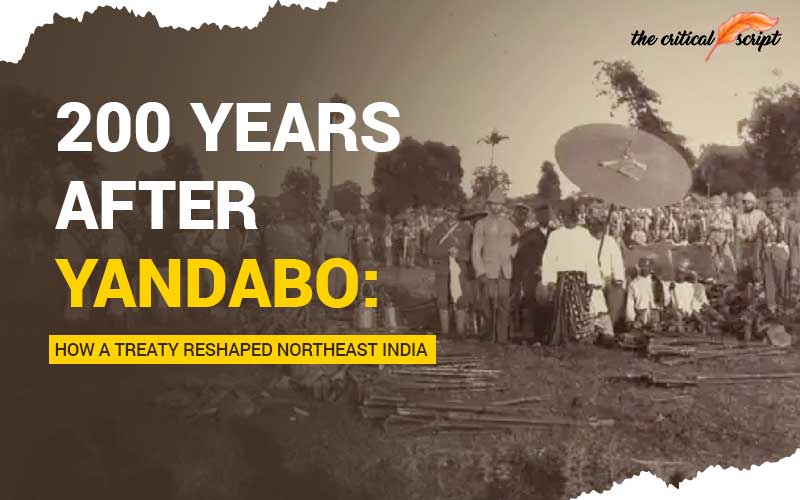
200 Years After Yandabo: How a Treaty Reshaped Northeast India
The Treaty of Yandabo, signed on 24 February 1826 between the
British East India Company and the Burmese Konbaung dynasty, represents a
watershed moment in the political and historical evolution of Northeast India.
Concluding the First Anglo-Burmese War (1824–1826), the treaty reconfigured
regional sovereignty, facilitated British imperial expansion, and reshaped socio-economic
trajectories across Assam, Manipur, and adjoining frontier regions. As the
bicentenary of the treaty approaches in 2026, scholarly attention has
increasingly focused on its multidimensional consequences, not only as a
diplomatic settlement but also as an instrument of colonial state formation in
the eastern periphery of the Indian subcontinent.
This article examines the background to the treaty, its
provisions, and its long-term political, economic, and socio-cultural
implications for Assam, Manipur, and the broader Northeast frontier, while
situating the agreement within the wider dynamics of regional conflict and
imperial competition.
Historical Background: Burmese Expansion and Regional Instability
The origins of the Treaty of Yandabo can be traced to the
profound political instability that characterized Northeast India during the
late eighteenth and early nineteenth centuries. Two interconnected processes,
the decline of indigenous polities and the expansionist ambitions of the
Burmese Konbaung dynasty, created the conditions for regional conflict and
eventual colonial intervention.
Ahom decline and political fragmentation in Assam
The Ahom kingdom, which had exercised political authority in the
Brahmaputra valley for nearly six centuries, entered a period of structural
crisis following the Moamoria Rebellion (1769–1805). This prolonged
insurgency weakened royal authority, disrupted administrative mechanisms, and
eroded military capacity. Subsequent succession disputes among Ahom elites
further fragmented the polity, leaving Assam vulnerable to external
intervention.
By the early nineteenth century, the Ahom state struggled to
maintain effective territorial control, and rival claimants increasingly sought
external support, inadvertently inviting Burmese involvement.
Manipuri crisis and the Seven Years Devastation
Parallel developments unfolded in Manipur, where dynastic
contestations and regional rivalries created openings for Burmese expansion.
Beginning in 1819, Burmese forces invaded Manipur, initiating a period
remembered in Manipuri historiography as the Seven Years Devastation
(ChahiTaretKhuntakpa).
During this period:
●
The Burmese army occupied the kingdom
●
Agricultural production collapsed
●
Large segments of the population were killed,
enslaved, or displaced
●
The political structure of the kingdom
disintegrated
King Marjit Singh lost effective authority, while
princes, including Gambhir Singh, were forced into exile in Cachar and
neighbouring territories. The displacement of the royal family deprived Manipur
of both military leadership and territorial base, rendering independent
resistance impracticable.
Consequently, the Manipuri elite increasingly viewed alliance
with the British East India Company as the only viable pathway for political
restoration.
Burmese expansion under the Konbaung dynasty
These regional crises coincided with the westward expansion of
the Konbaung dynasty under King Bodawpaya and later King Bagyidaw.
Burmese military commanders, notably MahaBandula, led campaigns into Manipur
and Assam between 1817 and 1822, consolidating Burmese influence across much of
Northeast India.
The Burmese occupation of Assam, remembered locally as the “Maan
invasion,” produced widespread devastation, depopulation, and economic
disruption, further destabilizing the region.
Regional Crisis and British Strategic Anxiety
The Burmese advance into Assam and Manipur brought Burmese
authority into proximity with British-controlled Bengal, transforming what had
been a regional conflict into a matter of imperial strategic concern. British
administrators feared:
●
Frontier insecurity
●
Disruption of trade networks
●
Refugee influx across colonial borders
●
Potential Burmese encroachment into Company
territories
Simultaneously, appeals from displaced regional elites,
including Manipuri princes and Assamese claimants, reinforced British
involvement in regional affairs.
Thus, the convergence of indigenous political instability,
Burmese imperial expansion, and British strategic anxieties created the
conditions for armed confrontation, culminating in the outbreak of the First
Anglo-Burmese War in 1824.
Post-Treaty Political Consolidation and Frontier Expansion
The Treaty of Yandabo triggered a gradual consolidation of
British authority across Assam and neighbouring frontier regions through a mix
of indirect rule, annexation, and frontier policy development.
Assam: From indirect rule to annexation
In Upper Assam, the British initially pursued indirect
administration by installing PurandarSingha as a tributary ruler in 1833.
This experiment proved temporary, and citing administrative inefficiency, the
British annexed Upper Assam in 1838. Thereafter, district
administration, revenue systems, and judicial institutions were established
across the Brahmaputra valley, integrating Assam more firmly into colonial
governance.
Manipur: Autonomy within imperial influence
Unlike Assam, Manipur retained formal sovereignty after the
treaty. However, British influence expanded through diplomatic engagement,
military cooperation, and strategic oversight of frontier security. The later
appointment of Political Agents institutionalized this relationship, reflecting
a protectorate-like arrangement combining nominal autonomy with imperial
supervision.
Frontier implications: Hill regions and Arunachal context
British consolidation in Assam facilitated gradual engagement
with adjoining hill regions. Under David Scott’s leadership, early
frontier policy emphasized political contact and regulated trade, including
initiatives such as frontier fairs at Sadiya. Exploratory missions into the
Mishmi, Abor, and Naga areas expanded political relationships with tribal
chiefs and geographical knowledge. These developments contributed to the
emergence of frontier governance mechanisms, including the conceptual
foundations of the Inner Line system, later formalized in 1873, and to the
incremental incorporation of hill regions into colonial administrative
frameworks.
Counterfactual Reflection: Northeast India Without the Treaty of Yandabo
As the bicentenary of the Treaty of Yandabo, it is historically
meaningful to consider how Northeast India’s political and socio-economic
trajectory might have evolved had the treaty not been concluded. While
counterfactual analysis cannot offer definitive outcomes, it enables
exploration of alternative historical pathways shaped by the interplay of
regional power dynamics, imperial competition, and local agency.
Two centuries later, imagining a Northeast without the Treaty of
Yandabo illuminates the profound extent to which this single diplomatic moment
redirected regional history, redefining political alignments, economic
pathways, and frontier identities across generations.
Disclaimer: The opinions expressed in this article are those of the author's. They do not purport to reflect the opinions or views of The Critical Script or its editor.
History And Facts Related Posts










Newsletter!!!
Subscribe to our weekly Newsletter and stay tuned.
Related Comments