


 INDIA ASIAN GAMES MEDAL MONITOR
·
India: 🥇 0
| 🥈 0
| 🥉 0
| Total: 0
INDIA ASIAN GAMES MEDAL MONITOR
·
India: 🥇 0
| 🥈 0
| 🥉 0
| Total: 0
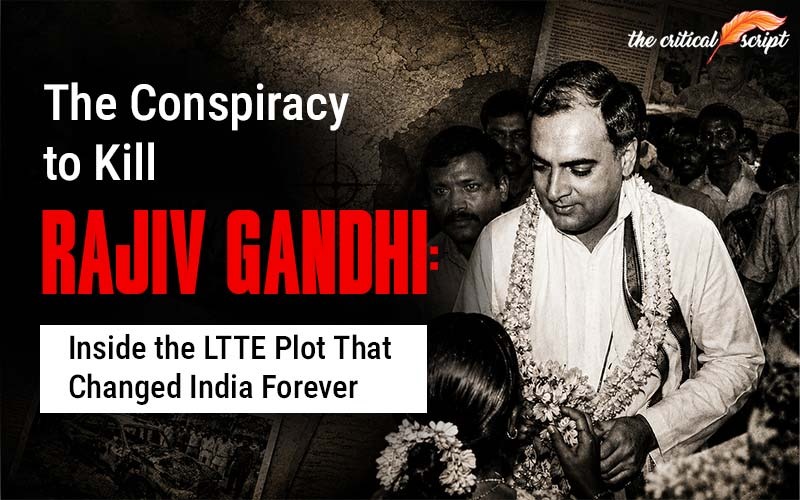
The Conspiracy to Kill Rajiv Gandhi: Inside the LTTE Plot That Changed India Forever
It was not a spontaneous act of terror. It was a carefully engineered assassination, planned across borders, executed with military precision, and driven by revenge, ideology, and the violent politics of South Asia.
On the night of 21 May 1991, former Prime Minister Rajiv Gandhi arrived at Sriperumbudur in Tamil Nadu to campaign for the upcoming general elections. What appeared to be a routine political gathering was, in reality, the final stage of a conspiracy that had been unfolding for months.
By the time Rajiv Gandhi stepped out of his vehicle and began greeting supporters, the assassination squad was already in position.
The woman who approached him with folded hands and a garland was not an ordinary supporter. She was ThenmozhiRajaratnam, better known by her alias “Dhanu,” an operative linked to the Liberation Tigers of Tamil Eelam (LTTE). Hidden beneath her clothes was a powerful explosive belt.
Seconds later, the blast killed Rajiv Gandhi, Dhanu, and many others standing nearby.
But the explosion at Sriperumbudur was only the visible end of a much deeper operation — one involving secret networks, covert movements across the Indian coastline, intelligence failures, and one of the most disciplined insurgent organizations in modern history.
The Origins of the Plot
The roots of the assassination lay in Sri Lanka’s brutal civil war.
The LTTE, led by VelupillaiPrabhakaran, had emerged as the most powerful Tamil militant organization fighting for an independent Tamil homeland in northern Sri Lanka. Fiercely secretive and militarily sophisticated, the LTTE operated almost like a parallel state with its own intelligence wing, naval unit, courts, and suicide commandos.
Initially, India’s relationship with Tamil militant groups had been complicated. During the early 1980s, several Tamil organizations reportedly found varying levels of sympathy and logistical support in India, particularly in Tamil Nadu. But everything changed after the Indo-Sri Lanka Accord signed by Rajiv Gandhi in 1987.
Under the agreement, India deployed the Indian Peace Keeping Force (IPKF) to Sri Lanka.
The LTTE felt betrayed.
What began as a peacekeeping mission soon transformed into a bloody conflict between Indian troops and LTTE fighters. The organization suffered heavy casualties. Entire LTTE strongholds were attacked. Deep resentment toward Rajiv Gandhi grew within the LTTE leadership.
According to investigators and later court findings, Prabhakaran came to believe that Rajiv Gandhi’s possible return to power in India could mean another Indian military intervention in Sri Lanka. Eliminating him became both strategic and symbolic.
The Intelligence Chief Behind the Operation
One of the central figures behind the assassination conspiracy was believed to be Pottu Amman, the feared chief of the LTTE’s intelligence wing.
Unlike conventional militant leaders, Pottu Amman specialized in covert operations, assassinations, infiltration, and psychological warfare. Under his leadership, the LTTE developed one of the most effective underground intelligence networks in South Asia.
Investigators later concluded that the Rajiv Gandhi assassination was supervised through this intelligence apparatus.
The operation required the secret entry of LTTE operatives into India, the establishment of safe houses across Tamil Nadu, local logistical support, constant surveillance of Rajiv Gandhi’s movements, procurement of explosives, and careful coordination between handlers and suicide operatives, revealing that the assassination was not the act of a lone attacker but part of a highly organized conspiracy network.
The Assassination Squad
The core assassination squad reportedly included Dhanu, the suicide bomber who carried out the attack; Sivarasan, the field commander who coordinated the operation on Indian soil; Subha, another LTTE operative closely associated with the mission; and several others, including NaliniSriharan, Murugan, Santhan, and Perarivalan, who were later accused or convicted in connection with the conspiracy. Among them, Sivarasan, known as the “One-Eyed Jack,” emerged as the central figure in the investigation and became one of the most hunted men in India following Rajiv Gandhi’s assassination.
Known as the “One-Eyed Jack” because he had lost an eye in combat, Sivarasan was allegedly the operational mastermind on Indian soil. Calm, disciplined, and highly trained, he coordinated movements, reconnaissance, communication, and escape plans.
Witnesses later described how the team blended into civilian life across Tamil Nadu, frequently shifting locations to avoid detection.
The Final Preparations
One of the most disturbing aspects of the plot was the meticulous reconnaissance carried out before the assassination.
Before the assassination, the conspirators reportedly attended several political rallies to closely study security arrangements, crowd movement, VIP access procedures, the physical proximity allowed between leaders and the public, and weaknesses in screening protocols, enabling them to carefully plan and execute the attack at Sriperumbudur.
Rajiv Gandhi’s campaign style unintentionally made the assassination easier. Unlike heavily isolated leaders, he often preferred walking directly into crowds, accepting garlands, and interacting closely with supporters.
The LTTE understood this vulnerability perfectly.
Dhanu was trained specifically for the mission. Investigators later believed she had mentally prepared for death long before the operation began. The LTTE’s “Black Tigers” suicide wing glorified self-sacrifice as martyrdom. Suicide operatives underwent ideological conditioning and were treated with extraordinary reverence within the organization.
The assassination at Sriperumbudur was among the earliest major suicide bombings captured so clearly in modern political history.
The Photographer Who Captured the Final Seconds
One of the most chilling details of the case involved a local photographer named Haribabu.
Standing near Rajiv Gandhi during the rally, Haribabu unknowingly photographed the assassin seconds before the explosion. His camera survived even though he did not.
Those images became crucial evidence.
Investigators carefully developed the damaged film and reconstructed the bomber’s final movements frame by frame. The photographs revealed Dhanu approaching Rajiv Gandhi and helped identify several conspirators.
Without Haribabu’s camera, investigators later admitted, the conspiracy may have taken much longer to unravel.
The Hunt for the Conspirators
After the assassination, India launched one of the country’s largest manhunts.
The Special Investigation Team (SIT) of the Central Bureau of Investigation launched one of India’s most extensive manhunts, tracing LTTE operatives through telephone records, photographic evidence, intelligence intercepts, witness testimonies, forensic analysis, and raids on multiple safe houses across southern India.
The investigation exposed a secret LTTE network operating across Tamil Nadu.
But the LTTE operatives were trained never to be captured alive.
Many carried cyanide capsules around their necks, a signature LTTE practice. When cornered, several operatives committed suicide rather than surrender.
The most dramatic moment came in August 1991 in Bengaluru, where Sivarasan and several associates were finally surrounded by Indian security forces. Before commandos could capture them, the operatives consumed cyanide and died inside the safe house.
With their deaths, many unanswered questions died as well.
Nalini and the Debate Over Justice
Among those arrested alive was NaliniSriharan.
Her conviction later became one of India’s most controversial legal and political debates. Initially sentenced to death, her punishment was later commuted to life imprisonment after appeals and public campaigns.
Over the years, questions surrounding mercy petitions, prolonged incarceration, rehabilitation, and political pressure kept the case alive in public discourse.
The assassination, therefore, evolved beyond terrorism into a national debate about justice, punishment, and reconciliation.
The Larger Conspiracy Debate
Although Indian courts concluded that the LTTE leadership was responsible, debates about the “larger conspiracy” never fully disappeared.
The Jain Commission extensively investigated the intelligence failures, possible political connections, LTTE support networks operating in Tamil Nadu, security lapses, and the broader ecosystem that enabled the assassination of Rajiv Gandhi to take place. Its findings and observations triggered major political controversy and turmoil in India during the 1990s.
Even decades after the assassination, several troubling questions continued to linger: Could the attack have been prevented had intelligence warnings been acted upon more seriously? Were crucial alerts ignored or underestimated by authorities? Did local networks in Tamil Nadu provide greater assistance to LTTE operatives than officially acknowledged? And how deeply had the LTTE managed to infiltrate parts of southern India during that period?
The LTTE’s Most Consequential Operation
Ironically, the assassination ultimately damaged the LTTE itself profoundly.
India, which once had complex relations with Tamil militant groups, turned decisively against the organization after Rajiv Gandhi’s death. Public sympathy disappeared rapidly. The LTTE was banned in India, and international scrutiny intensified.
Many analysts later argued that assassinating Rajiv Gandhi was one of the LTTE’s greatest strategic mistakes.
It isolated the organization diplomatically and destroyed whatever political space remained for it in India.
A Conspiracy That Reshaped Indian Security
The assassination permanently changed India’s security architecture.
After Rajiv Gandhi’s assassination in 1991, India’s security framework underwent major changes. VIP protection became significantly stricter, intelligence coordination between agencies improved, suicide bombing threats emerged as a central national security concern, and political rallies began operating under far tighter security protocols and crowd-control measures.
India also began understanding transnational militancy in far more serious terms.
The Rajiv Gandhi assassination revealed how regional conflicts beyond India’s borders could evolve into devastating domestic threats.
The killing of Rajiv Gandhi was not simply an assassination. It was the culmination of ideology, revenge, geopolitics, and militant strategy colliding in one catastrophic moment.
Behind the explosion stood a complex conspiracy involving trained operatives, intelligence networks, secret logistics, and political anger born from the Sri Lankan civil war.
More than three decades later, the assassination remains one of the most consequential acts of political violence in modern India — not only because a former Prime Minister was killed, but because it exposed how deeply conflict, extremism, and international politics had begun to intertwine in South Asia.
Disclaimer: The opinions expressed in this article are those of the author's. They do not purport to reflect the opinions or views of The Critical Script or its editor.
National Related Posts









Newsletter!!!
Subscribe to our weekly Newsletter and stay tuned.
Related Comments