


 INDIA ASIAN GAMES MEDAL MONITOR
·
India: 🥇 0
| 🥈 0
| 🥉 0
| Total: 0
INDIA ASIAN GAMES MEDAL MONITOR
·
India: 🥇 0
| 🥈 0
| 🥉 0
| Total: 0
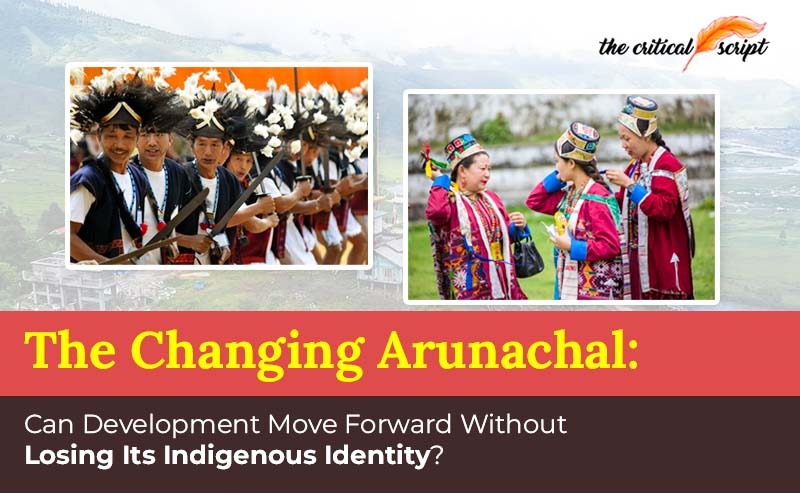
The Changing Arunachal: Can Development Move Forward Without Losing Its Indigenous Identity?
Arunachal Pradesh is entering a
period of transformation unlike any it has experienced in recent history. Roads
and tunnels are changing the geography of movement, digital connectivity is
shrinking distances between remote communities and the outside world, tourism
is bringing increasing numbers of visitors into previously isolated regions,
and large infrastructure and hydropower projects are bringing new investments
into the state. Towns are expanding, young people are increasingly studying and
working outside their traditional communities, and new economic opportunities
are emerging in sectors that barely existed at scale a generation ago. Yet
beneath this visible transformation lies a question that is becoming
increasingly important for the state's future: how can Arunachal modernise
rapidly while ensuring that the indigenous cultures, languages, customary
institutions and community identities that define the state remain living and
evolving parts of that future?
The question becomes particularly
significant because Arunachal Pradesh is not culturally homogeneous. The state
government's Department of Indigenous Affairs describes Arunachal as home to 26
major tribes and numerous sub-tribes, each possessing distinctive cultural
and linguistic characteristics. The state's statistical publications similarly
describe a population divided among numerous indigenous communities and note
the extraordinary linguistic diversity of the region. This diversity is not
simply a matter of different names or costumes. It encompasses different
systems of customary governance, agricultural practices, belief systems,
architecture, oral traditions, languages, festivals, food cultures, crafts,
music and relationships with the natural environment.
The Nyishi, Adi, Galo, Apatani
and Tagin communities, among others belonging to the broader Tani cultural
sphere, share certain historical and cultural connections associated with the
traditions of Abotani and Donyi-Polo, while each community has its own
language, customs and social institutions. The Apatani cultural landscape
around Ziro, for example, is particularly associated with its distinctive
paddy-cum-fish cultivation system, while the Adi cultural world encompasses
traditions of agriculture, weaving, oral literature, community institutions and
festivals such as Solung. The Galo community's Mopin remains an important
cultural festival, while Tagin communities celebrate Si-Donyi. Nyishi
communities celebrate Nyokum, a major festival associated with community life
and traditional beliefs. These are not interchangeable expressions of one
generic “tribal culture”; each reflects a distinct cultural history.
Further west, the cultural landscape
changes again. Monpa communities in Tawang and adjoining areas have a
deep association with Mahayana Buddhist traditions, with the Tawang Monastery
remaining one of the most significant centres of Tibetan Buddhist culture in
the region. The Memba and Khamba communities of the high Himalayan areas
have their own distinct cultural traditions, while the Sherdukpen and Hrusso
(Aka) communities of the western region combine distinctive indigenous
practices with influences from Buddhism and neighbouring Himalayan cultures.
The Bugun, Sartang and Miji/Sajolang communities add
further layers to the cultural landscape of West Kameng and neighbouring areas.
The diversity of this western belt demonstrates why any discussion about
“Arunachali culture” needs to recognise that there is no single cultural
template.
The eastern and southeastern parts
of the state tell another story. The Idu, Digaru/Taraon and Miju/Kaman
Mishmi communities possess distinct traditions associated with the Mishmi
cultural world, including rich oral traditions, textile practices, customary
knowledge and festivals such as Reh among the Idu Mishmi and Tamladu among
Mishmi communities. The Tai Khamti and Singpho communities have
historical and cultural connections extending into the wider Southeast Asian
world, while maintaining distinctive traditions within Arunachal Pradesh. The
Khamti tradition is particularly notable for its Tai language and Buddhist
heritage. In Tirap, Longding and parts of Changlang, the Nocte, Wancho and
Tangsa communities possess their own languages, customary institutions,
festivals, music, dances, textile traditions, woodcraft and social histories.
Festivals such as Chalo Loku among the Nocte and Oriah among the Wancho remain
important expressions of community identity.
Other communities, including the Puroik,
Tutsa, Singpho, Yobin/Lisu and Khowa, along with several smaller
communities and sub-tribes, further demonstrate why Arunachal's cultural
identity cannot be reduced to a handful of large communities. Published ethnographic
research has identified a broad spectrum of major tribal communities, including
Adi, Aka/Hrusso, Apatani, Bugun, Digaru Mishmi, Galo, Idu Mishmi, Khamba,
Khampti, Memba, Miji/Sajolang, Monpa, Nocte, Nyishi, Puroik, Tagin, Tangsa,
Singpho, Sartang, Wancho, Yobin and Zakhring, among others.
This diversity is perhaps
Arunachal's greatest cultural strength, but it also presents one of its
greatest challenges. When a state contains so many languages and cultural
systems within a relatively small population, modernisation can have different
consequences for different communities. A road may bring a new market to one
village, while a tourism boom may place pressure on another community's sacred
landscape. Digital education may help preserve one language while the dominance
of Hindi or English in another setting gradually reduces the everyday use of a
local language. A major infrastructure project may create employment for one
community while requiring land acquisition and livelihood changes for another.
Development, therefore, cannot be understood as having one uniform cultural
impact across Arunachal.
This is why the conversation about
the state's future needs to move beyond the simplistic opposition between development
and tradition. Arunachal does not have to choose between roads and culture,
between modern education and indigenous knowledge, or between economic
integration and cultural identity. The real challenge is to build systems in
which these things reinforce rather than undermine one another.
For decades, geography itself
provided a degree of protection to many of Arunachal's communities. Mountains,
rivers and difficult terrain limited movement and kept settlements relatively
dispersed. That geographical isolation also allowed languages, customs and knowledge
systems to develop within distinct community environments. Today, that
isolation is rapidly disappearing. Improved highways, tunnels,
telecommunications and air connectivity are integrating even remote areas more
closely with the rest of India. This transformation is essential for economic
development and national connectivity, but it also means that cultural change
will happen more quickly.
The significance of this
transformation becomes clear when considering the Inner Line Permit system.
Arunachal Pradesh continues to regulate the entry of visitors from outside the
state through the ILP, a system rooted historically in the Bengal Eastern
Frontier Regulation of 1873. The state's ILP portal describes the system as a
mechanism regulating entry into Arunachal Pradesh, while the contemporary
debate increasingly concerns how such regulation should function in a state
undergoing rapid infrastructure and economic expansion.
The modern Arunachal economy
requires movement. Large infrastructure projects require labour and technical
expertise. Tourism requires visitors. Businesses require employees, suppliers
and customers. Universities and institutions require professionals. At the same
time, indigenous communities have legitimate concerns about land, settlement
patterns, employment opportunities and the long-term demographic character of
their communities. Recent academic analysis has examined precisely this tension
between infrastructure-led development, migration, the ILP and indigenous
identity.
The challenge, therefore, is not
simply to decide whether Arunachal should be open or closed. That binary is
inadequate for the realities of a modern economy. The more important question
is whether the state can develop a regulatory framework that allows legitimate tourism,
investment, employment and economic activity while maintaining effective
safeguards for indigenous land, community interests and cultural continuity.
Land occupies a particularly
sensitive position in this discussion. For many indigenous communities, land is
not merely an economic asset that can be evaluated through market price. It is
connected to ancestry, customary rights, agricultural practices, community
identity and social relationships. Traditional village institutions have
historically played important roles in regulating social relations, settling
disputes and maintaining community responsibilities. Government documentation
of Arunachal's traditional institutions records different forms of village
councils among communities such as the Monpa, Sherdukpen, Idu Mishmi, Khampti,
Tangsa, Nyishi, Apatani, Nocte, Tagin, Wancho and Adi.
These institutions are an important
reminder that indigenous identity is not simply about festivals and traditional
dress. It also involves systems of community organisation and customary
knowledge that have historically helped societies govern themselves.
Modern governance does not need to
reproduce these systems exactly as they existed in the past. But neither should
development assume that traditional institutions are irrelevant. They can
provide valuable knowledge about local conditions, community relationships and
customary practices, particularly when major development projects affect land,
forests and livelihoods.
The question becomes even more
important when discussing hydropower. Arunachal possesses enormous hydropower
potential, and the sector can provide revenue, electricity, infrastructure and
employment while contributing to India's wider energy requirements. But
hydropower projects can also transform river systems, require land, affect
communities and alter local livelihoods. A serious discussion about development
therefore needs to acknowledge both sides rather than treating either economic
benefit or community concern as the only legitimate consideration.
The same principle applies to
highways and other infrastructure. A road can bring a hospital within reach of
a village, reduce travel time, enable agricultural marketing and create tourism
opportunities. But roads also change land values, settlement patterns and
commercial activity. They can bring outside investment and labour. They can
change what young people aspire to and how communities interact with
surrounding towns. The question is not whether these changes should happen at
all, but whether local institutions and communities have the capacity to manage
them.
Tourism provides perhaps the
clearest example of this cultural balancing act.
Arunachal's appeal to visitors comes
precisely from the qualities that modernisation can potentially weaken: its
landscapes, indigenous communities, traditional architecture, festivals, food,
handicrafts, music and relatively distinctive ways of life. A visitor does not
travel to Ziro, Tawang, Mechuka or other destinations merely because they can
see a mountain. They also encounter a cultural landscape.
That creates an important paradox.
The more successfully Arunachal markets its culture, the greater the
responsibility to ensure that tourism does not turn living communities into
cultural exhibits.
A festival should remain meaningful
to the community that celebrates it, rather than becoming simply a performance
scheduled for visitors. Traditional architecture should not survive only as a
backdrop for commercial resorts. Indigenous food should generate opportunities
for local producers rather than merely being reproduced by businesses from
outside. Handicrafts should provide sustainable income to artisans. Local
guides should be able to earn from their knowledge of landscapes, traditions
and ecology.
In other words, the people whose
culture attracts visitors should also be among the principal economic
beneficiaries of tourism.
This is where local entrepreneurship
becomes critical. Development should not merely create jobs for indigenous
communities; it should create opportunities for them to own businesses and
control value chains. A tourism economy in which local communities provide
labour while outside operators capture most of the value does little to
strengthen long-term economic autonomy. The same principle applies to construction,
food processing, handicrafts, logistics and other emerging sectors.
The state already has an important
foundation in its traditional knowledge systems. Agriculture, bamboo and cane
work, weaving, food preservation, forest knowledge, herbal knowledge, hunting
traditions, architecture and community resource management have developed
through generations of adaptation to the Himalayan environment. Some of these
practices may not be suitable in their traditional form for every contemporary
need, but many contain knowledge that can inform modern approaches to
sustainability.
The Apatani agricultural system,
for instance, demonstrates how local ecological knowledge can create highly
productive land-use systems within a difficult mountain environment. The
state's many traditions of cane and bamboo work demonstrate how locally
available materials have historically been incorporated into everyday life.
Communities across Arunachal have developed distinctive textile traditions,
woodcraft, food practices and agricultural techniques suited to their
environments. These should not be viewed merely as remnants of the past. With
appropriate innovation and market access, some can become part of the state's
contemporary creative and rural economy.
Language, however, may be the area
where the impact of modernisation is most difficult to reverse.
The Directorate of Research's
Philology section has been documenting indigenous languages through
dictionaries, phrasebooks, language guides and other publications for decades. It
has undertaken work involving languages including Adi, Idu Mishmi, Monpa,
Nyishi, Galo, Tagin, Apatani and Tangsa, among others, and has specifically
identified the need to study indigenous languages facing the possibility of
decline.
This work matters because language
is more than a communication tool. It carries a community's memory.
A word for a plant may contain
ecological knowledge. A traditional expression may encode a social rule. A song
may preserve a historical event. A proverb may carry generations of accumulated
experience. A lullaby may contain linguistic forms that are rarely found
elsewhere. When a language disappears, translating the words into another
language does not necessarily recreate the cultural world that existed around
them.
Yet preserving indigenous languages
should not mean isolating young people from the wider world. Arunachal's young
generation needs English, Hindi and digital skills to participate fully in
India's economy and the global economy. The objective should instead be multilingual
confidence: the ability to communicate beyond one's community without
losing the language of home.
Education can play a central role
here. A child should be able to learn modern science, mathematics, technology,
artificial intelligence and global history while also having meaningful
exposure to the history, language, ecology and cultural traditions of their own
community. Modern education should expand a young person's world without
erasing the place from which that person comes.
Technology could make this possible
at a scale that earlier generations never had. Indigenous languages can be
recorded, digitised and developed into educational content. Oral histories can
be archived. Traditional songs can be documented. Old manuscripts can be digitised.
Young filmmakers can create content in local languages and reach audiences
beyond the state. Social media can become a tool through which communities
represent themselves rather than allowing their culture to be defined
exclusively by outsiders.
But digital preservation has to be
accompanied by real-world use. A language cannot survive solely inside a
digital archive. It needs to be spoken at home, in community gatherings and
cultural spaces. Young people need reasons to use it. Cultural knowledge must
remain part of everyday life rather than becoming something encountered only
during festivals.
This distinction is particularly
important because Arunachal's culture has historically been transmitted through
oral traditions. Government cultural documentation notes the importance
of oral literature in preserving the state's historical and cultural knowledge,
while the Department of Indigenous Affairs is now building digital resources
around tribes, festivals, music, folk dance and traditional knowledge.
The cultural map of Arunachal is
therefore not a museum collection. It is a living system.
The Adi have Solung; the Galo
have Mopin; the Nyishi have Nyokum; the Apatani have Dree; the Tagin have
Si-Donyi; the Idu Mishmi have Reh; the Monpa have Losar; the Nocte have Chalo
Loku; the Wancho have Oriah; the Tai Khamti have Poi-Pee-Mau; and numerous
other communities have their own festivals and ceremonial traditions. The
state government's cultural portal now documents dozens of such festivals and
cultural practices, demonstrating the extraordinary range of traditions that
exist within Arunachal.
But even these festivals should not
be treated as isolated cultural events. They are connected to agriculture,
community relationships, religious beliefs, oral traditions, food, music, dance
and customary life. The festival is often the visible part of a much larger
cultural system.
This is why cultural preservation
must move beyond annual celebrations. It must include the people who make the
culture possible: farmers, weavers, musicians, storytellers, priests and
traditional knowledge holders, artisans, cooks, craftspeople and community
elders. If these practices are to survive, younger generations need
opportunities to learn them and, wherever possible, earn from them.
This brings us back to the central
question of development.
What kind of economic growth does
Arunachal want?
A state can have impressive roads,
large infrastructure projects and rising tourism numbers while still
experiencing cultural erosion. Conversely, a state can preserve traditions
while failing to provide young people with sufficient economic opportunities,
thereby encouraging them to leave.
Neither outcome is sustainable.
The real objective should be to
create an economy in which young people do not have to choose between
opportunity and belonging.
A young Apatani should be able to
build a technology company without abandoning an understanding of the cultural
landscape of Ziro. A young Adi should be able to become an engineer while
retaining the language and traditions of the Siang region. A young Monpa should
be able to pursue a career anywhere in India while remaining connected to the
cultural heritage of Tawang. A young Khamti, Nocte, Wancho, Tangsa, Mishmi,
Nyishi, Galo, Tagin or other indigenous youth should similarly be able to
participate in a modern economy without feeling that cultural identity is an
obstacle to progress.
That requires development policy to
think beyond infrastructure.
It requires local skills, local
enterprise, cultural education, language preservation, community participation,
responsible tourism and mechanisms that allow indigenous communities to capture
a meaningful share of the economic value generated in their regions.
It also requires acknowledging that
indigenous identity itself will change. No culture remains completely static.
Arunachal's communities have changed throughout history through interaction
with neighbouring regions, migration, trade, religion, education and political
transformation. The objective should therefore not be to freeze culture at an
imagined historical moment. That would neither be possible nor desirable.
The objective should be to ensure
that communities have the confidence and institutional strength to determine
how their culture evolves.
That is an important distinction.
Preservation is not the same as
isolation.
A culture can evolve and still
remain recognisably itself. A traditional craft can acquire contemporary
designs. A festival can incorporate new forms of participation. Indigenous
music can enter new genres. Traditional food can become part of modern
hospitality. Oral histories can become films and digital archives. Indigenous
ecological knowledge can contribute to contemporary conservation.
Modernisation becomes a threat when
communities lose the ability to make these choices themselves.
This is why consultation and
participation matter so much in the development process. Whether the issue is
land acquisition, infrastructure, tourism, natural resources or urban
expansion, communities should have meaningful opportunities to participate in
decisions that affect them. Consultation does not mean that every project will
be accepted by every person, nor does it mean that development must stop
whenever disagreement occurs. It means that development should recognise
communities as stakeholders with knowledge, rights and interests rather than
treating them simply as populations living around a project.
Arunachal's traditional community
institutions provide a useful reminder of this principle. Historically, village
councils across different tribes performed functions ranging from dispute
resolution and social regulation to community welfare and festival
organisation. These institutions have evolved alongside formal democratic
governance, but the underlying principle of community participation remains
relevant.
There is also an economic dimension
to cultural preservation that deserves greater attention. If indigenous
products, designs, food and cultural experiences are to become part of
Arunachal's economy, the communities that created them should not be reduced to
suppliers of raw cultural material. Intellectual property, branding,
geographical indications, cooperatives, local enterprises and community-owned
tourism models can help ensure that economic value remains closer to the
source.
The same principle applies to
knowledge. Traditional ecological knowledge should be documented with the
participation and consent of knowledge-holding communities. Cultural archives
should not become repositories in which outsiders extract information without
meaningful involvement of the communities that created it.
Ultimately, Arunachal's greatest
cultural asset is not any single festival, tribe, landscape or monument. It is
the extraordinary diversity of living communities that have developed
different ways of understanding and inhabiting the Himalayan environment.
That diversity deserves to be
protected, but it also deserves to be allowed to evolve.
The state cannot turn back the clock
on connectivity. It should not want to. Better roads can save lives. Digital
networks can transform education. Tourism can generate income. Hydropower can
provide revenue and electricity. Investment can create opportunities. Young
people should have access to all of these.
But development should not be
measured only by kilometres of roads built, megawatts generated, tourists
received or investments announced. Another set of questions deserves equal
attention: Are local people acquiring skills? Are local businesses growing? Are
indigenous languages being transmitted to children? Are traditional knowledge
systems being documented? Are cultural practitioners able to earn a livelihood?
Are communities participating in decisions affecting their land? Are young
people able to imagine a successful future without feeling that success
requires them to become culturally detached from home?
These questions are harder to
measure than infrastructure statistics, but they may ultimately say more about
whether development is sustainable.
Arunachal Pradesh is not faced with
a choice between modernity and tradition. It is faced with the much more
interesting challenge of creating its own form of modernity.
One in which a road can connect a
remote village to a national market without disconnecting that village from its
cultural roots. One in which tourism can create livelihoods without turning
communities into spectacles. One in which hydropower and infrastructure can
generate economic opportunity while recognising the interests of affected
communities. One in which young people can master technology and global
languages while continuing to speak the languages of their grandparents. One in
which indigenous knowledge is not regarded as an obstacle to progress but as a
resource that can inform a more sustainable future.
Arunachal has never been one
culture. It has always been a meeting place of many cultures: Tani
traditions in the central belt; the Buddhist cultures of Monpa, Memba, Khamba
and related communities in the highlands; the distinctive traditions of Mishmi
communities in the east; the Tai Khamti and Singpho heritage of the eastern
valleys; and the rich cultural worlds of Nocte, Wancho, Tangsa, Tutsa and other
communities of the southeast, alongside the many smaller communities whose
traditions complete the state's cultural mosaic.
That diversity is not something
development needs to overcome.
It is something development needs to
carry forward.
The real measure of a modern
Arunachal will therefore not be whether the state changes. It inevitably will.
The measure will be whether, amid the highways, tunnels, universities,
industries, tourism destinations and digital networks of the future, its people
continue to recognise their languages, their histories, their landscapes, their
traditions and themselves in the Arunachal that emerges.
And perhaps that is the central
challenge of the coming decades: not to preserve Arunachal by keeping it
unchanged, but to ensure that Arunachal has enough cultural confidence,
economic strength and community agency to decide what it wants to become.
Disclaimer: The opinions expressed in this article are those of the author's. They do not purport to reflect the opinions or views of The Critical Script or its editor.
Regional Related Posts






Newsletter!!!
Subscribe to our weekly Newsletter and stay tuned.
Related Comments