


 INDIA ASIAN GAMES MEDAL MONITOR
·
India: 🥇 0
| 🥈 0
| 🥉 0
| Total: 0
INDIA ASIAN GAMES MEDAL MONITOR
·
India: 🥇 0
| 🥈 0
| 🥉 0
| Total: 0
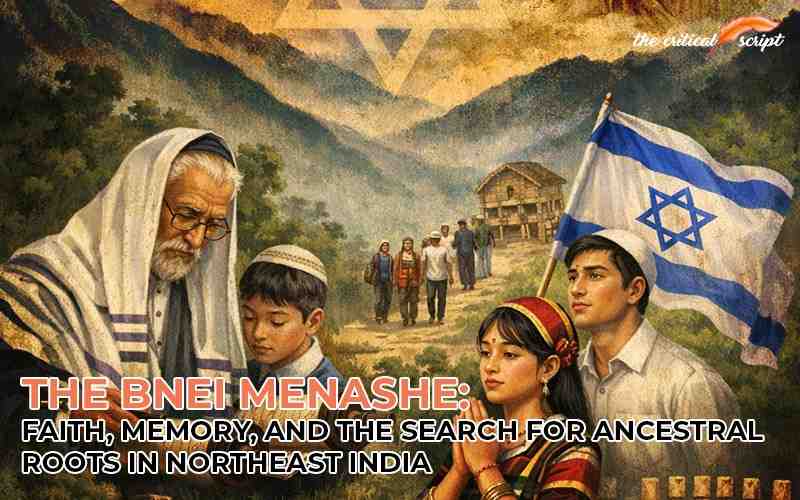
The Bnei Menashe: Faith, Memory, and the Search for Ancestral Roots in Northeast India
In
the hills of Northeast India, among the Mizo and Kuki-Chin communities of Mizoram and Manipur, a
small but determined group has, for decades, articulated a remarkable claim:
that they are descendants of the ancient Israelite tribe of Manasseh, one of
the Ten Lost Tribes exiled from the Kingdom of Israel in the 8th century BCE.
Known as the Bnei Menashe
“Children of Manasseh” their story sits at the intersection of faith,
migration, identity, and geopolitics.
Their
journey from remote hill settlements to recognition by Israeli religious
authorities is one of the most unusual modern identity movements in global
Jewish history.
The Lost Tribes and a Distant Echo
The
narrative of the Ten Lost Tribes originates in biblical history. After the
Assyrian conquest of the northern Kingdom of Israel around 722 BCE, ten of the
twelve tribes were exiled. Over centuries, these tribes faded from recorded
history, giving rise to enduring speculation about their fate.
Across
continents, various communities from Ethiopia to Central Asia have claimed
descent from these tribes. The Bnei Menashe represent one such claim, emerging
in the 20th century within the broader Kuki-Chin-Mizo ethnolinguistic world.
However,
unlike mythic associations that attach loosely to entire populations, the Bnei
Menashe identity developed through a specific religious revival movement rather
than a universally held ethnic tradition.
Origins of the Movement
The
roots of the Bnei Menashe movement can be traced to the mid-20th century, when
certain community leaders began drawing connections between local oral
traditions and biblical narratives. These included stories of ancestral
migrations, river crossings, and westward journeys motifs that were interpreted
as parallel to the Exodus narrative.
In
the 1970s and 1980s, some members began formally adopting Jewish religious
practices. Observance of the Sabbath, dietary laws, and Jewish festivals
gradually replaced Christian customs among adherents. The movement gained
momentum through contact with Jewish organizations abroad, particularly those
interested in investigating Lost Tribe traditions.
It
is important to note that the broader Mizo and Kuki-Chin populations largely
identify as Christian and do not claim Israelite ancestry. The Bnei Menashe
represent a distinct subgroup within these communities.
Recognition by Israel
The
question of recognition became central in the late 20th century. After
religious and historical evaluations, Israel’s Chief Rabbinate in 2005
acknowledged that the Bnei Menashe might have Israelite roots but required
formal conversion to Judaism according to halakhic (Jewish legal) standards.
This
decision was significant. It neither fully validated historical descent nor
dismissed it outright. Instead, it opened a pathway: members of the community
could immigrate to Israel under the Law of Return, provided they underwent
conversion.
Since
then, several thousand Bnei Menashe have migrated to Israel. Their absorption
has not been without challenges. Integration into Israeli society, economic
adaptation, and cultural transition have required resilience and adjustment.
Scholarly Perspectives
From
an academic standpoint, the claims of direct descent remain unproven.
Linguistic research places the Kuki-Chin-Mizo peoples firmly within the
Tibeto-Burman language family, with migration histories tracing back to East
and Southeast Asia. Genetic studies conducted to date have not provided
conclusive evidence linking the community to ancient Near Eastern populations.
Most
scholars interpret the Bnei Menashe phenomenon as a modern religious identity
movement shaped by:
· Oral
tradition reinterpretation
· Colonial-era
missionary influence
· Global
Jewish outreach networks
· The
enduring allure of Lost Tribe narratives
Rather
than viewing the movement purely through the lens of historical verification,
many anthropologists frame it as a compelling example of identity formation in
a globalized world — where faith, memory, and aspiration intersect.
Faith, Identity, and Belonging
For
members of the Bnei Menashe, the question is not solely one of archaeology or
genetics. It is about belonging, spiritual, historical, and communal. Their
embrace of Judaism is deeply lived and practiced, not symbolic. Religious
study, ritual observance, and commitment to Jewish law form the foundation of
their communal life.
Their
story also complicates simplistic understandings of ethnicity. It raises
enduring questions:
· Is
identity determined solely by genetic evidence?
· Can faith
reshape historical belonging?
· How do
communities negotiate recognition in the modern nation-state system?
A Story Still Unfolding
Today,
the Bnei Menashe community exists both in Northeast India and in Israel. Their
journey continues to evolve, socially, politically, and spiritually.
Whether
viewed as descendants of an ancient tribe or as a modern religious revival
movement, the Bnei Menashe represent one of the most fascinating intersections
of history, belief, and migration in contemporary times.
Their
story reminds us that identity is rarely static. It is negotiated, remembered,
reinterpreted and, at times, reclaimed.
Disclaimer: The opinions expressed in this article are those of the author's. They do not purport to reflect the opinions or views of The Critical Script or its editor.
Regional Related Posts











Newsletter!!!
Subscribe to our weekly Newsletter and stay tuned.
Related Comments