


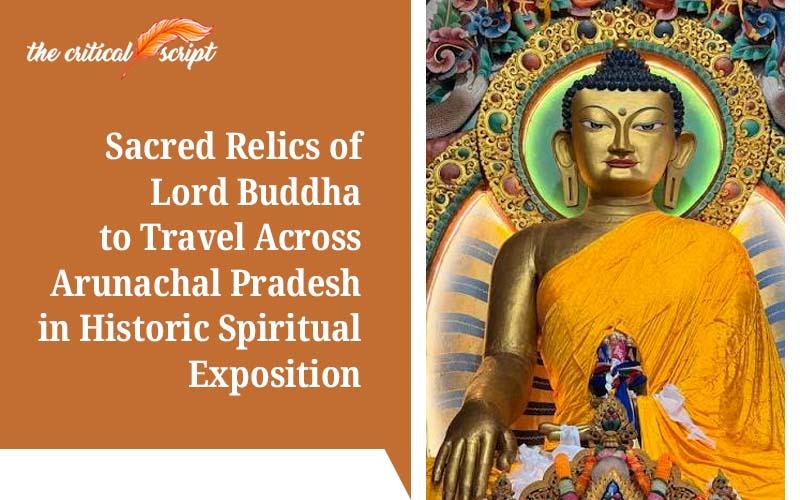
Sacred Relics of Lord Buddha to Travel Across Arunachal Pradesh in Historic Spiritual Exposition
Arunachal Pradesh
is preparing to host the sacred relics of Lord Buddha across three prominent
Buddhist destinations, marking a significant moment for the state’s religious
and cultural heritage. The exposition will take place at Tawang Monastery,
Bomdila in West Kameng district, and the Golden Pagoda in Namsai district
between October 31 and November 20, 2026.
The exposition
will give devotees, monks and visitors from Arunachal Pradesh and neighbouring
regions an opportunity to pay their respects to the sacred relics and reflect
on the enduring teachings of Gautama Buddha - peace, compassion, harmony and
non-violence.
The programme is
being organised with the involvement of the Ministry of Culture, Government of
India; the Government of Arunachal Pradesh; the International Buddhist
Confederation (IBC); and the National Museum, New Delhi, where the relics are
preserved.
According to the schedule announced by Chief
Minister Pema Khandu, the exposition will begin at Tawang Monastery from
October 31 to November 7, move to Bomdila from November 8 to 13, and conclude
at the Golden Pagoda in Namsai from November 14 to 20.
The Sacred Relics of Lord Buddha: History and
Significance
The sacred relics
of Gautama Buddha, revered by Buddhists worldwide, are tangible links to the
life and teachings of the Enlightened One. Known as Buddha Dhatu,
these relics may include bodily remains preserved in reliquaries and stupas.
They symbolise faith, compassion, wisdom and the enduring message of peace.
Among the most
significant collections are the Piprahwa relics, discovered in
Uttar Pradesh in 1898 by British archaeologist William Claxton Peppé.
Associated with the ancient Shakya community, the relics hold immense
archaeological and religious significance. In 2025, a collection of Piprahwa
relics was repatriated to India after more than a century, marking an important
moment in the preservation of the country's Buddhist heritage.
The exposition of
these sacred relics in Arunachal Pradesh brings this rich history closer to
devotees, offering an opportunity for prayer and reflection while highlighting
the state's diverse Buddhist traditions. From Tawang and Bomdila to Namsai, the
event underscores the timeless relevance of the Buddha's teachings of peace,
compassion and harmony.
Three
Destinations, One Spiritual Journey
The decision to
host the exposition at three locations allows devotees across different parts
of Arunachal Pradesh to participate in the occasion. Each destination has its
own religious and cultural identity, reflecting the diversity and continuity of
Buddhist traditions in the state.
Tawang:
A Major Centre of Buddhist Heritage
The exposition
will begin at Tawang Monastery, one of the most prominent centres of Tibetan
Buddhism in India. Located in the mountains of western Arunachal Pradesh, the
monastery has long served as a place of worship, learning and spiritual
practice.
The arrival of the
sacred relics is expected to hold particular significance for the region’s
Buddhist communities. Preparations have included coordination among the
district administration, religious institutions and other stakeholders to
facilitate security, crowd management, visitor movement and the overall conduct
of the event.
An official
coordination meeting held in September reviewed arrangements for the
exposition. The administration also highlighted the need to communicate
programme details to villages and communities so that devotees can plan their
visits.
The exposition
coincides with the period of Lhabab Düchen, an important occasion in the
Buddhist calendar associated with the Buddha’s descent from the heavenly realm.
The timing adds further spiritual significance to the event.
Bomdila:
Bringing Sacred Heritage to West Kameng
From November 8 to
13, the relics will be displayed at Bomdila in West Kameng district. The town
and its surrounding areas have a strong Buddhist presence, with monasteries
serving as important centres of religious life, education and community
gatherings.
Preparations in
Bomdila have involved the district administration, representatives of the
Ministry of Culture, the International Buddhist Confederation, monasteries and
other officials. A review of the proposed venue and arrangements has focused on
infrastructure, security, logistics, crowd management and visitor facilities.
An exhibition by
the International Buddhist Confederation is also planned alongside the
exposition, adding an educational dimension to the programme.
For devotees in
West Kameng and neighbouring areas, the event will offer an opportunity to
encounter an important part of Buddhist heritage without having to travel to
New Delhi, where the relics are preserved.
Namsai:
The Golden Pagoda as the Final Destination
The final leg of
the exposition will be held at the Golden Pagoda, also known as Kongmu Kham, in
Namsai district from November 14 to 20.
The Golden Pagoda
is an important Buddhist landmark in eastern Arunachal Pradesh and is closely
associated with the Tai Khamti community’s Buddhist traditions. Its distinctive
architecture and role as a religious and cultural centre have made it a
prominent destination for devotees and visitors.
The Namsai
district administration has held coordination meetings with representatives of
the International Buddhist Confederation and the National Museum to review
security protocols, inter-agency coordination, visitor management, logistics
and other preparations.
Hosting the relics
at the Golden Pagoda will extend the exposition’s reach to eastern Arunachal
Pradesh and provide another opportunity for devotees to participate in the
spiritual event.
Understanding
the Significance of Buddha’s Sacred Relics
In Buddhist
tradition, relics associated with Gautama Buddha are revered as sacred objects
connected with the life and legacy of the Enlightened One. These may include
bodily remains and other objects associated with the Buddha or the early
Buddhist tradition.
Following the
Buddha’s cremation, Buddhist accounts describe the distribution of his relics
among different groups and rulers. These relics were enshrined in stupas, which
became important centres of pilgrimage, devotion and Buddhist cultural life.
Over centuries,
relics and stupas have played a significant role in the spread of Buddhism
across Asia. They have served not only as objects of veneration but also as
links connecting Buddhist communities across geographical and cultural
boundaries.
For many devotees,
paying respects to sacred relics is an expression of faith, reverence and a
commitment to the Buddha’s teachings. The significance of such an exposition
therefore extends beyond the physical presence of the relics: it also creates
an opportunity to reflect on the principles they represent.
The relics scheduled for exposition in Arunachal Pradesh are associated with Piprahwa in Uttar Pradesh, a site widely linked to ancient Kapilavastu and the early life of Gautama Buddha. They are preserved at the National Museum in New Delhi.
A
Link Between Archaeology, Faith and Living Tradition
The exposition
also draws attention to the relationship between archaeological heritage and
living religious traditions. The relics preserved in national collections carry
historical and cultural significance, while their public display allows
communities to engage with that heritage through established religious
practices.
For Arunachal
Pradesh, the event provides an opportunity to highlight the state’s place
within the wider Buddhist landscape of India. Buddhist traditions have shaped
religious institutions, festivals, art, architecture and community life in
several parts of the state.
Tawang and West
Kameng are prominent centres of Tibetan Buddhist traditions, while Namsai is
closely associated with the Theravada Buddhist traditions of the Tai Khamti
community. The exposition across these locations brings different regional expressions
of Buddhism into a shared programme centred on the life and teachings of
Gautama Buddha.
The event also
reflects the importance of cooperation between cultural institutions,
government departments, religious organisations and local administrations in
safeguarding and presenting heritage to the public.
The
Universal Message of Peace and Compassion
Although the
exposition is rooted in Buddhist religious tradition, the values associated
with the Buddha’s teachings have a wider relevance.
Compassion calls
for sensitivity towards the suffering of others. Non-violence emphasises
restraint and respect for life. Mindfulness encourages awareness of one’s
thoughts and actions, while the pursuit of wisdom calls for reflection rather
than blind acceptance.
In a world often
marked by conflict, division and uncertainty, these principles continue to
inform discussions about peaceful coexistence, responsible conduct and mutual
respect.
The exposition
offers an opportunity for visitors not only to pay their respects but also to
reflect on how these values can be applied in everyday life and community
relationships.
Preparations
for a Smooth and Dignified Exposition
Given the expected
interest among devotees and visitors, the three host locations are coordinating
arrangements for the safe and orderly conduct of the programme.
Official
preparations have included reviews of security, logistics, crowd management,
venue readiness and inter-agency coordination. Local administrations have also
emphasised cooperation among government departments, monasteries, community
representatives and the public.
Visitors should
follow official advisories for darshan timings, venue access, travel
arrangements, security protocols and other instructions. These details should
be confirmed through official channels before travelling.
The official
Sacred Relics Darshan portal launched by the state government is intended to
provide information and help devotees plan their visits.
A
Significant Moment for Arunachal Pradesh
The exposition of
the sacred relics of Lord Buddha is an important occasion for Arunachal
Pradesh, bringing together religious devotion, cultural heritage and public
participation across three destinations.
From the historic
monastery at Tawang to the Buddhist institutions of Bomdila and the Golden
Pagoda in Namsai, the programme will connect communities through a shared
opportunity for prayer, reflection and learning.
As the relics
travel across the state, the larger significance of the event lies in the
values they represent: peace, compassion, harmony and respect for all living
beings.
For devotees, it
will be an opportunity to pay their respects. For the state, it will be a
moment to share its Buddhist heritage with a wider audience. And for all who
participate, it will be a reminder that the Buddha’s message continues to speak
across generations, cultures and borders.
Disclaimer: The opinions expressed in this article are those of the author's. They do not purport to reflect the opinions or views of The Critical Script or its editor.
Regional Related Posts






Newsletter!!!
Subscribe to our weekly Newsletter and stay tuned.
Related Comments