


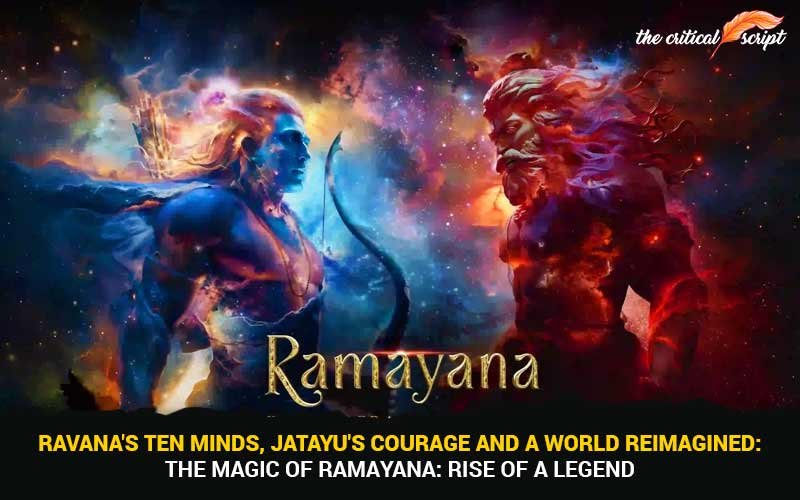
Ravana's Ten Minds, Jatayu's Courage and a World Reimagined: The Magic of Ramayana: Rise of a Legend
There are films
that entertain us, films that move us, and then there are films that leave us
in awe of what human imagination, creativity and collective effort can achieve.
Nitesh Tiwari's Ramayana: Rise of a Legend belongs to a category that deserves
to be discussed beyond the usual parameters of cinema.
Bringing the Ramayana to the big screen is, in itself, an enormous responsibility. It is an epic that generations have grown up listening to, reading and experiencing through their own cultural and spiritual understanding. Its characters are deeply familiar, its stories are cherished, and its significance goes far beyond entertainment. Yet, what makes this cinematic adaptation particularly interesting is the fresh creative imagination with which certain aspects of this timeless epic have been presented.
Ravana: A brilliant interpretation of the ten heads
One of the most remarkable creative decisions in the film is its interpretation of Ravana's ten heads.
Traditionally, the ten heads have been depicted as a physical manifestation of his extraordinary power, knowledge and ego. However, the film takes a fascinating creative leap by presenting them as ten distinct personalities and conflicting voices within Ravana's own mind.
This is a cinematic
masterstroke.
It transforms what could have been merely a larger-than-life visual representation into an exploration of a deeply complex character. The different voices represent his conflicting thoughts, ambitions, wisdom, devotion, anger and arrogance. They reveal a mind constantly negotiating with itself, where intelligence and ego, restraint and aggression, devotion and ambition coexist.
It makes us look at Ravana differently. A man of immense knowledge, a great scholar and a devoted worshipper of Lord Shiva, yet someone whose own arrogance ultimately becomes his greatest weakness.
The most fascinating aspect of this interpretation is that Ravana's greatest conflict appears to begin within himself, long before the actual battle with Rama.
Yash deserves appreciation for bringing this layered imagination to life. His screen presence, expressions and character modulations give this interpretation its impact.
Jatayu: A sequence that deserves special mention
If there is one sequence that leaves a particularly lasting impression, it is the portrayal of Jatayu.
The attention to detail in bringing this magnificent bird to life is extraordinary. From his appearance and movements to the sheer scale of his encounter with Ravana, the character reflects an impressive combination of visual craftsmanship and cinematic imagination.
But beyond the technical brilliance, what makes Jatayu's episode so powerful is the emotion behind it.
When Jatayu witnesses Sita being abducted, he knows exactly how formidable his opponent is. He understands the danger, yet he chooses to fight. There is something profoundly moving about this act of courage. He is not fighting for recognition, reward or personal glory. He fights because he cannot bring himself to watch injustice unfold. In that moment, his compassion becomes his greatest strength.
His struggle against Ravana is not merely a battle between two powerful beings; it is an extraordinary expression of selflessness and devotion. He may not possess Ravana's might, but his courage is immeasurable. Even in defeat, Jatayu emerges as a symbol of extraordinary bravery.
What makes his sacrifice even more touching is his final encounter with Rama, when, despite his grievous injuries, he manages to convey what happened to Sita. It is a deeply emotional reminder that even in his final moments, his concern remains for someone else's suffering.
Jatayu's story reminds us that bravery is not about knowing that you will win; sometimes, it is simply about refusing to surrender when someone needs you.
The visual detailing and execution of this entire sequence deserve tremendous appreciation. It is one of those moments where technology and storytelling come together to create something genuinely memorable.
VFX: Bringing an extraordinary world to life
The visual effects are undoubtedly among the film's biggest achievements.
Creating the world of the Ramayana requires much more than impressive computer-generated imagery. It requires building an entire visual universe, one that feels magnificent, believable and immersive while retaining the grandeur associated with the epic.
From the landscapes and kingdoms to the characters, creatures, battles and aerial sequences, the scale of visual execution is remarkable.
What deserves particular appreciation is the effort involved in making these elements work together. Every movement, every frame, every expression and every visual detail requires extensive planning, artistic understanding and technical precision.
The VFX should not be viewed merely as an added attraction. In a film of this scale, they become an essential storytelling medium, allowing the audience to experience a world that would otherwise be almost impossible to recreate.
There may be moments where certain visual elements could have been refined further, but the overall ambition and technical effort deserve recognition.
Behind the
spectacle is an extraordinary collective effort
Perhaps one of the most important things to acknowledge is the enormous amount of work that goes into making a film like this.
The audience sees the finished product on screen, but behind every spectacular sequence are hundreds of people working tirelessly, often for years, to make a director's imagination a reality.
The work of the production designers, costume designers, makeup artists, cinematographers, VFX supervisors, animators, sound engineers, editors, stunt teams and countless technicians deserves equal appreciation.
The detailing of the costumes, the visual identity of the characters, the textures, the environments and the overall presentation reflect the contribution of an incredibly dedicated team.
Credit must also go to director Nitesh Tiwari for attempting to bring such a vast and culturally significant epic to the screen with this level of ambition, and producer Namit Malhotra for backing a project of such enormous scale.
The music, too, adds another important dimension, with the collaboration of A. R. Rahman and Hans Zimmer bringing together two extraordinary musical sensibilities.
A film like this is never the achievement of one individual. It is the result of thousands of creative decisions, countless hours of dedication and a shared commitment to creating something extraordinary.
More than a cinematic spectacle
What ultimately makes the Ramayana timeless is not merely the grandeur of its battles or the extraordinary abilities of its characters, but the values and human emotions that remain relevant across generations.
Rama represents dharma and righteousness, Sita reflects dignity and resilience, Lakshmana embodies loyalty and sacrifice, Hanuman represents firm devotion, and Jatayu reminds us that courage is not measured by physical strength. Ravana, despite his immense knowledge and power, reminds us of how arrogance and unchecked ego can lead to one's downfall.
Each character, in their own way, adds meaning and depth to this timeless story. Their relationships, choices and sacrifices are what make the Ramayana so enduring.
The performances of the cast, including those in supporting roles, deserve appreciation for bringing these familiar characters to the screen. Equally commendable is the effort of the director and the entire crew, whose collective work across cinematography, production design, costumes, music and visual effects has helped shape this cinematic experience.
Perhaps that is the beauty of adapting an epic like the Ramayana: introducing its timeless wisdom to a new generation while allowing those familiar with the story to experience it from a fresh artistic perspective.
The Ramayana has always been an extraordinary story. This film offers another opportunity to revisit that legacy through the language of cinema, imagination and creativity.
Disclaimer: The opinions expressed in this article are those of the author's. They do not purport to reflect the opinions or views of The Critical Script or its editor.
Lifestyle And Entertainment Related Posts












Newsletter!!!
Subscribe to our weekly Newsletter and stay tuned.
Related Comments