


 INDIA ASIAN GAMES MEDAL MONITOR
·
India: 🥇 0
| 🥈 0
| 🥉 0
| Total: 0
INDIA ASIAN GAMES MEDAL MONITOR
·
India: 🥇 0
| 🥈 0
| 🥉 0
| Total: 0
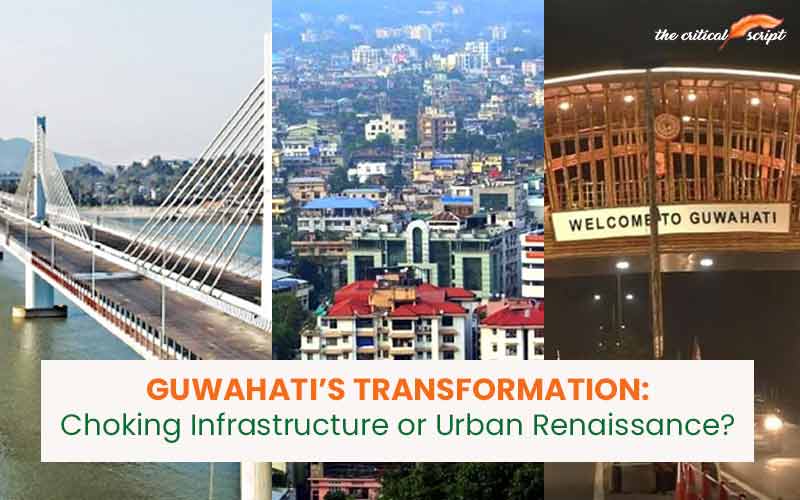
Guwahati’s Transformation: Choking Infrastructure or Urban Renaissance?
Guwahati
is at a critical crossroads. Positioned aggressively as India’s "Gateway
to Southeast Asia," the city is witnessing an unprecedented flurry of
capital expenditure. However, beneath the gleaming billboards of a
self-proclaimed "urban renaissance" lies a fragile civic reality.
Striking a balance between rapid physical expansion and real-world liveability
remains the city's greatest challenge.
The
Flyover Paradox and Strategic Bottlenecks
The
state’s approach to traffic management relies heavily on concrete
interventions. While new flyovers alter the skyline, they frequently shift
congestion down the road rather than solving it.
The AthgaonOverbridge Crisis: The essential repairs and structural maintenance at the Athgaonoverbridge serve as a case study in urban disruption. The temporary closure of this vital artery immediately paralyzed traffic across neighboring commercial areas like Fancy Bazar and Chatribari, highlighting the city’s lack of resilient, alternative routing options. We learnt nothing from the year-long similar disruption during Six Mile flyover repair.
Decongestion Deficits: Major structural upgrades, like shifting wholesale hubs to the periphery, have freed up some space. However, the core commercial grid remains prone to gridlock due to narrow lanes, unregulated parking, and delayed multi-modal transit integrations.
Artificial
Floods: The Cost of Displaceable Ecology
Guwahati’s
annual battle with monsoon waterlogging has turned from a seasonal occurrence
into a permanent structural failure.
Infrastructure
Deadlines: The city’s long-delayed, JICA-assisted drinking water supply projects,
first launched in 2012, have faced decades of missing deadlines. The state has
set a strict target for full completion by December 2026. In the meantime, only
a fraction of the city enjoys reliable piped water.
Ecology
vs. Concrete: The newly sanctioned ₹5,729-crore, 121-kilometer Guwahati Ring
Road project aims to enhance seamless logistics. However, environmentalists
warn that the extensive hill cutting and construction cutting through forested
buffers and wetlands will destroy natural drainage. This risks aggravating the
flash floods seen in critical choke points like Jorabat.
Air
Quality and the 'Purple City' Facade
To
counter its growing environmental footprint, the administration has introduced
the "Purple City" and green air quality initiatives.
Monsoon
vs. Real Pollution: Thanks to heavy monsoon washouts, real-time air quality
metrics appear deceptive, sitting comfortably in the "Good" to
"Moderate" range (AQI between 25 and 65).
The
Dry Season Reality: Experts warn that this green imagery faces a severe test
during dry winter months. Unchecked construction dust, rapid road expansions,
and industrial emissions regularly drive the city's winter AQI to hazardous
levels, exposing the limitations of superficial greening programs.
The
Satellite Strategy: A Final Gamble?
Realizing
that the existing urban core is pushing past its carrying capacity, the state
assembly passed the Guwahati Satellite (Cities) Development Authority (GSCDA)
Bill.
The
Blueprint: Chaired directly by the Chief Minister, this high-power authority
has wide-ranging land acquisition mandates to build specialized, standalone
knowledge, tech, and economic corridors outside the main city limits.
The
Critical Catch: While developing satellite townships can successfully draw
fresh commercial investments away from the core, it risks replicating
Guwahati's historical planning errors. If these satellite hubs are built
without integrated stormwater management, strict zoning, and mass public
transit, they will simply expand the boundaries of the existing infrastructure
crisis.
Disclaimer: The opinions expressed in this article are those of the author's. They do not purport to reflect the opinions or views of The Critical Script or its editor.
Regional Related Posts











Newsletter!!!
Subscribe to our weekly Newsletter and stay tuned.
Related Comments