


 INDIA ASIAN GAMES MEDAL MONITOR
·
India: 🥇 0
| 🥈 0
| 🥉 0
| Total: 0
INDIA ASIAN GAMES MEDAL MONITOR
·
India: 🥇 0
| 🥈 0
| 🥉 0
| Total: 0
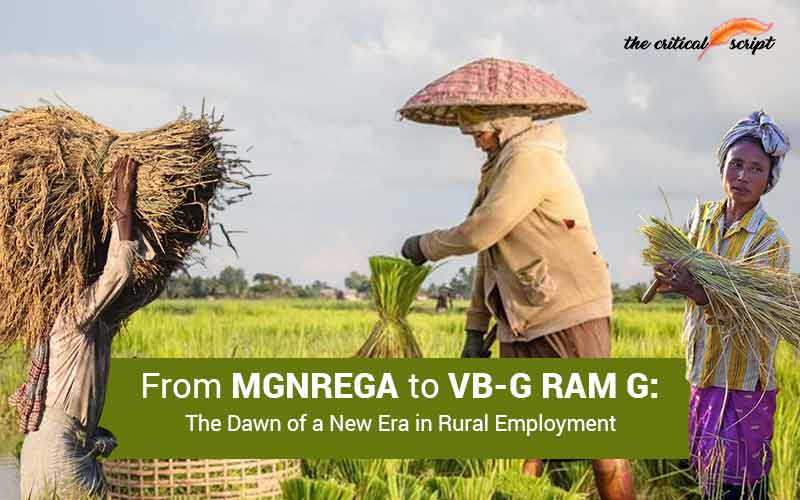
From MGNREGA to VB-G RAM G: The Dawn of a New Era in Rural Employment
After Two Decades of India's Largest Rural Jobs Programme, a New Framework Seeks to Build Stronger Livelihoods, Sustainable Assets and Self-Reliant Villages
For nearly twenty years, the Mahatma Gandhi National Rural Employment Guarantee Act (MGNREGA) stood as one of independent India's most ambitious social welfare programmes. Introduced to provide employment security to rural households, it became a lifeline for millions of families, particularly during periods of drought, economic distress and the COVID-19 pandemic.
On 30 June
2026, that chapter formally came to an end.
From 1July 2026, India begins a new phase in rural development with the implementation of the Viksit Bharat – Guarantee for Rozgar and Ajeevika Mission (Gramin), popularly known as VB-G RAM G. The new law replaces MGNREGA with an expanded employment guarantee and a broader vision focused not only on wage employment but also on sustainable livelihoods, durable rural assets and long-term village development aligned with the national goal of Viksit Bharat @2047.
A Landmark Law That Changed Rural India
MGNREGA was
enacted by Parliament in 2005 and came into force in February
2006. It was the first legislation in the country to make rural
employment a legal entitlement rather than a government
welfare scheme.
Every eligible
rural household was guaranteed 100 days of wage employment
each financial year through unskilled manual work. If employment was not
provided within fifteen days of demand, workers became legally entitled to
receive unemployment allowance.
The programme
marked a significant shift in India's approach to poverty alleviation by
empowering rural citizens with a legally enforceable right to work rather than
discretionary assistance.
Two Decades of Transformation
Over the last
twenty years, MGNREGA evolved into the world's largest public employment
programme.
Millions of rural
households found employment during lean agricultural seasons, helping reduce
distress migration and providing a dependable source of income. During the
COVID-19 pandemic, the programme became the backbone of rural employment as
returning migrant workers sought livelihoods close to home.
Beyond wages, the
scheme contributed significantly to rural infrastructure. Across the country,
villages witnessed the construction of farm ponds, irrigation canals, village
roads, check dams, water harvesting structures, plantations and flood
protection works. These assets strengthened agriculture, improved water
conservation and enhanced resilience against climate-related challenges.
The programme also
played an important role in promoting women's participation in the workforce.
Women consistently generated nearly half of all workdays under the scheme,
making MGNREGA one of India's largest platforms for female employment.
Another major
achievement was the expansion of financial inclusion. Wage payments through
Direct Benefit Transfer (DBT) encouraged millions of rural workers to open bank
and post office accounts, reducing leakages and improving transparency.
The Challenges That Prompted Reform
Despite its
achievements, MGNREGA also faced persistent implementation challenges.
Delayed wage
payments affected workers in many states. Instances of fake job cards, ghost
beneficiaries and irregular muster rolls raised concerns about misuse of public
funds. In several regions, incomplete assets and uneven quality of works
limited long-term benefits.
There were also
concerns that labour demand under the scheme sometimes coincided with peak
agricultural seasons, creating shortages for small farmers. Critics argued that
while the programme successfully provided employment, it needed stronger
integration with broader rural development goals and better use of technology
for monitoring and accountability.
The Beginning of VB-G RAM G
The Government of
India enacted the VB-G RAM G Act, 2025, with effect from 1
July 2026, formally repealing MGNREGA after two decades of
implementation. Existing verified job cards remain valid during the transition
until new GraminRozgar Guarantee Cards are issued, while
ongoing works continue seamlessly under the new framework.
The transition is
intended to ensure that no eligible worker faces disruption in employment
during the shift to the new system.
What Changes Under the New Law?
One of the most
significant improvements is the enhancement of the statutory employment
guarantee from 100 days to 125 days per financial year,
providing eligible rural households with an additional 25 days of assured work.
The Government has
also notified revised wage rates, with daily wages under the programme set at not
less than ₹300, subject to state-specific
notifications.
Technology assumes
a much larger role under the new framework. Digital attendance, geo-tagging of
assets, e-KYC verification and real-time monitoring systems are expected to
improve transparency and reduce irregularities. Wage payments will continue
through Direct Benefit Transfer and are to be made weekly or within fifteen
days, with compensation for delays where applicable.
Another
distinguishing feature of VB-G RAM G is its emphasis on creating productive and
durable community assets. The programme seeks greater convergence with
agriculture, irrigation, watershed management and rural infrastructure
initiatives so that employment generation simultaneously contributes to
long-term economic development.
To support the
nationwide rollout, the Central Government has made an interim allocation of ₹95,692.31 crore for 2026–27, the highest
Budget Estimate allocation for a rural employment programme.
Evolution Rather Than Abandonment
Supporters
describe VB-G RAM G as an evolution of India's rural employment architecture
rather than a departure from it.
Core features such
as the statutory guarantee of employment, demand-based work allocation, social
audits, grievance redressal and unemployment allowance continue under the new
law. At the same time, the framework introduces higher employment guarantees,
stronger technology-driven governance and greater emphasis on creating
productive rural assets that contribute to sustained economic growth.
Questions That Remain
As with any major
policy reform, the transition has generated debate.
Some economists
and opposition parties have raised concerns about implementation, the increased
role of technology and the capacity of states to adapt quickly to the revised
framework. Others argue that the success of VB-G RAM G will ultimately depend
on timely fund release, efficient execution and effective coordination between
the Centre, states and Gram Panchayats.
The true measure
of the programme will emerge over the coming years as villages experience its
impact on employment, infrastructure and rural livelihoods.
A New Chapter for Rural India
The end of MGNREGA
marks the conclusion of one of India's most influential social protection
programmes, one that provided livelihood security to millions of rural
households and transformed the landscape of public employment.
With the launch of
VB-G RAM G, the country enters a new chapter that seeks to build upon that
legacy through expanded employment opportunities, improved transparency, stronger
rural infrastructure and a renewed focus on self-reliant villages.
Whether remembered
as a bold reform or a transformative evolution, 1 July 2026
will remain a defining date in the history of India's rural development, symbolising
the transition from a programme centred on employment guarantee to a broader
mission of sustainable livelihoods and village transformation under the vision
of Viksit Bharat @2047.
Disclaimer: The opinions expressed in this article are those of the author's. They do not purport to reflect the opinions or views of The Critical Script or its editor.
Regional Related Posts










Newsletter!!!
Subscribe to our weekly Newsletter and stay tuned.
Related Comments