


 INDIA ASIAN GAMES MEDAL MONITOR
·
India: 🥇 0
| 🥈 0
| 🥉 0
| Total: 0
INDIA ASIAN GAMES MEDAL MONITOR
·
India: 🥇 0
| 🥈 0
| 🥉 0
| Total: 0
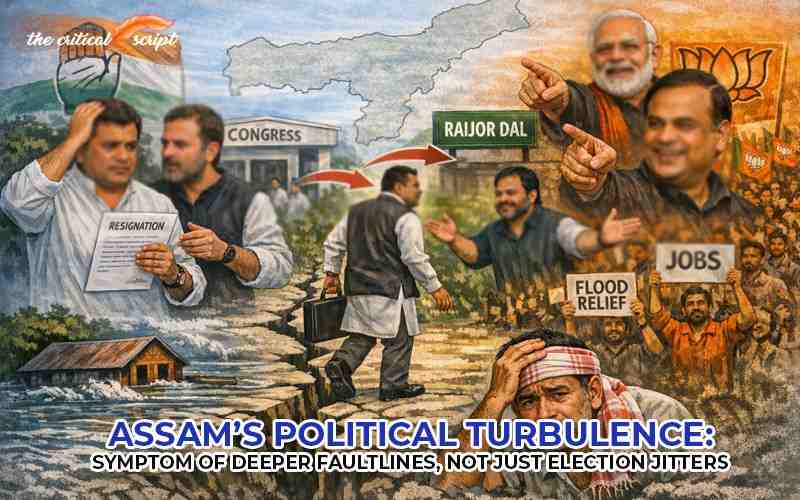
Assam’s Political Turbulence: Symptom of Deeper Faultlines, Not Just Election Jitters
Assam’s political landscape is witnessing dramatic shifts just
weeks before the state assembly elections, with resignations and party switches
grabbing headlines. While these moves are often framed as strategic
realignments ahead of polls, a closer look suggests deeper systemic issues in
party structures, leadership credibility, and political confidence.
Congress
in Chaos, Not Only Competition
The resignation drama of Bhupen Kumar Borah, the former
president of the Assam Pradesh Congress Committee, was supposed to be a major
setback for the party. Borah cited feelings of being ignored and internal
dissatisfaction as key reasons for stepping down, a rare open criticism from
within a party that often suppresses dissent.
However, within hours, Borah withdrew his resignation
after party heavyweights intervened, including Rahul Gandhi and senior state
leaders.
This public flip-flop may have prevented an immediate crisis,
but it highlights something more troubling: a lack of internal cohesion and
confidence within the Congress unit in Assam. Instead of a robust
discussion on strategy and leadership, we see last-minute damage control, a
reflection of a party uncertain about its direction and ability to contest
effectively. The retreat from resignation raises more questions than it answers
about morale and trust in leadership.
2.
Defections and Opportunism: The Case of Abdur Rashid Mandal
The shift of MLA Abdur Rashid Mandal from Congress to the
regional Raijor Dal might seem like a boost for opposition
fragmentation, but this move is less about ideological alignment and more about
political survival.
Mandal’s switch coming after Borah’s brief exit suggests that
leaders feel insecure in a party perceived to be losing ground. Raijor Dal, led
by Akhil Gogoi, obviously presents a fresh brand with grassroots appeal, yet its
electoral strength remains modest. Mandal’s move could signal opportunism
rather than a principled shift, exploiting the uncertainty within Congress
rather than helping build a coherent alternative platform.
BJP’s
Strategic Advantage: Not Just Power, But Perception
Chief Minister Himanta Biswa Sarma’s comments after Borah’s
resignation, openly welcoming him into the BJP fold and hinting at more
departures, underscore a sharp strategic advantage for the ruling party: it projects
confidence and invites rivals in on its terms.
This highlights a striking dynamic in Assam’s politics today:
the BJP doesn’t merely defend its position; it actively seeks to absorb
opposition dissent. By presenting itself as a stable and expansive political
home, the BJP reinforces a narrative that the opposition is fragmented and
leaderless. And with national leaders like Prime Minister Narendra Modi publicly
attacking rival parties’ credibility in the state discourse, the BJP’s message
resonates with voters seeking stability.
A
Distressed Opposition and a Fragmented Strategy
The developments point to a fundamental problem for opposition
parties in Assam, the failure to present a unified alternative politics.
Instead of focusing on ground issues like unemployment, flood relief, or
agricultural distress, much of the narrative revolves around internal rivalries
and last-minute alignments.
Raijor Dal’s modest gains in local bodies, a reflection of some
regional traction, show there are spaces for alternatives. But without a
cohesive strategy to unify fragmented opposition voices and articulate a clear
vision, these shifts risk being seen as personal manoeuvres rather than
substantive political renewal.
What
Assam’s Electorate Sees
For the voter on the ground, these political theatrics may feel
distant from real concerns. Frequent resignations and uncertain alliances risk
disengagement, reinforcing a perception that political activity is more about power
play than people’s issues.
If Assam’s democracy is to be strengthened, political leaders,
especially those in opposition, must go beyond election-season solidarity and
offer consistent, issue-based engagement. Right now, these last-minute shifts
may be newsworthy, but they don’t necessarily help the state’s democratic
health.
Disclaimer: The opinions expressed in this article are those of the author's. They do not purport to reflect the opinions or views of The Critical Script or its editor.
Politics Related Posts








Newsletter!!!
Subscribe to our weekly Newsletter and stay tuned.
Related Comments