


 INDIA ASIAN GAMES MEDAL MONITOR
·
India: 🥇 0
| 🥈 0
| 🥉 0
| Total: 0
INDIA ASIAN GAMES MEDAL MONITOR
·
India: 🥇 0
| 🥈 0
| 🥉 0
| Total: 0
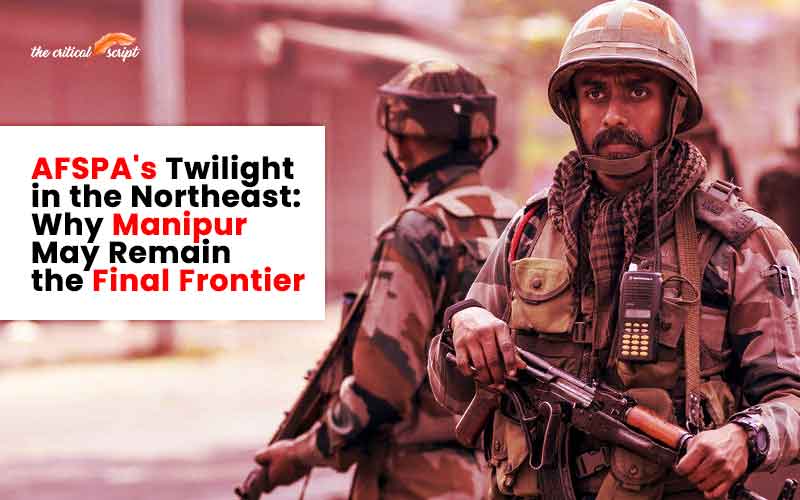
AFSPA's Twilight in the Northeast: Why Manipur May Remain the Final Frontier
For nearly seven decades, the Armed Forces (Special Powers) Act (AFSPA) has shaped the political and social landscape of Northeast India. Introduced in 1958 to address insurgency in the Naga Hills, the law gradually expanded across much of the region, becoming one of the most contentious legislations in independent India.
Today, however, the Northeast may be witnessing the beginning of the end of an era.
Union Home Minister Amit Shah recently stated that, barring one or two states, AFSPA could be withdrawn from the entire Northeast by next year. The announcement reflects a dramatic shift in the Centre's approach from a security-centric framework to one increasingly focused on peace, connectivity, and development.
Yet, while much of the region appears poised to move beyond AFSPA, one state stands apart from this narrative: Manipur.
Understanding AFSPA
The Armed Forces (Special Powers) Act, 1958 grants extraordinary powers to the armed forces operating in areas declared "disturbed."
Under AFSPA, security forces operating in "disturbed areas" are granted extraordinary powers that go beyond ordinary policing. They can be arrested without warrants, conduct searches without prior judicial authorization, use force under specified circumstances, and are protected from prosecution unless the Central Government grants permission. While supporters view these provisions as essential tools for counter-insurgency operations, critics argue that they weaken accountability and increase the risk of human rights violations.
Supporters argue that AFSPA provided security forces with the operational flexibility required to tackle insurgencies in difficult terrain and volatile situations.
Critics contend that it institutionalized exceptionalism, weakened accountability, and contributed to human rights violations.
For millions in the Northeast, AFSPA was not merely legislation. It was a lived reality.
The Long Shadow of Conflict
The Northeast witnessed multiple insurgencies after Independence.
Naga nationalism, Mizo separatism, ULFA in Assam, Meitei insurgent movements in Manipur, and numerous ethnic armed groups transformed the region into one of India's most militarized spaces.
Checkpoints, counter-insurgency operations, curfews, and military convoys became part of everyday life.
For decades, the region was viewed primarily through the lens of national security.
A Changing Northeast
Over the last decade, the security landscape has undergone significant transformation.
The Ministry of Home Affairs notes that since 2014, insurgency-related incidents in the Northeast have fallen by over 70%, civilian deaths by around 85–90%, and security force casualties by nearly 70%. In addition, multiple peace accords have been signed with armed groups across the region. These indicators are frequently cited by the Centre as evidence that the Northeast is transitioning from an era defined by conflict to one increasingly shaped by peace, development, and connectivity.
The Centre cites these developments as evidence that AFSPA is no longer necessary across vast parts of the region.
This transition has already begun.
Meghalaya
AFSPA has long been withdrawn.
Tripura
The Act was revoked in 2015 following improved security conditions.
Mizoram
Since the historic Mizo Peace Accord of 1986, the state has largely remained free of AFSPA.
Assam
The disturbed area notification has been progressively reduced, with AFSPA lifted from most districts.
Nagaland
Several districts have seen the Act withdrawn, though certain areas continue to remain under its ambit.
Arunachal Pradesh
AFSPA today applies only to a few police station jurisdictions bordering insurgency-affected regions.
Taken together, these developments signal a remarkable transformation.
The Northeast that was once synonymous with insurgency is increasingly being discussed in terms of infrastructure, tourism, trade, entrepreneurship, and strategic connectivity.
Manipur: The Exception
If AFSPA's withdrawal symbolizes the normalization of the Northeast, Manipur represents the unfinished chapter.
Ironically, no state challenged AFSPA more fiercely than Manipur.
Irom Sharmila: The Iron Lady
Following the Malom massacre in November 2000, in which ten civilians were killed, Irom Sharmila Chanu began a hunger strike demanding the repeal of AFSPA.
Her fast lasted nearly sixteen years, making it one of the world's longest non-violent protests.
She transformed the debate around AFSPA from a regional issue into an international human rights concern.
The Meira Paibi Protest
In 2004, after the custodial killing of Thangjam Manorama by personnel of the Assam Rifles, twelve Meira Paibi women staged a nude protest before Kangla Fort.
Holding banners reading:
"Indian Army Rape Us,"
their act became one of the most powerful symbols of resistance in modern Indian history.
It forced the nation to confront uncomfortable questions about militarization and accountability.
The New Crisis
Yet today's Manipur is confronting a different challenge.
The violence that erupted in May 2023 between the Meitei and Kuki-Zo communities transformed the state's security environment.
The conflict has resulted in hundreds of deaths and the displacement of tens of thousands of people. Communities that once lived alongside one another now remain divided by heavily guarded buffer zones. The unprecedented looting of thousands of firearms from state armouries has heightened security concerns, while the erosion of trust between ethnic groups has made reconciliation increasingly difficult. The crisis in Manipur is therefore not merely a question of restoring order, but of rebuilding a fractured society.
Unlike earlier insurgencies directed primarily against the Indian state, the current crisis is rooted in ethnic polarization and competing political aspirations.
This distinction is critical.
Even if insurgent groups weaken, societal fractures remain.
Why AFSPA May Continue in Manipur
Most analysts believe that Manipur is among the states likely to retain AFSPA in the near future.
Several factors contribute to this assessment:
Ongoing Security Concerns
The presence of armed groups and the circulation of looted weapons continue to pose serious challenges.
Ethnic Divisions
The restoration of trust between communities remains elusive.
Displacement
Thousands of internally displaced persons have yet to return home.
Fragile Peace
Periodic incidents continue to threaten stability.
Removing AFSPA under such circumstances may create concerns about operational readiness and security management.
Peace Beyond Legislation
At the same time, many Manipuris argue that peace cannot be achieved solely through military measures.
Peace cannot be legislated through a notification alone. True normalization requires difficult conversations and courageous choices: political dialogue over confrontation, justice alongside accountability, the dignified return and rehabilitation of displaced families, economic revival that restores hope, reconciliation between divided communities, and governance that is inclusive rather than exclusionary. Without these foundations, the end of conflict may remain elusive even if the guns fall silent.
The debate over AFSPA in Manipur is therefore not simply about retaining or removing a law.
It is about the kind of peace the state seeks to build.
The Symbolism of Withdrawal
If AFSPA is eventually withdrawn from most of the Northeast, it would represent a historic milestone.
It would acknowledge decades of peace-building efforts and recognize the region's changing realities.
It would also signal a shift in national perception—from seeing the Northeast primarily as a security concern to recognizing it as a region of opportunity and strategic importance.
However, symbolism alone cannot guarantee lasting peace.
The experiences of the Northeast demonstrate that development, dialogue, and dignity must accompany security reforms.
Where does it ends ?
AFSPA's story in Northeast India is one of conflict and resilience, of insurgency and negotiation, of fear and hope.
For states such as Mizoram, Tripura, Meghalaya, and much of Assam and Arunachal Pradesh, its gradual withdrawal reflects remarkable progress.
For Manipur, however, the journey remains unfinished.
The state that gave India its strongest anti-AFSPA movement now finds itself trapped in one of its deepest internal crises.
Perhaps the real question is not whether AFSPA will leave Manipur next year.
It is whether Manipur can heal.
For future generations across the Northeast, the hope is simple: that AFSPA will be remembered not as an enduring reality, but as a difficult chapter in history - one that eventually gave way to reconciliation, trust, and an enduring peace.
Disclaimer: The opinions expressed in this article are those of the author's. They do not purport to reflect the opinions or views of The Critical Script or its editor.
Regional Related Posts









Newsletter!!!
Subscribe to our weekly Newsletter and stay tuned.
Related Comments