


 INDIA ASIAN GAMES MEDAL MONITOR
·
India: 🥇 0
| 🥈 0
| 🥉 0
| Total: 0
INDIA ASIAN GAMES MEDAL MONITOR
·
India: 🥇 0
| 🥈 0
| 🥉 0
| Total: 0
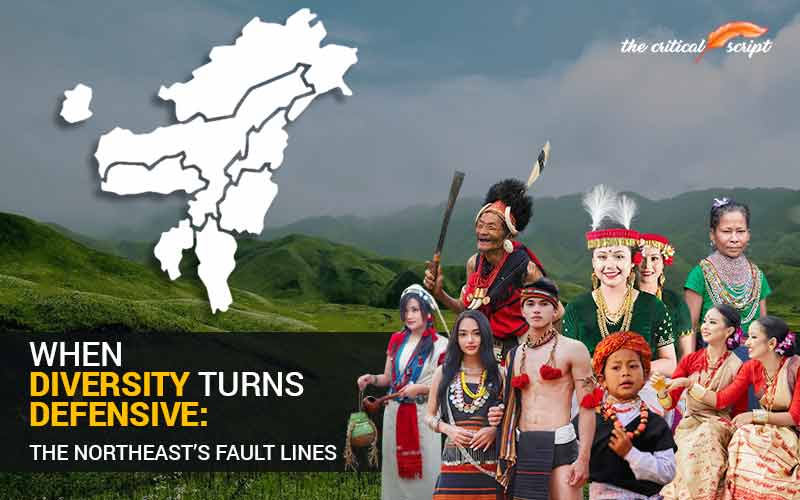
When Diversity Turns Defensive: The Northeast’s Fault Lines
The Northeast is routinely celebrated as India's most vivid expression of “unity in diversity” - seven states, hundreds of communities, dozens of languages, distinct traditions and histories, living alongside one another in a region that is as culturally rich as it is strategically important.
But beneath that celebrated diversity lies a more uncomfortable reality: too many old disputes remain unresolved, too many identities are becoming defensive, and too many local disagreements are acquiring the language of collective grievance.
The question is no longer whether the Northeast has fault lines. It does.
The more urgent question is: how long can these fault lines remain contained before one of them becomes a flashpoint?
Recent developments should make us uncomfortable.
Along the Assam–Arunachal Pradesh border, an old territorial dispute turned violent again this month. A confrontation in Dhemaji district on August 10 left at least 18 people injured, according to reports, with the dispute linked to competing claims over land and alleged encroachment. The two states share an approximately 800-km boundary and had already signed an agreement intended to resolve differences involving 123 villages.
That agreement demonstrates something important: political dialogue can reduce a dispute on paper, but it does not automatically remove resentment on the ground.
And Assam–Arunachal is hardly an isolated case.
The Assam–Meghalaya relationship has once again come under strain, not initially because of a formal border dispute, but because of something much more ordinary and therefore potentially more dangerous: who gets to carry passengers across a state boundary?
Following violence during a Khasi Students’ Union rally in Shillong on August 19, taxi operators in Assam and Meghalaya restricted one another’s vehicles. Highways were blocked, passengers were stranded, and vehicles were turned back. Although the respective associations have since suspended their actions and governments have intervened, reports of vehicles still being stopped after the formal suspension show how quickly a transport dispute can acquire an interstate and identity-based character.
This should concern everyone.
Because a roadblock is never merely a roadblock when the people on either side begin to see the other side not as fellow citizens, but as outsiders.
The Borders We Inherited Are Still Living Wounds
Assam's relationship with its neighbours is particularly complicated because today's neighbouring states were once part of undivided Assam.
Nagaland, Meghalaya, Mizoram and Arunachal Pradesh emerged as separate political entities through a long process of administrative reorganisation, identity assertion and political mobilisation. The boundaries created in that process did not always correspond neatly with older patterns of settlement, customary land use, tribal territories or historical memory.
That history continues to surface.
The Assam–Mizoram dispute, for instance, is rooted partly in competing interpretations of colonial-era boundary notifications from 1875 and 1933. The 165-km border has previously witnessed serious violence, including the deadly 2021 confrontation. Assam continues to rely on the boundary associated with the 1933 notification, while Mizoram has historically argued for the 1875 line.
The Assam–Nagaland boundary carries another layer of historical grievance. The two states share more than 500 km of disputed frontier, and clashes have occurred over decades. Fresh disputes around Merapani demonstrate how quickly questions of land and eviction can revive old territorial claims.
The Assam–Meghalaya boundary, despite substantial progress in negotiations, also continues to generate friction at the local level.
These are not simply lines on a map. They are lines passing through farms, forests, roads, villages and people's memories.
A government may negotiate a boundary in a conference room. But people living along that boundary experience it every day. The map may be settled long before the mind is.
When a Taxi Becomes an Interstate Dispute
The recent Assam–Meghalaya vehicle controversy demonstrates how quickly an apparently ordinary issue can acquire an identity dimension.
What began around taxi and transport operations developed into restrictions on vehicles moving between the two states. Even after the drivers' blockade was suspended, reports of vehicles being stopped highlighted how difficult it can be to immediately restore normalcy once public sentiment has hardened.
This is precisely why such incidents should not be dismissed as merely a dispute between transport associations.
Thousands of people cross these state boundaries every day for work, education, healthcare, business and family.
When an ordinary passenger begins to wonder whether a vehicle bearing an Assam registration plate will be allowed to enter Meghalaya, or vice versa, the psychological border becomes more significant than the administrative one.
That is dangerous.
Interstate mobility is one of the most basic expressions of national integration. A road should connect two states and not become a moving border checkpoint.
Manipur: A Conflict Within a Conflict
Then there is Manipur.
The Meitei–Kuki-Zo conflict has already transformed the state's social landscape, displaced communities, and devastated trust.
But reducing Manipur to a simple Meitei-versus-Kuki narrative risks missing another important reality. The hill–valley divide has deep political and historical roots, involving questions of land, constitutional protections, political representation, administrative autonomy, and competing concepts of territorial belonging.
And now, the Naga–Kuki dimension adds another layer. The fact that communities within the hills themselves have competing political interests should tell us something important:
There is no single “hill identity”, just as there is no single “Northeast identity”.
The region's diversity exists at multiple levels.
Sometimes the divisions are between states. Sometimes between districts. Sometimes between neighbouring villages. And sometimes within the same ethnic umbrella.
The Naga–Kuki relationship deserves particular attention because it demonstrates how conflict can develop new dimensions.
Historical territorial claims, competing memories, political representation, and land have all contributed to tensions between the communities.
The danger is not merely another isolated ethnic confrontation. It is the creation of multiple competing territorial imaginations - different communities believing that the same geographical space belongs to them historically, politically, or culturally.
Once territory becomes inseparable from identity, compromise becomes extremely difficult.
A village becomes a claim, a road a boundary, a forest a question of ancestral ownership, a district a political assertion, and history a weapon in the present.
Meghalaya's Internal Fault Lines
Meghalaya is often projected as one of the Northeast's most peaceful and culturally distinctive states.
But its internal diversity is far more complex than the image suggests. Khasi, Garo and Jaintia identities coexist with different histories and political aspirations.
Recent tensions surrounding the Garo Hills Autonomous District Council elections demonstrated another fault line: tribal versus non-tribal political rights and anxieties.
The question underneath such controversies is much larger than an election:
Who belongs?
Who has political rights? Who can contest? Who can own or access land? Who is considered indigenous? Who is an outsider?
These questions have enormous emotional power in the Northeast because land and identity are frequently inseparable.
Tripura: When Demography Becomes Destiny
Tripura offers perhaps one of the clearest examples of how demographic change can reshape political identity.
The state's indigenous tribal population became a minority over the course of the twentieth century, fundamentally altering the demographic and political landscape. The resulting indigenous–non-indigenous divide continues to influence politics, land questions, and demands for greater political protection.
The debate around Kokborok, the language of the indigenous Tiprasa communities, and disagreements over its script demonstrate another dimension of the same issue.
Not every identity conflict is about land. Sometimes it is about language, a script, or the right to preserve a community’s cultural voice.
Sometimes it is about whether a community feels that its history is being preserved—or slowly absorbed. For communities that have experienced demographic change, culture can become the last line of defence.
Perhaps the most important point often missed in discussions about the Northeast is that Assam itself cannot be reduced to one homogeneous Assamese identity.
The state contains multiple major ethnic, linguistic and cultural communities: Bodo, Karbi, Dimasa, Mishing, Deori, Tiwa, Rabha, Bengali-speaking communities and the broader Assamese identity, among others.
There have been tensions involving Bodo and non-Bodo communities, Karbi and Dimasa interests, tribal land rights, migration, language, and political representation. The Karbi–Assamese question, for instance, reflects the complicated relationship between ethnic autonomy and a larger Assamese political identity.
The same state can simultaneously be:
Assamese to India, tribal to Assam, indigenous to one community and an outsider to another. Identity is layered. Politics often isn't.
Then comes one of Assam's most under-discussed divides: Barak Valley versus Brahmaputra Valley.
The two regions have different historical experiences, linguistic compositions, cultural identities, and political priorities.
Language remains an especially sensitive issue. Development, representation, administrative attention, migration, and cultural recognition can all become part of the debate.
The danger is not disagreement. A democratic state must accommodate disagreement. The danger is when people begin to believe that the other valley does not understand them or does not care about them.
Geographical distance can eventually become psychological distance. And psychological distance can become political alienation.
The Chakma Question: When Identity, Territory and Citizenship Collide
The Chakmas present another, often overlooked, dimension of the Northeast's complicated identity landscape.
Their story crosses borders in Bangladesh, Myanmar, and India, and within India, Chakma communities are spread across Mizoram, Tripura, Arunachal Pradesh, and Assam. Their history brings together questions of displacement, citizenship, land, cultural identity and political autonomy.
In Arunachal Pradesh, the presence of Chakma and Hajong communities has remained politically sensitive for decades. The debate has involved citizenship, land, tribal status, and concerns among sections of indigenous communities about demographic change.
The issue remains current. In August 2026, the Chakma Development Foundation raised concerns over objections to 1,292 Chakma voters during the ongoing revision of electoral rolls in Arunachal Pradesh. The controversy illustrates how questions of citizenship and identity can quickly become questions of belonging.
No serious discussion of Northeast India can avoid migration.
Assam, Tripura, Meghalaya, Mizoram and other parts of the region have long experienced migration across porous and historically interconnected borders.
The India–Bangladesh and India–Myanmar borders add particularly sensitive dimensions. The conflict in Myanmar has also produced refugee movements into India's northeastern states, especially Mizoram and Manipur.
Security agencies have legitimate concerns about undocumented migration, arms trafficking, narcotics, and cross-border militant networks.
Those concerns must be addressed firmly. But there is an equally important responsibility:
Security concerns must not become a justification for collective suspicion of an entire ethnic or refugee population.
A refugee is not automatically an infiltrator. An ethnic community is not automatically a security threat. Legitimate concerns about illegal migration should not be diluted by unverified claims circulating on social media.
The sustainable answer is evidence, documentation, lawful verification, and transparent policy. Otherwise, demographic anxiety becomes a political instrument.
The Northeast's geography means India's internal security cannot be completely separated from developments across the Myanmar border.
Mizoram and Manipur have ethnic and familial links across the international boundary. The conflict in Myanmar has directly affected communities in the region, while weapons, narcotics, trafficking, and militant networks present genuine security challenges.
But the border also represents something else:
human connectivity that existed long before the modern international boundary.
This is why the Northeast requires a sophisticated border policy, one capable of distinguishing between humanitarian realities, traditional cross-border ties, and genuine security threats.
Treating all three as the same thing will only deepen mistrust.
The Siliguri Corridor: A Geographical Vulnerability
There is also a fault line that has nothing to do with ethnicity. The Northeast is connected to the rest of India through the narrow Siliguri Corridor.
The strategic vulnerability of this corridor means that instability anywhere in the broader region can have consequences far beyond the immediate conflict zone. This is why internal peace in the Northeast is not merely a regional issue. It is a national-security imperative.
The Northeast borders China, Myanmar, Bhutan and Bangladesh. It is India's gateway to Southeast Asia. Its stability matters to India's connectivity ambitions, trade routes, Act East policy and strategic posture.
A divided Northeast is therefore not simply a social problem. It is a strategic vulnerability.
The Three Maps of the Northeast
Perhaps the easiest way to understand the region's current anxiety is to imagine three different maps.
The first is the political map - seven states, clearly marked on paper, with boundaries recognised by law. Yet on the ground, those lines can still remain contested, disputed, and deeply contested in the memories of the people who live along them.
The second is the ethnic map - Naga, Kuki-Zo, Meitei, Bodo, Karbi, Dimasa, Khasi, Garo, Jaintia, Mizo, Tiprasa, Assamese, and hundreds of other identities. Unlike political boundaries, these lines are fluid, overlapping, and deeply rooted in history, ancestry, and belonging. They rarely fit neatly within the borders drawn on a map.
The third is the emotional map - shaped not by official boundaries, but by perceptions of belonging and exclusion: indigenous and outsider, hill and valley, tribal and non-tribal, Assamese and non-Assamese, Barak and Brahmaputra, mainland and Northeast.
These are the lines that can shift overnight through politics, rhetoric, rumours, and social media. And perhaps, this is the map we should worry about most.
Where Is the Unity in Diversity?
The phrase sounds beautiful. But unity in diversity is not the absence of conflict; it is the ability to navigate disagreement without allowing identity to harden into hatred.
A border dispute should remain a question of territory and law. A transport dispute should not become an interstate confrontation. Concerns over migration should be addressed through evidence, due process, and lawful verification. An election dispute should never become an ethnic confrontation. A debate over language or culture should not become a question of who belongs. And a political demand should not come at the cost of making another community feel threatened.
That is the real test of coexistence: not whether we disagree, but whether we can disagree without turning difference into division.
The Northeast Does Not Need Another Flashpoint
The region has already experienced enough violence to know how quickly a local confrontation can become something far larger. Manipur is a stark reminder that conflicts rarely remain confined to the issue that first triggered them.
That is why governments cannot afford to wait for violence before opening dialogue. Prevention must begin long before the first stone is thrown or the first road is blocked.
Interstate mechanisms must function continuously, not only during crises. Border disputes need permanent local-level channels for resolution. Community leaders need spaces for dialogue before tensions spill onto the streets. Security concerns must be addressed through evidence and due process. Migration must be managed through transparent documentation and lawful verification.
And political leadership must recognise a crucial distinction: there is a difference between giving voice to a grievance and turning that grievance into a weapon.
The Northeast does not need more firefighting after every flashpoint. It needs the political courage to address the embers before they become a fire.
Connectivity Is Returning. Is Trust?
There is a striking contradiction unfolding across the region. The Northeast is becoming more connected than ever - roads are expanding, highways are improving, interstate bus services are returning, trade is growing, and tourism is bringing people across state boundaries. The region is also increasingly being positioned as India’s gateway to Southeast Asia.
Yet physical connectivity does not automatically create social cohesion. A highway can connect two towns. A bus can cross a state border in a few hours. But trust cannot be built with concrete and asphalt alone.
It takes dialogue, shared experiences, and the confidence that crossing a border will not mean crossing into hostility. The real challenge, therefore, is not simply to build more roads between the seven states. It is to build bridges between their people.
The Northeast does not need another tragedy to remind us that its fault lines exist. The warning signs are already visible not as one looming crisis, but as a pattern of tensions accumulating across the region.
In border disputes and blockades; identity politics and demographic anxieties; ethnic mistrust and linguistic tensions; competing territorial claims and cultural insecurities; and misinformation that can turn local grievances into regional anger through social media.
And, most dangerously, in the growing tendency to see neighbouring communities not as fellow citizens, but as competitors.
These tensions may appear separate, but they can feed into one another. A local grievance can acquire an ethnic character; an ethnic dispute can take on a political dimension; and a political confrontation can quickly spill across administrative boundaries.
The question should therefore not be: “Where will the next flashpoint occur?”
The more important question is: “Why are so many grievances being allowed to simmer in the first place?”
Because the Northeast's greatest strength, its diversity, can remain its greatest strength only if diversity is accompanied by trust. Otherwise, every unresolved dispute becomes another ember. And when enough embers glow beneath the surface, all it takes is one spark.
The Northeast is not on fire. But it would be a mistake to pretend that everything is calm.
Disclaimer: The opinions expressed in this article are those of the author's. They do not purport to reflect the opinions or views of The Critical Script or its editor.
Regional Related Posts









Newsletter!!!
Subscribe to our weekly Newsletter and stay tuned.
Related Comments