


 INDIA ASIAN GAMES MEDAL MONITOR
·
India: 🥇 0
| 🥈 0
| 🥉 0
| Total: 0
INDIA ASIAN GAMES MEDAL MONITOR
·
India: 🥇 0
| 🥈 0
| 🥉 0
| Total: 0
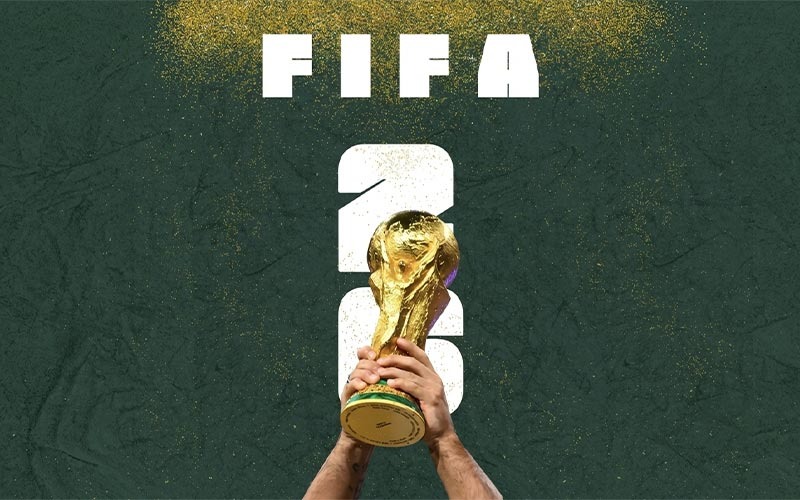
The FIFA World Cup 2026: The Greatest Sporting Spectacles on Earth?
Every four years, the world pauses. And every four years, I wait.
Wars do not stop, economies do not cease functioning, and politics continue their relentless march. Yet for a month, billions of people across continents become united by a single event. Streets empty, offices become quieter, and nations hold their collective breath - not just for ninety minutes, but often through extra time, penalties, and moments that seem to stretch into eternity.
That is the magic of the FIFA World Cup.
As someone who has followed football for years, I still do not know what to expect from the World Cup ahead. And that uncertainty is precisely what makes football so special. The beautiful game never ceases to surprise. Favourites stumble, underdogs rise, legends are born, and history is rewritten when least expected. In football, certainty is often the first casualty, and that is why billions remain captivated by it.
The World Cup is where giants fall without warning. France was humbled by Senegal, Germany collapsed against South Korea, Brazil suffered the unthinkable 7-1 defeat on home soil, Saudi Arabia shocked Messi's Argentina, and Morocco dared to dream beyond every limit placed upon them. It is this beautiful unpredictability that transforms the World Cup from a tournament into a global obsession.
The excitement is immense, but so is the disruption. Living in India means many of the matches in the 2026 World Cup will kick off late at night or continue into the early hours of the morning. And if history is any guide, I will almost certainly convince myself that missing a crucial match is simply not an option.
My biggest concern is not who will lift the trophy or which star player will shine brightest. It is my sleep cycle.
Only the Olympic Games surpass it in scale and global reach. Yet there is a compelling argument that the FIFA World Cup is the most emotionally powerful sporting event on Earth. Unlike the Olympics, where hundreds of disciplines compete for attention, the World Cup revolves around a single sport and a single trophy. Every fan, every nation, and every player shares one dream.
The 2026 FIFA World Cup, hosted jointly by the United States, Canada, and Mexico, represents a historic moment in the evolution of the tournament. It will be the largest World Cup ever held, featuring 48 teams, 104 matches, and 16 host cities across North America. It is the first World Cup to be hosted by three nations and the first to expand beyond the 32-team format that has existed since 1998.
Bigger Than Ever Before
The numbers alone are staggering.
For the first time in history, 48 nations will compete for football's ultimate prize, an increase from the 32 teams that participated in Qatar 2022. The tournament will feature 104 matches over 39 days, compared to 64 matches in previous editions. Twelve groups of four teams will battle for a place in an expanded knockout stage featuring 32 teams.
Supporters of the expansion argue that it democratizes the World Cup.
For decades, football's biggest stage was dominated by traditional powers from Europe and South America. The new format provides greater opportunities for emerging football nations from Asia, Africa, Oceania, and North America to participate and gain invaluable experience. Countries that previously found qualification nearly impossible now have a realistic pathway to the tournament.
From a global development perspective, this is undoubtedly positive.
Football is no longer a sport dominated solely by Brazil, Germany, Argentina, and France. Nations such as Morocco, Japan, South Korea, Senegal, and the United States have demonstrated that the gap between traditional and emerging powers is narrowing.
The Debate Over Expansion
Yet the expansion also raises legitimate concerns.
One of the reasons the World Cup has maintained its prestige is its exclusivity. Qualification has always been brutally difficult. Every World Cup featured stories of major nations falling short before the tournament even began.
Critics fear that increasing the number of participants may dilute the quality of the group stage. More matches could mean more one-sided contests and less of the drama that made qualification so meaningful.
However, football's history suggests caution before dismissing newcomers.
Many of today's football powers were once considered outsiders. Croatia reached the semi-finals in its first World Cup appearance as an independent nation. Morocco became the first African team to reach a World Cup semi-final in 2022. Underdogs often produce the stories that define tournaments.
The World Cup has always thrived on unpredictability.
A Tournament of Continents
Perhaps the most fascinating aspect of World Cup 2026 is its geography.
The tournament will span three countries, sixteen cities, and thousands of kilometres.
Mexico will become the first nation in history to host three men's World Cups, having previously staged the tournament in 1970 and 1986. The United States returns as a host after the highly successful 1994 edition that transformed soccer's commercial future in North America. Canada, meanwhile, hosts the men's tournament for the first time.
This tri-national hosting arrangement reflects football's transformation into a truly global industry.
No previous World Cup has attempted logistics on this scale. Organizers must coordinate transportation, security, accommodation, broadcasting, and fan experiences across three sovereign nations and multiple time zones. Security officials have already described preparations as among the most complex in sporting history.
The Last Dance for a Generation?
The World Cup has always been a ruthless stage where legends say goodbye and new heroes are born. In 2026, Messi and Ronaldo may arrive as the faces of the tournament, but they are unlikely to define it. Their role may be that of poster men, living monuments to a glorious era that is drawing to a close.
The spotlight is already shifting.
A new generation is gathering at the gates, hungry to claim the throne. Kylian Mbappe is chasing immortality. Jude Bellingham and Kane carries the hopes of England. Jamal Musiala embodies Germany's revival. Vinicius Junior seeks to restore Brazil to football's summit. Pedri and Mikel dreams of leading Spain's next golden generation. And then there is Lamine Yamal, the teenage phenomenon who already plays with the confidence of a veteran and the imagination of a street footballer. But World Cups are seldom written by scriptwriters. They belong to the unexpected - the goalkeeper who becomes a national hero, the substitute who changes history, the underdog who refuses to bow. For all we know, the next legend of 2026 may still be unknown to the world today.
For these players, World Cup 2026 is not merely another tournament. It is an audition for football's future.
History suggests that every great World Cup crowns a new king. Pele emerged in 1958. Maradona conquered the world in 1986. Ronaldo Nazario captivated a generation in 1998 and 2002. Messi completed his destiny in 2022.
Now the stage is set for another passing of the torch.
Somewhere across the 104 matches that await us, a young footballer will score a goal, produce a moment of genius, or lead his nation on an improbable run that changes the trajectory of his career forever. When the final whistle blows in July 2026, the game's hierarchy may look very different from the one we have known for the last twenty years.
And perhaps that is what makes this World Cup so compelling.
Why the World Cup Matters
The true significance of the World Cup cannot be measured through television ratings or ticket sales alone.
The tournament occupies a unique space in global culture.
For smaller nations, qualification itself becomes a source of national pride. For diaspora communities, the World Cup reconnects identities across continents. For children, it creates lifelong memories and heroes.
Football's simplicity is part of its strength.
Unlike many global sports, it requires minimal equipment. A ball and an open space are often enough. This accessibility allows football to transcend class, geography, language, and politics.
The World Cup therefore becomes more than a sporting competition. It becomes a global cultural event.
The Future of Football
World Cup 2026 may ultimately be remembered as a turning point.
It is the first truly modern mega-World Cup: larger, more inclusive, more commercialized, and more technologically sophisticated than any previous edition.
Its success or failure will influence how future tournaments are organized.
If the expanded format produces compelling football and new stories of emerging nations, FIFA's decision will be vindicated. If the tournament feels bloated and diluted, critics will argue that bigger is not always better.
Either way, the tournament represents a defining experiment in football's evolution.
Whether one considers it the second greatest sporting event after the Olympics or the greatest sporting event of all, there is little doubt that the FIFA World Cup occupies a unique place in human society.
It is where nations dream, legends are made, and history is rewritten.
The 2026 FIFA World Cup promises to be the largest, most ambitious, and perhaps most consequential tournament in football history. It will bring together 48 nations, billions of viewers, and an entire planet united by a common language: football.
For one month, the world will once again gather around a ball.
And that may be the most remarkable spectacle of all.
How I want it to end!
Argentina arrives as favourites. Now, without the burden of proving themselves, they possess perhaps the most complete squad in the tournament. Emiliano Martinez remains the dependable guardian capable of thriving under the pressure of penalty shootouts. Cristian Romero marshals the defence with authority, while Alexis Mac Allister and Enzo Fernandez provide intelligence, grit, and creativity in midfield. Julian Alvarez brings relentless energy and a striker's instinct, and Lautaro Martinez continues to be one of the most lethal finishers in world football.
And if Lionel Messi chooses to make his own fairytale script on football's grandest stage, the romance of destiny will once again surround Argentina.
Yet, what do we really know about this beautiful game? Let the game begin.
Disclaimer: The opinions expressed in this article are those of the author's. They do not purport to reflect the opinions or views of The Critical Script or its editor.
Sports Related Posts





Newsletter!!!
Subscribe to our weekly Newsletter and stay tuned.
Related Comments