


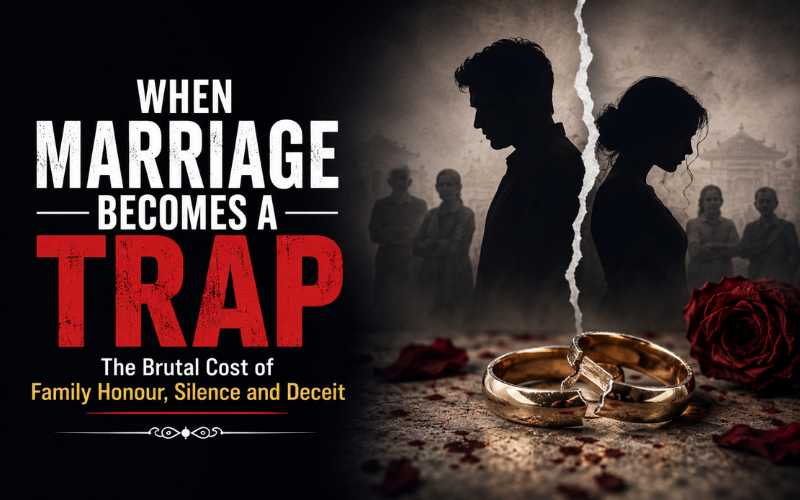
When Marriage Becomes a Trap: The Brutal Cost of Family Honour, Silence and Deceit
The alleged murders of Raja Raghuvanshi and Ketan Agarwal have horrified the country not merely because of their brutality, but because of the intimate betrayal at their core. In both cases, investigators allege that enemies, rivals or strangers did not kill the men, but by women they had trusted as life partners - women who, according to the police case, were involved with other men and saw marriage as an obstacle rather than a commitment.
These are allegations before the courts, and the law must take its course. But even at this stage, the broad social questions raised by these cases are too serious to ignore.
The first and most haunting question is also the simplest: why not just say no?
Why agree to an engagement or a marriage if your heart, your loyalties, and your future lie elsewhere? Why walk into a relationship, accept the trust of another family, participate in ceremonies, make plans, and exchange vows - only to allegedly turn that relationship into a carefully laid trap?
What was the fault of Raja Raghuvanshi? What was the fault of Ketan Agarwal? If the allegations are true, their only fault was trust - trust in a person, trust in a family arrangement, trust in the promise of a shared future.
It is tempting to see such cases as isolated acts of individual cruelty, the work of exceptionally cold-hearted people. That explanation is emotionally satisfying because it keeps the problem at a safe distance. It allows society to say: these were monsters, not mirrors. But that would be too easy. These crimes, or the conditions in which such crimes are conceived, do not emerge in a vacuum. They emerge in a social environment where marriage is often less about consent and compatibility and more about family prestige, caste comfort, business interests, social standing and community approval.
Across many affluent, tightly knit communities - particularly among families where caste, biradari, wealth and “reputation” still dictate marital choices - honesty is often the first casualty. Young men and women are told that marriage is not merely a personal decision but a family project. The “right” match is not necessarily the one they love, but the one that preserves status, expands business networks, pleases relatives, or remains safely within the accepted social fold. In such homes, the fear of disappointing parents often outweighs the moral courage required to tell the truth.
This is not to excuse murder. Nothing can excuse murder. The decision to allegedly deceive, conspire, and kill is a personal moral collapse for which the accused, if proven guilty, must bear the full weight of the law. But society must still ask what kind of culture produces so many people who find it easier to lie, manipulate, and live double lives than to simply refuse a marriage they do not want.
A disturbing pattern underlies these stories: the inability to say a clear, difficult, honest “no.” That “no” may come at a cost. It may invite emotional blackmail, family outrage, social gossip, temporary ostracism or even the collapse of carefully negotiated alliances. But those are the costs of truth. They are still infinitely less monstrous than the cost imposed on an innocent person who is drawn into a relationship under false pretences and then treated as disposable.
The larger failure here is not only legal or moral; it is cultural. We continue to raise children, especially in status-conscious families, to fear scandal more than dishonesty, to fear parental disapproval more than personal wrongdoing, and to fear social embarrassment more than the destruction of another person’s life. In such a world, appearances become sacred. A broken engagement is seen as shameful; a failed love affair is hidden; a relationship outside caste or community is treated as rebellion. The pressure to conform does not automatically produce violence, but it does create the ecosystem in which secrecy, emotional fraud, and calculated betrayal can thrive.
It is also important to resist turning this into a simplistic gendered script of “evil women” and “helpless men.” Men too have committed horrific crimes in the name of control, honour, and betrayal. But that cannot become an excuse to look away when men are the victims of alleged violence by women they trusted. Equality in moral judgment means exactly that: when a woman allegedly uses marriage as cover for manipulation or murder, society must condemn it with the same seriousness with which it condemns violence by men. Sympathy cannot be selective. Accountability cannot depend on gender.
The lesson from these cases, tragic as they are, is not simply that some individuals are capable of shocking cruelty. It is that our institutions of marriage and family remain riddled with dishonesty, coercion, and status anxiety. We still do not normalise the right to say no early, clearly and without shame. We still do not teach that rejecting a match, breaking an engagement, or defying family pressure is difficult but legitimate. Instead, too many people are taught to comply outwardly, conceal inwardly and improvise later.
That “later” can destroy lives.
A true introspection is needed, within families, within communities, and within the social imagination of marriage itself. No son or daughter should be pushed into a marriage they do not want. No family should treat caste, biradari, business convenience, or social standing as more important than free consent. And no individual should ever imagine that the solution to an unwanted relationship lies in deception, conspiracy, or violence.
If you do not want the marriage, say so. If you love someone else, say so. If your family refuses, resist them. Walk away, face the anger, endure the gossip, break the arrangement, start over if necessary. It may be painful. It may be messy. It may even be humiliating in the short term.
But it is still human.
What is inhuman is to let another person step into marriage believing he/she is entering a life, when in fact he/she is being led, unknowingly, toward betrayal.
Disclaimer: The opinions expressed in this article are those of the author's. They do not purport to reflect the opinions or views of The Critical Script or its editor.
Social Related Posts












Newsletter!!!
Subscribe to our weekly Newsletter and stay tuned.
Related Comments