


 INDIA ASIAN GAMES MEDAL MONITOR
·
India: 🥇 0
| 🥈 0
| 🥉 0
| Total: 0
INDIA ASIAN GAMES MEDAL MONITOR
·
India: 🥇 0
| 🥈 0
| 🥉 0
| Total: 0
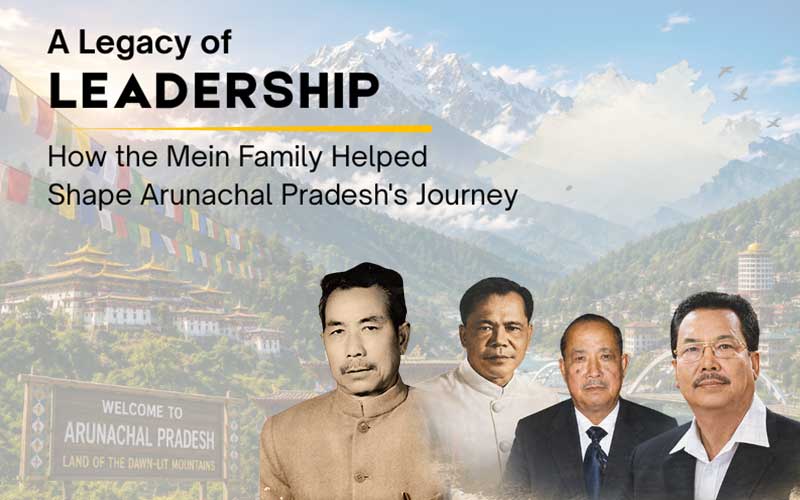
A Legacy of Leadership: How the Mein Family Helped Shape Arunachal Pradesh's Journey
The history of Arunachal Pradesh is a remarkable journey of political evolution, administrative transformation, and constitutional integration. From its early administration as the North-East Frontier Tracts under British India to its emergence as the 24th State of the Republic of India on 20 February 1987, the region witnessed a series of significant institutional and democratic milestones that laid the foundation for modern governance.
Parallel to this transformation, a number of visionary leaders played a pivotal role in shaping the political, social, and administrative landscape of the frontier region. Among them, the Mein family occupies a distinguished place in the history of the former North-East Frontier Agency (NEFA) and present-day Arunachal Pradesh. From the formative years of the North-East Frontier Agency (NEFA) to the modern era of infrastructure, cultural revival and economic transformation, members of the family have remained closely associated with the political and developmental journey of the state.
Today, Deputy Chief Minister Chowna Mein represents the continuation of that legacy. Yet, his public life is not merely an inheritance of political tradition; it is defined by a vision that seeks to balance rapid development with the preservation of Arunachal Pradesh's rich cultural heritage and ecological wealth.
A Family at the Foundation of Arunachal Pradesh
Long before Arunachal Pradesh became a full-fledged state in 1987, the region was administered as the North-East Frontier Agency (NEFA). During this formative period, the foundations of democratic governance were gradually being laid, and the Mein family emerged among the early contributors to public life.
Chowna Mein's father, Late Chow Pook Mein (Gohain), was one of the founding political figures of the region. Elected to the first Agency Council in 1969, he served until 1972, a pivotal year when NEFA was renamed Arunachal Pradesh and became a Union Territory. At a time when representative institutions were still evolving, leaders like Chow Pook Gohain helped establish the democratic framework upon which the state's governance would later be built.
His contributions extended beyond politics. In 1948, he established a sawmill at Sunpura, making him one of the earliest entrepreneurs and widely regarded as the first industrialist in present-day Arunachal Pradesh. At a time when industrial activity in the region was almost non-existent, his initiative reflected an early understanding that economic development and employment generation would be essential for the region's future.
Public service was deeply rooted across the extended family.
Chowna Mein's maternal uncle, Late Chow Khamoon Namchoom (Gohain), became the first Member of Parliament to represent the entire NEFA after being nominated by the President of India in 1952. He was re-nominated for a second term in 1957, serving as the region's voice in the national Parliament during the crucial years immediately after Independence.
Another maternal uncle, Late Chow Chandret Namchoom (Gohain), later represented the region in the Fifth Lok Sabha, continuing the family's engagement with national politics.
His elder brother, Late Chow Tewa Mein, was elected to the Pradesh Council in 1972. When the Council was transformed into the Provisional Legislative Assembly in 1975, he became one of its members before being elected to the first Legislative Assembly of Arunachal Pradesh in 1978 from the Namsai-Chongkham constituency. He later served as a minister in the state government.
Across three generations, the Mein family has therefore remained closely connected with the political evolution of Arunachal Pradesh from the Agency Council and Parliament to the Legislative Assembly and the present government.
Carrying Forward the Legacy
Born into this distinguished lineage, Chowna Mein entered politics at a relatively young age but gradually established an identity distinct from that of his predecessors.
He has often spoken about the importance of identity and heritage, once remarking: "I am extremely proud to be an Arunachalee and a Tai Khamti. Your identity is your perception of who you are."
The statement reflects a philosophy that has shaped much of his public life. While pursuing economic growth and infrastructure development, he has consistently emphasised the need to preserve Arunachal Pradesh's indigenous cultures, languages, traditions and historical memory.
Over more than three decades in public office, he has become one of the state's longest-serving political leaders, holding important portfolios including Speaker of Arunachal Pradesh Legislative Assembly, Education, PHE&WS, RWD, PWD, Agriculture & Allied, Finance, Planning & Investment, Power, Non-Conventional Energy Resources, Tax & Excise, and becoming the longest incumbent Deputy Chief Minister of the country since 2016.
As an Education Minister, he was instrumental in bringing the only Central University to the State by converting Arunachal University to a Central University.
Driving Economic Transformation
Among Chowna Mein's most significant contributions has been his advocacy for harnessing Arunachal Pradesh's vast hydropower potential.
With an estimated capacity of nearly 58,000 MW, almost 40 per cent of India's total hydropower potential, the state possesses one of the country's greatest renewable energy resources. For years, however, much of this remained untapped.
Under his leadership, Arunachal Pradesh has pursued major hydropower partnerships with central public sector enterprises such as NHPC, NEEPCO, THDC India Limited and SJVN. Most of these projects are under implementation, and some are under various stages of development which are expected to be launched soon. These projects have attracted investments worth several lakh crore rupees while generating substantial long-term revenue for the state.
He has consistently argued that hydropower should not merely produce electricity but should become an engine of socio-economic development through infrastructure creation, employment generation, revenue sharing and community development.
Alongside power generation, he has also focused on strengthening transmission networks, improving rural electrification and modernising the state's energy infrastructure.
Championing Fiscal Discipline
As Finance Minister for several years, Chowna Mein played a significant role in improving Arunachal Pradesh's fiscal management.
His budgets have consistently emphasised capital investment, infrastructure development, agriculture, education, healthcare, youth empowerment and social welfare. Under his stewardship, the state has introduced reforms aimed at strengthening financial transparency, improving revenue generation and ensuring that public expenditure translates into tangible developmental outcomes.
He has also encouraged participatory governance through citizen consultations in the budget-making process, reflecting a broader effort to make public policy more inclusive.
Preserving Culture and Identity
Perhaps one of the defining aspects of Chowna Mein's leadership has been his commitment to preserving Arunachal Pradesh's cultural diversity. In his budget speech in 2021-22, he called for ‘acceptance of modernity with adherence to traditions’, emphasizing the importance of preservation of age-old traditions and culture.
He was instrumental in introducing the Gurukul System of Education in the State, promoting indigenous culture, Agri-Horti, handlooms and handicraft products, facilitating GI registration of more than 20 products of the State.
He has advocated for preservation and promotion of each and every tribe of Arunachal Pradesh, Oral literature, research & documentation of our age-old rich cultural practices.
He initiated documentation of the ‘spiritual healing system of Idu-Mishmi ’, which is nearing completion.
As a member of the Tai Khamti community, he has actively supported the preservation of the Tai Khamti script, literature and Buddhist traditions through institutions such as the Tai Khamti Heritage and Literature Society.
He has also played a leading role in promoting the International Maha Sangken Festival at Namsai, transforming a traditional Tai Khamti New Year celebration into an internationally recognised cultural event that attracts visitors from across India and abroad.
Similarly, under his patronage, the Arunachal Rang Mahotsav has emerged as an important platform for theatre, indigenous storytelling and cultural exchange, providing opportunities for artists while strengthening public awareness of Arunachal Pradesh's history and traditions.
Restoring Forgotten History
Recognising that many important figures in Arunachal Pradesh's history remained absent from mainstream narratives, Chowna Mein spearheaded efforts to document the lives of the state's unsung heroes.
Under his chairman as the Core Committee for Unsung Heroes of Arunachal Pradesh, extensive research work have been carried out engaging research scholars to collect archival materials and documents from National Museum, British Library in the UK to identify freedom fighters, community leaders and indigenous heroes whose contributions had long remained overlooked as a result of which more than 220 Unsung Heroes including freedom fighters and martyrs of the State have been identified.
The initiative has helped preserve oral histories, archival records and traditional knowledge, ensuring that future generations inherit a more complete understanding of their State's past.
Promoting Tourism and Spiritual Heritage
Chowna Mein has also been instrumental in promoting Arunachal Pradesh as a destination for cultural, historical and spiritual tourism.
The Golden Pagoda at Namsai has evolved into one of Northeast India's most prominent Buddhist pilgrimage centres, while major projects such as the Vajirasana Buddha Vihara, the 108-foot Buddha Statue and the Mahabodhi Sanghavasa have further strengthened the region's spiritual landscape.
Beyond Buddhist tourism, he has advocated for the development of heritage circuits centred on the historic Stilwell Road, Pangsau Pass and World War II sites, recognising tourism as an important avenue for economic growth and cultural exchange.
Revitalising Parshuram Kund as a Global Spiritual Destination
Among Chowna Mein's notable contributions has been his sustained effort to transform Parshuram Kund, one of Northeast India's most revered Hindu pilgrimage sites, into a world-class spiritual and cultural destination. Located in Lohit district, the sacred site attracts thousands of devotees every year, particularly during the annual Makar Sankranti pilgrimage.
Recognising its immense religious, cultural and tourism potential, Chowna Mein has consistently advocated for the holistic development of Parshuram Kund. Under his leadership, major infrastructure initiatives have been undertaken to improve road connectivity, pilgrim amenities, accommodation facilities and visitor experience while preserving the site's ecological and spiritual significance.
A landmark initiative is the installation of a 51-foot statue of Lord Parshuram. The towering statue has become an iconic symbol of the pilgrimage centre, enhancing its appeal as a spiritual landmark and boosting religious tourism in the region.
Development with Sustainability
Unlike conventional models of development that focus solely on infrastructure, Chowna Mein has consistently advocated a balance between economic progress and environmental conservation.
His support for biodiversity conservation, river restoration, eco-tourism, water conservation and community-based environmental initiatives reflects an understanding that Arunachal Pradesh's forests, rivers and mountains constitute not only ecological assets but also cultural and economic resources.
This approach has become increasingly relevant as the state seeks to expand infrastructure while preserving one of the world's richest biodiversity hotspots.
Empowering the Next Generation
Youth empowerment has remained another central pillar of his governance.
Whether through entrepreneurship, sports infrastructure, skill development, education or campaigns against substance abuse, Chowna Mein has repeatedly emphasised that young people must become active participants in shaping Arunachal Pradesh's future rather than passive beneficiaries of government programmes.
His declaration of 2024 as the "Year of the Youth" symbolised this commitment to creating opportunities for the next generation.
Reviving Arunachal's Cultural Spirit Through Arunachal Rang Mahotsav
Among Chowna Mein's most enduring cultural initiatives is the Arunachal Rang Mahotsav (ARM), a state-wide theatre movement that has redefined the role of performing arts in preserving Arunachal Pradesh's history, heritage and indigenous identity. Conceived as more than just a cultural festival, the Mahotsav has become a platform for storytelling, historical documentation and social dialogue.
As the Chief Patron of the festival, Chowna Mein has consistently championed theatre as a medium to reconnect younger generations with their roots. Under his guidance, the festival has showcased original productions inspired by Arunachal Pradesh's tribal traditions, folklore, freedom fighters, unsung heroes and contemporary social issues. The Mahotsav has also provided a much-needed platform for local youths as playwrights, actors, directors and technicians, creating opportunities for the state's creative community.
The festival has steadily grown in scale and recognition. Its productions have travelled beyond Arunachal Pradesh to cities such as New Delhi, Mumbai, Kolkata and Guwahati, introducing audiences across the country to the state's rich cultural narratives. The international editions have further expanded its reach by bringing together artists from India and abroad, fostering cultural exchange while positioning Arunachal Pradesh as an emerging hub for theatre and the performing arts in Northeast India.
Honoured in the World of Science
Chowna Mein's commitment to environmental conservation has earned him a rare distinction having two newly discovered plant species named in his honour by botanists.
In October 2025, scientists from the State Horticulture Research and Development Institute (SHRDI) discovered a new Begonia species in Basar, Leparada district, and named it Begonia Chowna Buku Chulu (Aryarakta), meaning "Noble Red," in honour of Deputy Chief Minister Chowna Mein. The species, distinguished by its striking crimson-red foliage, was named in recognition of his pivotal role in strengthening research and innovation in Arunachal Pradesh's agriculture and horticulture sectors, including the establishment of SHRDI in 2015.
The recognition was followed by another scientific honour in 2026, when researchers discovered Ophiorrhiza chownai, a critically endangered flowering plant endemic to the wet evergreen forests of Lower Dibang Valley. Belonging to the Rubiaceae (coffee) family and with fewer than 200 individuals recorded in the wild, the species was named after Chowna Mein in acknowledgement of his continued support for biodiversity conservation and environmental stewardship.
A Distinguished Political Journey
Building upon a rich legacy of public service, Chowna Mein has carved out a political career defined by experience, continuity and visionary leadership. First elected to the Arunachal Pradesh Legislative Assembly in 1995 from the Lekang Assembly Constituency, he has since earned the trust of the people through successive electoral victories, making him one of the state's most experienced and longest-serving legislators.
Over nearly three decades in public life, Chowna Mein has held several key portfolios, including Planning & Investment, Finance, Power, Education, PWD, RWD, PHE&WS, Agriculture & allied, Non-Conventional Energy Resources, Tax & Excise, where he has played a pivotal role in shaping the State's fiscal policies, strengthening energy infrastructure, and driving developmental initiatives. His administrative acumen and steady leadership have contributed significantly to Arunachal Pradesh's progress across multiple sectors.
In 2016, he assumed office as the Deputy Chief Minister of Arunachal Pradesh, ushering in a new phase of collaborative governance and development. In 2024, he created history by taking oath as Deputy Chief Minister for a third consecutive term, becoming one of the longest-serving Deputy Chief Ministers in India's political history. His continuity in office reflects not only the confidence reposed in him by the people and his party but also the administrative stability that has supported Arunachal Pradesh during a period of rapid infrastructure growth, economic transformation and institutional reforms.
Throughout his political journey, Chowna Mein has consistently advocated for inclusive development, prudent financial management, cultural preservation and sustainable progress. His leadership continues to bridge Arunachal Pradesh's rich historical legacy with its aspirations for a modern and prosperous future.
A Legacy Still Being Written
The story of the Mein family mirrors the story of Arunachal Pradesh itself, from the early days of democratic institution-building under NEFA to the state's emergence as an important frontier of India's economic and strategic development.
Beginning with pioneers such as Chow Pook Gohain Mein, Chow Khamoon Gohain, Chow Chandret Gohain and Chow Tewa Mein, the family's contributions span politics, entrepreneurship, governance and public service.
Chowna Mein has carried that legacy into the twenty-first century, adapting it to contemporary challenges through infrastructure development, financial reforms, cultural preservation, renewable energy, tourism, environmental conservation and youth empowerment.
While history will ultimately judge the long-term impact of his policies, there is little doubt that his leadership has played a significant role in shaping the trajectory of modern Arunachal Pradesh. His journey reflects not only the continuation of a distinguished family legacy but also an enduring commitment to building a state that is economically vibrant, culturally confident and firmly rooted in its identity.
Disclaimer: The opinions expressed in this article are those of the author's. They do not purport to reflect the opinions or views of The Critical Script or its editor.
Social Related Posts






Newsletter!!!
Subscribe to our weekly Newsletter and stay tuned.
Related Comments