


 INDIA ASIAN GAMES MEDAL MONITOR
·
India: 🥇 0
| 🥈 0
| 🥉 0
| Total: 0
INDIA ASIAN GAMES MEDAL MONITOR
·
India: 🥇 0
| 🥈 0
| 🥉 0
| Total: 0
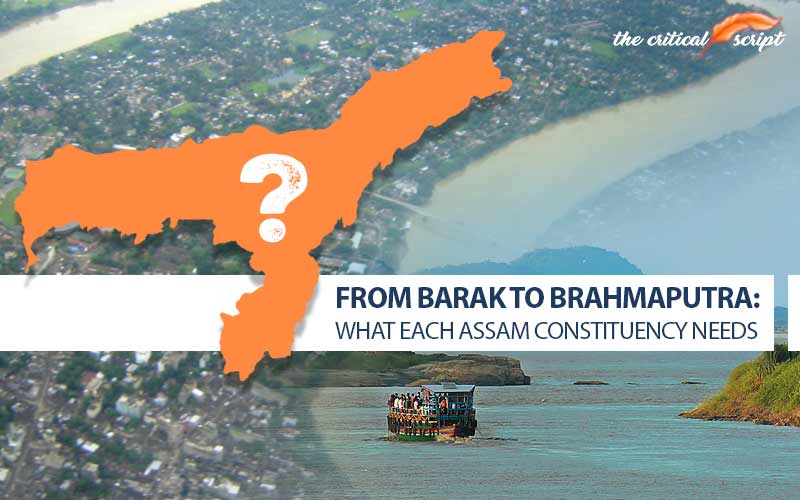
From Barak to Brahmaputra: What Each Assam Constituency Needs
In Assam, politics is not fought solely in capitals or party offices; it is shaped across 126 Assembly constituencies, each with its own geography, demography, and demands. The Assam Legislative Assembly, housed in Dispur, represents these 126 voices through directly elected representatives, forming the backbone of governance in the state.
But beneath this democratic structure lies a deeper truth: Assam is not one development story; it is 126 parallel realities.
From Gossaigaon and Kokrajhar in the Bodoland belt to Silchar and
Karimganj in Barak Valley, and from Dibrugarh and Tinsukia in Upper Assam to
Dhubri and Goalpara in the west, each constituency reflects a distinct set of
needs.
The Political Geography of Inequality
The current map of Assam’s constituencies, finalised after delimitation, retains 126 seats, a number unchanged since 1972, with reserved constituencies for Scheduled Castes and Scheduled Tribes reflecting the state’s diversity.
Yet, uniform representation has not translated into uniform development.
Upper Assam: Resource-Rich, Future-Uncertain
Constituencies such as Dibrugarh, Chabua-Lahowal, Duliajan, Tinsukia, Naharkatia, and Tingkhong sit atop Assam’s oil and tea wealth. Nearby seats like Sivasagar, Nazira, Mahmora, and Sonari carry the legacy of Ahom history.
These regions have:
·
Strong industrial presence
· Better access to education and
healthcare
But they also face:
·
Annual flooding along the Brahmaputra
·
Soil erosion threatens livelihoods
· Youth migration despite local
resources
The paradox is stark: Economic
wealth without long-term security.
Lower Assam: Where Population Meets Precarity
In western Assam, constituencies like Dhubri, Gauripur, Bilasipara,
Mankachar, Jaleshwar, Goalpara West, and Goalpara East exist in a constant
negotiation with the river.
Further east, Abhayapuri, Bongaigaon, Bijni, and Sidli-Chirang represent
a mix of agrarian and tribal belts.
Here, the realities are different:
·
High population density
·
Riverine (char) settlements vulnerable to displacement
· Limited healthcare and
education infrastructure
For these constituencies, the central issue is survival:
Flood control is not policy; it is a
necessity.
Central Assam: The Demographic Engine
The constituencies of Nagaon, Dhing, Rupahihat, Hojai, Lumding, and Morigaon form the demographic heart of Assam.
This region is politically influential and economically active, but also
under strain:
·
Rapid urbanisation without planning
·
Rising unemployment among youth
· Pressure on land and public
services
Even agriculturally strong constituencies like Samaguri and Kaliabor are
witnessing transitions from rural to semi-urban economies.
Central Assam is no longer rural but not yet urban:
It is a region in transition, struggling to
keep pace with itself.
Barak Valley: Identity at the Margins
The southern constituencies, Silchar, Sonai, Udharbond, Katigorah, Borkhola, Hailakandi, Algapur-Katlicherra, Karimganj North, Karimganj South, Patharkandi, and Ram Krishna Nagar, present a different narrative.
Barak Valley is marked by:
·
Strong linguistic and cultural identity
· Educational institutions and
literacy pockets
Yet it continues to face:
·
Poor connectivity with the Brahmaputra Valley
·
Limited industrial development
· Perception of political neglect
The region’s core demand is simple:
Integration without losing identity.
Hill and Tribal Constituencies: The Untapped Frontier
In constituencies like Diphu, Bokajan, Howraghat, Rongkhang, Amri, and Haflong, governance operates in a completely different terrain both literally and politically.
Similarly, the Bodoland Territorial Region includes seats like Kokrajhar,
Dotma, Baokhungri, and Parbatjhora.
These areas possess:
·
Rich biodiversity
·
Cultural depth
· Tourism potential
But face:
·
Weak connectivity
·
Limited institutional reach
· Employment challenges
Here, development is not about expansion; it is about access.
Urban Constituencies: Growth Without Planning
In and around Guwahati, constituencies like Dispur, Jalukbari, and Panbazar (Paltan Bazaar region) represent Assam’s urban aspirations.
These seats benefit from:
·
Administrative presence
·
Better infrastructure
· Economic activity
Yet they struggle with:
·
Chronic waterlogging
·
Traffic congestion
· Unplanned expansion
· Urban Assam’s biggest challenge is clear: Growth has outpaced governance.
What Unites All 126 Constituencies
Despite their diversity, a few themes cut across Assam:
· 🌊 Flood and erosion from Dhubri to Majuli
·
🚧 Infrastructure gaps from Hailakandi to Haflong
· 👨🎓 Youth migration from Tinsukia
to Nagaon
·
🏥 Uneven healthcare access
· 🌐
Connectivity as the ultimate divider
Each constituency experiences these differently, but none are untouched.
Beyond One-Size-Fits-All Governance
The idea that Assam can be governed through a single development model is increasingly outdated.
What Gossaigaon needs is not what Silchar demands.
What
works in Dibrugarh may fail in Mankachar.
The future lies in:
·
Constituency-specific planning
·
Regionally tailored policies
· Decentralised governance
A State of 126 Realities
From the tea gardens of Mariani and Titabor to the river islands of Majuli, from the hills of Haflong to the floodplains of Barpeta and Dhubri, Assam is a state defined by diversity not just of culture, but of need.
The map of Assam is not just political; it is deeply human.
To understand Assam is to understand its constituencies. And to develop
Assam is to listen to all 126 of them.
Disclaimer: The opinions expressed in this article are those of the author's. They do not purport to reflect the opinions or views of The Critical Script or its editor.
Politics Related Posts










Newsletter!!!
Subscribe to our weekly Newsletter and stay tuned.
Related Comments