


 INDIA ASIAN GAMES MEDAL MONITOR
·
India: 🥇 0
| 🥈 0
| 🥉 0
| Total: 0
INDIA ASIAN GAMES MEDAL MONITOR
·
India: 🥇 0
| 🥈 0
| 🥉 0
| Total: 0
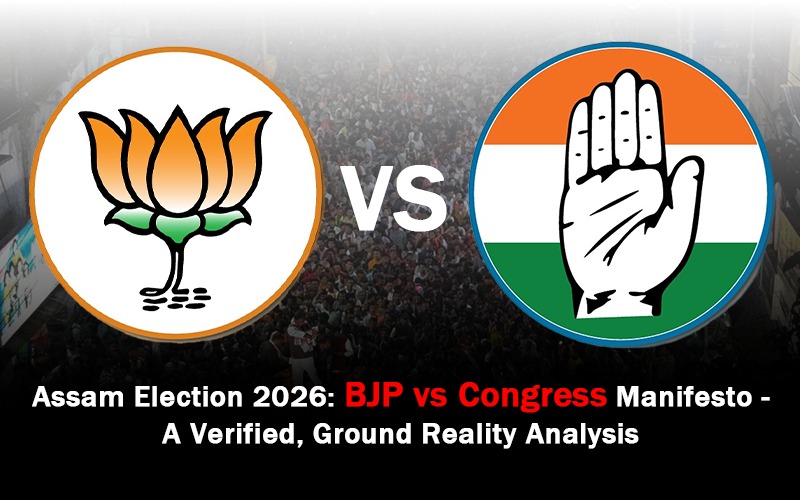
Assam Election 2026: BJP vs Congress Manifesto - A Verified, Ground Reality Analysis
The 2026 Assam Assembly election, scheduled for April 9 with counting on May 4, is shaping up as a contest between two sharply contrasting political visions. A careful review of recent news reports, manifesto announcements, and campaign narratives shows that while both parties promise development, their priorities and strategies differ significantly.
BJP Manifesto: Strong on Identity, Infrastructure and Growth
Recent verified reports confirm that the BJP’s “Sankalp Patra” is built around three pillars: identity protection, economic expansion, and governance continuity.
Key Confirmed Promises (Fact-Checked)
·
2 lakh government jobs and broader employment generation
initiatives
·
Support for entrepreneurship and startups (around 10 lakh
beneficiaries)
·
Target to expand Assam’s economy to $150 billion by 2031
·
Massive ₹5 lakh crore infrastructure
push, including roads, rail, and airports
·
Investment of ₹50,000 crore in healthcare
Identity & Political Issues
·
Implementation of stricter anti-infiltration measures
·
Proposal to revive the Immigrants (Expulsion from Assam) Act, 1950
·
Commitment to reclaim encroached land
·
Push for Uniform Civil Code (with exemptions for tribal areas)
Reality Check:
These are consistent with the BJP’s long-standing political positioning in
Assam—especially around immigration, land, and indigenous identity, which
remain central election issues.
Congress Manifesto: Welfare Guarantees, Inclusion and Political Counter-Narrative
Compared to BJP, the Congress manifesto is less detailed in publicly reported specifics, but key elements are confirmed.
Key Confirmed Elements
·
Introduction of “5 guarantees” model (similar to other states)
·
Focus on social and economic welfare promises
·
Manifesto shaped through statewide public consultation across
districts
Political Positioning
·
Emphasis on inclusive development and social harmony
·
Criticism of the BJP on issues like land, identity politics, and
governance
·
Focus on people-centric policies rather than large-scale capital
projects
Reality Check:
Unlike the BJP, Congress has not yet publicly released a fully detailed,
sector-wise manifesto breakdown in media coverage, which indicates either:
·
a strategic flexibility, or
·
a lack of clarity compared to the BJP’s structured roadmap
This gap is also being pointed out in the political analysis of the opposition’s campaign.
Core Difference: Development Model vs Welfare Model
Based on verified data:
·
BJP is pushing a growth-driven, investment-heavy model
·
Congress is leaning toward a welfare-guarantee model
This mirrors national-level political patterns.
Key Election Issues (Cross-Verified Across Sources)
Across news reports and campaign coverage, the following issues dominate:
·
Illegal immigration and NRC/CAA debate
·
Land encroachment and eviction drives
·
Employment and youth opportunities
·
Infrastructure vs displacement concerns
·
Welfare vs growth debate
These issues are reflected in both manifestos but approached differently.
What Social & Political Signals Suggest (Ground Reality)
From media reports and campaign trends:
·
BJP is running a highly structured, policy-heavy campaign backed
by its governance record
·
Congress is relying more on alliances, guarantees, and an
anti-incumbency narrative
·
BJP’s messaging is clear and consistent
·
Congress messaging is broader but less sharply defined in policy
terms
Accuracy Verdict (Important)
Here is the honest fact-check summary:
·
BJP manifesto details are well-documented, specific, and publicly
verified across multiple sources
·
The Congress manifesto is confirmed to exist, but lacks a detailed
public breakdown in mainstream reporting so far
·
Many claims circulating on social media about Congress's promises
are not fully verifiable yet
This means:
·
BJP = high clarity, high specificity
·
Congress = broad promises, limited verified detail (so far)
Final Analytical Conclusion
The Assam election is not just a political contest; it is a choice between two governance models:
·
BJP is asking voters to choose continuity, identity protection,
and economic expansion
·
Congress is asking voters to choose welfare guarantees,
inclusivity, and political change
Beyond Manifestos, the Ground Reality Must Decide Assam’s Future
But elections are rarely decided on paper alone.
Manifestos represent intent, not necessarily delivery. The real test of governance lies not in promises made, but in what people have experienced on the ground over the past years. Voters across Assam, from Guwahati to Upper Assam, from Barak Valley to remote rural districts, have lived through the realities of policies, development projects, welfare schemes, and administrative decisions.
In a State where concerns around land rights, identity, economic opportunity, and governance remain deeply personal, voters must look beyond political narratives and campaign rhetoric.
The 2026 election is not simply a choice between two manifestos. It is a choice based on lived experience, accountability, and trust.
Ultimately, the future of Assam will not be shaped by the promises written in documents but by the ground realities that its people see, feel, and live every day.
Disclaimer: The opinions expressed in this article are those of the author's. They do not purport to reflect the opinions or views of The Critical Script or its editor.
Politics Related Posts







Newsletter!!!
Subscribe to our weekly Newsletter and stay tuned.
Related Comments