


 INDIA ASIAN GAMES MEDAL MONITOR
·
India: 🥇 0
| 🥈 0
| 🥉 0
| Total: 0
INDIA ASIAN GAMES MEDAL MONITOR
·
India: 🥇 0
| 🥈 0
| 🥉 0
| Total: 0
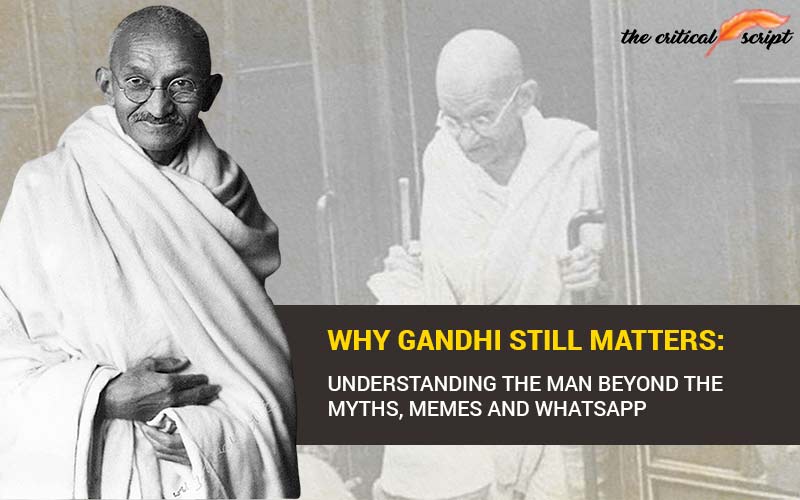
Why Gandhi Still Matters: Understanding the Man Beyond the Myths, Memes and WhatsApp Forwards
“He was no saint but a man who wrestled with his own
frailties to serve something larger than himself.”
Rajmohan Gandhi (The Good
Boatman, 1995)
Mahatma Gandhi remains one of the most talked about and least understood figures in modern history. In today’s age of instant opinions, memes and WhatsApp University forwards, he is ridiculed far more than he is read. The tragedy is not that people disagree with Gandhi but that they disagree with a Gandhi they have never encountered in any credible text. To restore clarity, one must return to what the most respected scholars have written: Ramachandra Guha’s layered historical analysis, Rajmohan Gandhi’s psychologically rich portrait, Judith M. Brown’s political realism, and the global scholarship that connects Gandhi to movements across continents.
Understanding why Gandhi still matters requires seeing him as a human being who grew, erred, battled his contradictions and still dared to hold a nation’s moral imagination together.
Gandhi Before India: The Making of a Radical in South Africa
Ramachandra Guha’s Gandhi Before India (Guha 2013) reveals the formative years that shaped Gandhi’s political vocabulary. His experiences in South Africa exposed him to racial injustice, civic humiliation and community disunity. It was there that he developed satyagraha, experimented with collective discipline and began crafting a new grammar of resistance. Guha’s work demonstrates how Johannesburg and Durban served as the laboratory where Gandhi transformed moral conviction into political method. These early years, often forgotten in popular discourse, shaped the Gandhi who later shook the British Empire.
The Good Boatman: Gandhi’s Moral Courage in Moments of Turmoil
Rajmohan Gandhi’s The Good Boatman (Rajmohan Gandhi 1995) brings out a Gandhi who not only reasoned but felt deeply. The biographer’s most compelling chapters describe Gandhi’s work during the violence of 1946 and 1947. While India prepared to celebrate independence, Gandhi chose to walk through the riot-scarred villages of Noakhali, living among families shattered by communal hatred. Instead of standing on a podium in Delhi, he was walking barefoot from village to village, knocking on doors, pleading for forgiveness and urging people to see their shared humanity. Rajmohan Gandhi emphasises that Gandhi’s aura rested not on spiritual mystique but on moral proximity. He was present where the pain existed.
Gandhi: Prisoner of Hope and the Political Strategist
Judith M. Brown’s *Gandhi: Prisoner of Hope (Brown 1989) offers a different yet valuable perspective. For Brown, Gandhi was a political strategist constantly negotiating between internal disagreements within Congress, British repression and India’s own social fractures. She argues that Gandhi was a prisoner of hope because he refused to surrender to despair even when the political field seemed stacked against him. This hope was not naïve idealism but a deliberate discipline. Brown’s interpretation resonates powerfully in an age when cynicism is often celebrated.
The Years That Changed India: The Nation Builder
In Gandhi: The Years That Changed India (Guha 2022), Guha chronicles Gandhi’s role in turning the freedom struggle into a mass movement. Gandhi drew ordinary Indians into politics by emphasising dignity, decentralised power, self-reliance and social reform. He challenged caste discrimination, promoted khadi as an economic weapon, encouraged Hindu Muslim harmony and nurtured democratic ethics long before independence. Many of these values, especially ecological restraint and community self-sufficiency, appear remarkably relevant today as the world confronts climate change and fragmented societies.
Gandhi Was Not Perfect: The Flawed Father and the Human Being
Any honest evaluation must acknowledge Gandhi’s flaws. His personal life, especially his relationship with his eldest son Harilal, reveals emotional blind spots. Harilal’s struggles with direction and identity, his resentment toward his father’s control, and his eventual spiral into alcoholism are documented by multiple biographers including Guha (Guha 2013) and Rajmohan Gandhi (1995). Gandhi’s inability to bridge the emotional gulf between him and his son shows how his public moral clarity did not always translate into private sensitivity.
His controversial brahmacharya experiments have also been widely scrutinised. Brown (1989) and Guha (2013) contextualise these practices within Gandhi’s lifelong ascetic discipline, though both note that they unsettled even his closest associates.
Gandhi’s strict rules within his ashrams, including harsh dietary expectations, celibacy, labour discipline and his tendency to dominate decision making, reveal an authoritarian streak. This contrasted with his strong advocacy of democratic participation at the national level. These contradictions remind us that Gandhi was not a flawless saint but a complex human being wrestling with his own ideals and limitations.
Ridicule Without Reading: The Tragedy of WhatsApp History
Gandhi has increasingly become a target of ridicule from individuals who have neither read his writings nor engaged with serious scholarship. Complex historical debates are flattened into WhatsApp forwards, memes and half truths. His disagreements with Ambedkar, his nuanced view of caste reform, his experiments in celibacy and his moral philosophy are routinely misrepresented.
This phenomenon reflects an intellectual decline where propaganda replaces reading. Criticising Gandhi is valid and necessary. Criticising a distorted caricature is not. Without an understanding of the historical Gandhi, public opinion becomes vulnerable to manipulation.
The Global Gandhi: A Legacy That Shaped Civilisations
Gandhi’s impact extended far beyond India. Martin Luther King Jr. drew deeply from Gandhi’s philosophy of nonviolent resistance. In his work Stride Toward Freedom (King 1958), King acknowledged Gandhi as the guiding force behind the American Civil Rights Movement.
Nelson Mandela recognised Gandhi as foundational to South Africa’s struggle against apartheid. In Long Walk to Freedom (Mandela 1994), Mandela writes about Gandhi’s early activism in South Africa and how his emphasis on dignity, reconciliation and moral courage influenced later generations.
Leaders such as the Dalai Lama, Václav Havel and Aung San Suu Kyi also drew from Gandhian political ethics, demonstrating that despite cultural, regional and political variations, Gandhi’s ideas travelled across civilisations with astonishing continuity.
Final Thoughts: Gandhi’s Relevance in a Fractured World
Gandhi matters today because the world resembles precisely the kind of place he feared. Hatred spreads faster than truth, misinformation replaces reading, and many believe that strength is measured only in domination. Gandhi’s life suggests another possibility. He reminds us that courage can be nonviolent, that resistance can be ethical, and that truth can be a form of power. His walk through Noakhali during the horrors of partition remains one of the most powerful images of moral responsibility in modern history.
Gandhi does not matter because he lived in the past but because he still speaks to the present. His vocabulary of ethical politics, compassion, humility and democratic morality remains a toolkit for societies struggling with division. If we must critique Gandhi, let us do it through knowledge, not propaganda. If we must move beyond him, let us move beyond the real Gandhi, not the distorted shadows circulating online.
The world may continue to debate Gandhi but it still needs the moral imagination he offered.
References
Brown, Judith M. Gandhi:
Prisoner of Hope. 1989.
Guha, Ramachandra. Gandhi
Before India. 2013.
Guha, Ramachandra. Gandhi:
The Years That Changed India. 2022.
Gandhi, Rajmohan. The Good
Boatman. 1995.
King, Martin Luther Jr.
Stride Toward Freedom. 1958.
Mandela, Nelson. Long Walk to
Freedom. 1994.
Disclaimer: The opinions expressed in this article are those of the author's. They do not purport to reflect the opinions or views of The Critical Script or its editor.
National Related Posts







Newsletter!!!
Subscribe to our weekly Newsletter and stay tuned.
Related Comments