


 INDIA ASIAN GAMES MEDAL MONITOR
·
India: 🥇 0
| 🥈 0
| 🥉 0
| Total: 0
INDIA ASIAN GAMES MEDAL MONITOR
·
India: 🥇 0
| 🥈 0
| 🥉 0
| Total: 0
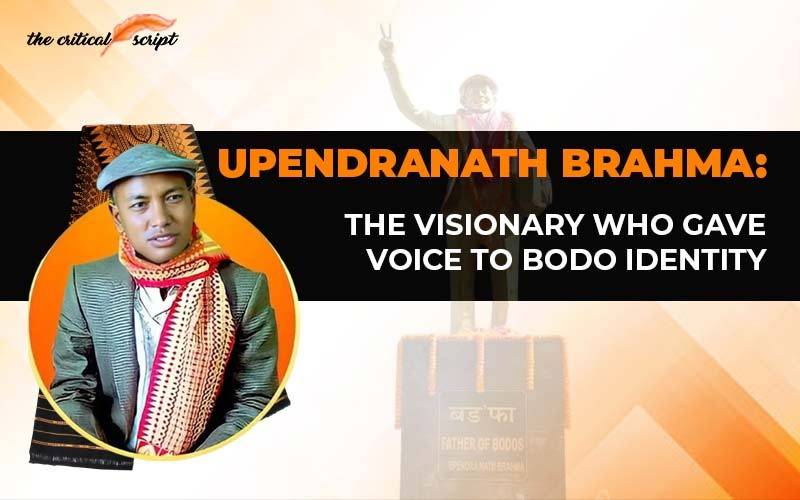
Upendranath Brahma: The Visionary Who Gave Voice to Bodo Identity
In the socio-political history of Assam, few leaders have left as deep and enduring an imprint as Upendranath Brahma. Revered as Bodofa, the Father of the Bodos, Brahma was not merely a political figure but a visionary who transformed a regional aspiration into a structured democratic movement. Though his life was tragically brief, his intellectual clarity, principled leadership, and unwavering commitment to his people continue to shape the trajectory of Bodo politics and identity.
 \
\
Roots in Rural Assam
Born on 31 March 1956 in Dotma village in present-day Kokrajhar
district, Upendranath Brahma grew up in a modest agrarian Bodo family. His
early years unfolded in a landscape marked by economic hardship, limited
educational infrastructure, and a growing sense of marginalisation among
indigenous communities. These lived realities deeply influenced his worldview.
Unlike many leaders who emerge from privilege, Brahma’s politics
was shaped by personal observation of rural deprivation, land alienation,
unemployment, and cultural neglect. The challenges faced by the Bodo community
were not abstract political issues for him, they were everyday realities.
Education as Empowerment
Academically inclined and intellectually rigorous, Brahma
pursued higher education with determination. After completing his schooling in
Kokrajhar, he graduated from Kokrajhar Government College and later obtained a
Master’s degree in Political Science from Gauhati University. His academic
training equipped him with a nuanced understanding of constitutional rights,
federalism, and democratic structures.
He strongly believed that education was the foundation of
empowerment. For Brahma, political power without literacy and social reform
would be hollow. This conviction would later become central to his leadership
philosophy.
Transforming Student Activism into a Mass Movement
Upendranath Brahma’s entry into public life began through
student activism. The All Bodo Students’ Union (ABSU), initially focused on
educational concerns, became the principal platform for broader socio-political
mobilisation under his leadership.
In 1986, he assumed the presidency of ABSU. The following year,
the organisation formally raised the demand for a separate state of Bodoland.
However, Brahma’s leadership stood apart in a turbulent era when several
movements in the Northeast were turning militant.
He insisted on constitutional and democratic means. His approach
combined mass mobilisation with political negotiation, emphasising dialogue
rather than violence. He framed the Bodoland demand not merely as a territorial
issue but as a struggle for dignity, identity, and socio-economic justice.
A Philosophy of Democratic Assertion
Brahma’s political philosophy rested on three pillars:
education, unity, and long-term institutional development. He believed that
sustainable progress required strengthening community consciousness, modern
education, and organisational discipline.
He repeatedly cautioned against emotional or reactionary
politics. Instead, he sought to build a movement rooted in strategic planning
and intellectual clarity. This earned him respect even among political
adversaries.
Personally, he was known for his simplicity and humility.
Despite leading a mass movement, he maintained a modest lifestyle and remained
accessible to ordinary supporters.
A Life Cut Short, A Legacy Enduring
On 1 May 1990, Upendranath Brahma passed away at the age of just
34 after a prolonged illness. His untimely death was a major blow to the
movement, depriving it of its most articulate and balanced voice.
Yet, his ideas outlived him. The later political and
administrative arrangements in the Bodoland Territorial Region trace their
ideological roots to the framework he envisioned. His birth anniversary, 31
March, is observed as Bodofa Day, a testament to the enduring affection and
reverence he commands.
More Than a Regional Leader
Upendranath Brahma’s legacy transcends regional politics. He
represents a model of identity assertion rooted in constitutionalism rather
than confrontation. In an era when ethnic movements often spiralled into cycles
of violence, he demonstrated that disciplined, educated, and democratic
mobilisation could redefine the political discourse.
Today, as Assam continues to navigate complex questions of
ethnicity, autonomy, and development, the life of Bodofa offers a powerful
reminder: that lasting empowerment is built not merely through protest, but
through education, unity, and principled leadership.
His story is not only the story of the Bodo community, but it is
also a chapter in the broader narrative of India’s democratic evolution.
Disclaimer: The opinions expressed in this article are those of the author's. They do not purport to reflect the opinions or views of The Critical Script or its editor.
Regional Related Posts









Newsletter!!!
Subscribe to our weekly Newsletter and stay tuned.
Related Comments