


 INDIA ASIAN GAMES MEDAL MONITOR
·
India: 🥇 0
| 🥈 0
| 🥉 0
| Total: 0
INDIA ASIAN GAMES MEDAL MONITOR
·
India: 🥇 0
| 🥈 0
| 🥉 0
| Total: 0
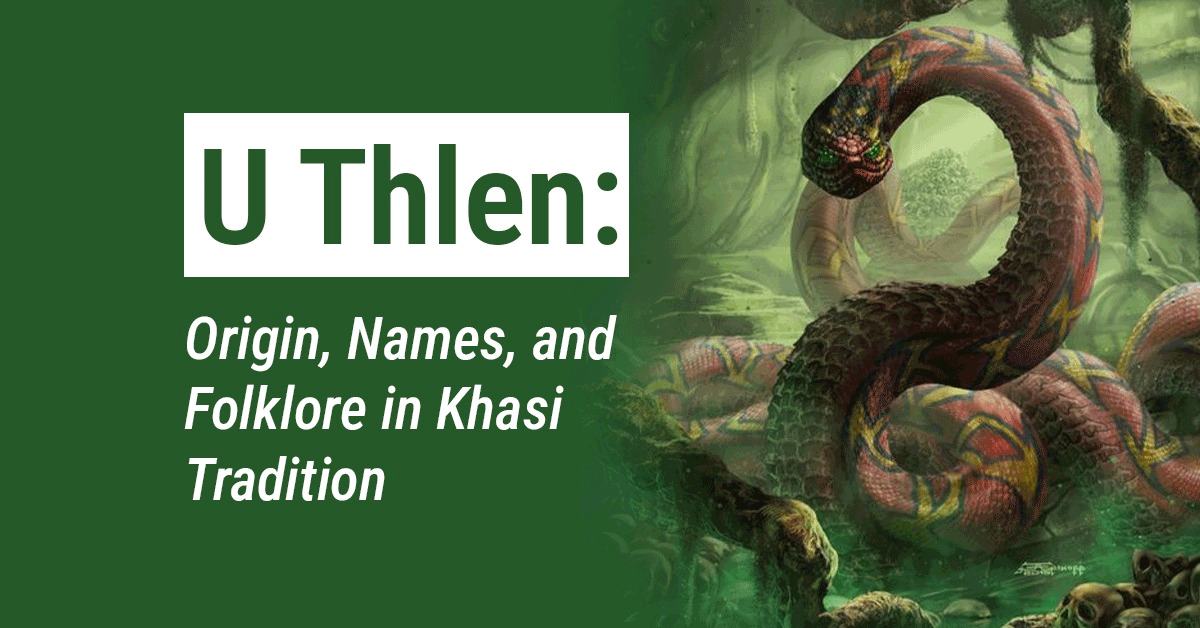
U Thlen: Origin, Names, and Folklore in Khasi Tradition
Introduction
The legend of U Thlen is one of the most deeply rooted narratives in the cultural memory of the Khasi people of Meghalaya. It is a story that blends mythology with social meaning, evolving across generations through oral tradition. More than a supernatural tale, it reflects ideas about morality, wealth, secrecy, and the unseen forces believed to influence human life. The legend has also found a place in Khasi literature, including works such as Ki Khannatang bad U Sier Lapalang by Primrose Gatphoh, which preserves elements of traditional storytelling.
Origin of the Legend
The origin of U Thlen can be traced to ancient Khasi oral traditions that existed long before written records. In early narratives, U Thlen is described as a monstrous serpent or dragon-like creature that lived in a cave near Sohra, particularly around the area now known as Daiñ Thlen Falls. The creature was feared for its appetite for human flesh, and entire communities lived under constant threat.
According to the legend, the village near the cave lay along the route connecting Sohra to nearby settlements such as Phudumsning and Nongsteng. Over time, people began to mysteriously disappear, creating fear and confusion. It was believed that the serpent preyed on travelers, especially when they passed the cave in odd numbers, while those traveling in even numbers remained unharmed. This pattern deepened the mystery and terror surrounding the creature.
As the number of villagers declined, the community turned to divine intervention. In response, a deity known as U ‘Lei Shyllong was said to have intervened and identified the serpent as the cause of the suffering. He then instructed a figure named Syiem Syrmoh, also known as Law Suidnoh, to destroy the creature.
The Slaying of U Thlen
The confrontation between Law Suidnoh and the serpent forms one of the most dramatic parts of the legend. Understanding that the creature had developed a taste for human flesh, Law Suidnoh devised a clever plan. He heated an iron rod until it became red hot and carried it to the cave. Mistaking the glowing iron for food, the serpent opened its mouth, allowing Law Suidnoh to thrust the burning rod into its throat.
The act caused immense turmoil, and the thrashing of the serpent was believed to have shaken the land violently, giving rise to geological formations such as cliffs and valleys in the Sohra region. Eventually, the creature died, bringing relief to the people. However, Law Suidnoh warned the villagers that the body must not be left intact, as the serpent could return to life.
The Return Through Fragmentation
Following these instructions, the villagers removed the serpent from its cave, washed it, and cut it into small pieces. They collectively consumed the meat, believing that doing so would prevent the creature from reviving. For a time, it appeared that the threat had ended.
However, the narrative takes a crucial turn with the actions of an elderly woman who set aside a portion of the meat for her absent grandchild. Forgetting about it, she later discovered that the piece had come back to life. Out of fear and guilt, she hid it instead of informing others. The revived fragment, now embodying the spirit of U Thlen, made a pact with her, promising wealth in exchange for worship and the offering of human blood.
This moment marks the transformation of the legend from a physical threat into a hidden and continuing presence within human society.
Names and Variations
The name “U Thlen” itself carries linguistic and symbolic meaning. In the Khasi language, the prefix “U” denotes a masculine entity, while “Thlen” refers to a devouring or consuming force. Together, the name conveys the idea of a destructive being driven by insatiable hunger.
Across different regions and retellings, variations of the legend exist. In some versions, U Thlen is portrayed less as a physical serpent and more as a spiritual force that inhabits households. Certain families are believed to have inherited its presence, giving rise to localized interpretations of the story. These variations illustrate the flexibility of oral traditions, which adapt to changing contexts while preserving core themes.
Folklore and Living Beliefs
As the legend evolved, it introduced the concept of individuals known as Nongshohnoh, who were believed to maintain or “feed” the Thlen. These individuals were thought to collect small personal items such as hair, nails, or pieces of clothing from unsuspecting victims. Through these objects, the Thlen was believed to consume the victim’s essence, leading to illness and eventual death.
Such beliefs contributed to a climate of suspicion, particularly toward individuals or families who appeared suddenly wealthy. Even in modern times, whispers about such practices persist in some areas, though they are often viewed with skepticism.
The story also became a tool for socialization. Parents would warn children about strangers by invoking the fear of the Thlen, embedding the legend into everyday life and behavior. For many, memories of hearing these stories around bonfires remain a vivid part of childhood.
Cultural and Symbolic Meaning
Within Khasi society, the legend of U Thlen carries profound symbolic significance. It represents the dangers of greed and the moral consequences of seeking wealth through unethical means. The pact between the old woman and the revived Thlen highlights the idea that prosperity gained through wrongdoing comes at a hidden cost.
The story also emphasizes the importance of collective responsibility. While the community initially succeeds through unity, the failure of one individual leads to the return of danger. This reinforces the belief that social harmony depends on the actions of every member.
At a deeper level, U Thlen symbolizes unseen threats within society. Unlike external enemies, it exists in hidden forms, suggesting that danger can arise from within rather than from outside forces.
Historical and Anthropological Context
During the colonial period, British administrators and scholars documented the legend while studying the cultures of Northeast India. These accounts introduced the story to a wider audience but were often shaped by external perspectives. In many cases, they emphasized sensational aspects, particularly the idea of ritual sacrifice.
Modern scholarship approaches the legend with greater nuance, recognizing it as a complex cultural narrative rather than a literal belief system. Anthropologists interpret it as a way for communities to explain social phenomena such as inequality, misfortune, and sudden success within a moral framework.
Continuity in Modern Times
Despite modernization and changing worldviews, the legend of U Thlen continues to persist in contemporary Meghalaya. While many people no longer believe in it literally, the story remains embedded in cultural memory. The term “U Thlen” is sometimes used metaphorically to describe individuals associated with corruption or hidden exploitation.
Its survival demonstrates the adaptability of folklore. The legend has evolved from a tale of a physical serpent into a broader symbol of ethical caution, retaining its relevance across generations.
The legend of U Thlen stands as a powerful example of how folklore can both shape and reflect societal values. Rooted in the oral traditions of the Khasi people, it combines elements of myth, morality, and social commentary. By examining its origins, variations, and cultural meanings, it becomes clear that U Thlen is not merely a creature of legend but a lasting symbol of the complex relationship between human desire, community responsibility, and moral balance.
Disclaimer: The opinions expressed in this article are those of the author's. They do not purport to reflect the opinions or views of The Critical Script or its editor.
Beliefs And Myths Related Posts






Newsletter!!!
Subscribe to our weekly Newsletter and stay tuned.
Related Comments