


 INDIA ASIAN GAMES MEDAL MONITOR
·
India: 🥇 0
| 🥈 0
| 🥉 0
| Total: 0
INDIA ASIAN GAMES MEDAL MONITOR
·
India: 🥇 0
| 🥈 0
| 🥉 0
| Total: 0
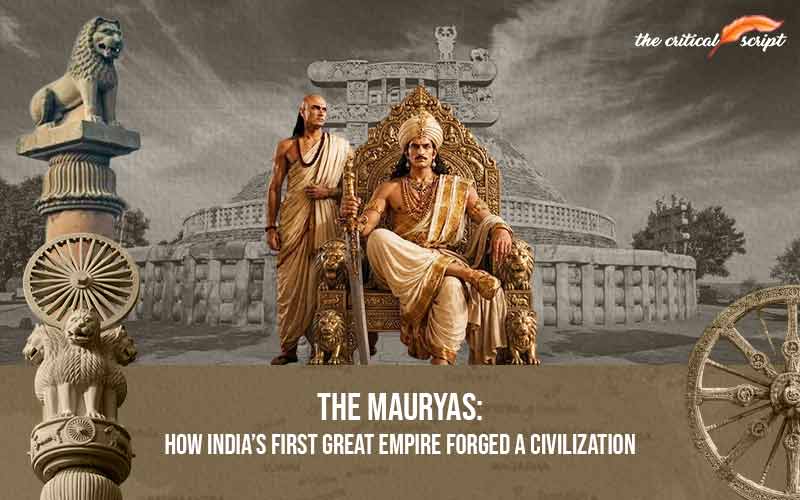
The Mauryas: How India’s First Great Empire Forged a Civilization
From the rise of Chandragupta Maurya and the brilliance of Chanakya to the transformation of Ashoka after the Kalinga War, the Mauryan Empire was not merely a dynasty - it was the birth of imperial India, statecraft, and a political vision that would shape the subcontinent for centuries.
Long before modern India emerged as a nation, the Indian subcontinent was a mosaic of kingdoms, republics, tribal territories, and warring powers. Kingdoms rose and fell with astonishing speed. Alliances shifted constantly. Trade flourished in some regions while warfare consumed others.
Then, in the fourth century BCE, a remarkable transformation began in the Gangetic plains.
A young man from modest origins, guided by one of history’s sharpest political minds, would overthrow a mighty dynasty, defeat the successors of Alexander the Great, and create the first empire that united most of the Indian subcontinent under centralized rule.
That empire became known as the Mauryan Empire.
Its rulers changed not only Indian politics, but also ideas of governance, warfare, diplomacy, economics, religion, and imperial administration. Under the Mauryas, India witnessed the rise of one of the ancient world’s most sophisticated states - an empire whose influence would echo across Asia for centuries.
India Before the Mauryas
To understand the Mauryas, one must first understand the fragmented world into which they emerged.
Around the sixth to fourth centuries BCE, northern India was divided among sixteen major kingdoms and republics known as the Mahajanapadas, of which Magadha gradually emerged as the most powerful due to its fertile agricultural land, rich iron resources, strategic river networks, and expanding military strength.
By the time of the Nanda Dynasty, Magadha had become immensely wealthy. Ancient sources describe the Nandas as rulers of enormous military strength, possessing thousands of elephants, cavalry units, and infantry.
Yet despite their wealth, the Nandas were deeply unpopular in many traditions. Several accounts portray them as authoritarian, excessively taxed rulers disconnected from public support.
This political dissatisfaction would create the opening through which Chandragupta Maurya emerged.
The Mystery of Chandragupta Maurya’s Origins
Few figures in ancient Indian history are surrounded by as much mystery as Chandragupta Maurya.
The origins of Chandragupta Maurya remain a subject of historical debate, with different traditions offering varying accounts. Some Buddhist texts describe him as belonging to the Moriya clan, while certain Jain traditions portray him as a man of humble beginnings. Greek writers provide only scattered references about him, and Brahmanical sources differ considerably in their descriptions of his ancestry and early life.
Some historians believe Chandragupta may not have come from traditional royal aristocracy at all, which makes his rise even more extraordinary.
What is clearer, however, is the role played by the man who would become his mentor:
Chanakya.
Chanakya: The Architect Behind the Empire
If Chandragupta built the empire, Chanakya designed it.
Also known as Kautilya or Vishnugupta, Chanakya remains one of the most influential political thinkers in Indian history. Scholar, strategist, economist, diplomat, philosopher, and master tactician, he envisioned a politically unified and strategically secure India.
According to legend, Chanakya was insulted by the Nanda ruler and vowed to destroy the dynasty. Whether fully historical or partly legendary, the story reflects a deeper truth: Chanakya saw the political fragmentation of India as dangerous.
The threat from the northwest had already become visible through Alexander’s invasion.
Chanakya understood something revolutionary for his era: A divided India could always become vulnerable to foreign powers.
His political treatise, the Arthashastra, later emerged as one of the ancient world’s most sophisticated manuals on governance and statecraft, covering subjects ranging from espionage, taxation, trade, diplomacy, and warfare to economic regulation, internal security, agriculture, mining, intelligence networks, and even psychological operations.
What makes the Arthashastra remarkable is its realism.
Unlike idealistic philosophical texts, it treated politics as a practical science of power.
Centuries later, many scholars would compare Chanakya to Machiavelli, though Chanakya predated him by nearly 1,800 years.
Alexander’s Invasion and the Power Vacuum
When Alexander the Great invaded northwestern India in 326 BCE, he encountered fierce resistance from regional kingdoms, most famously King Porus.
Although Alexander advanced into Punjab, his exhausted army eventually refused to march deeper into India.
After his withdrawal and subsequent death, his empire fragmented rapidly.This created political instability across northwestern India.Greek satraps struggled to maintain control.
Regional rulers competed for influence.The old order weakened.
Chanakya and Chandragupta recognized an opportunity where others saw chaos.
The Fall of the Nandas
Ancient traditions describe a long struggle against the Nanda Dynasty.
Some accounts suggest Chandragupta initially failed before regrouping strategically. Chanakya allegedly built alliances, recruited soldiers from frontier regions, and gradually weakened Nanda control.
Eventually, Chandragupta seized Pataliputra, the magnificent capital of Magadha.
The Nanda Empire collapsed, and around 322 BCE, the Mauryan Empire was born.
The Building of India’s First Great Empire
Chandragupta Maurya proved not merely a conqueror, but an empire builder.
Over the following years, Chandragupta Maurya expanded his authority across much of northern India, defeating rival kingdoms, consolidating administrative control, strengthening military structures, and integrating diverse populations under a centralized imperial system.
One of his greatest achievements came in conflict with Seleucus I Nicator, one of Alexander’s successors.
The confrontation between Chandragupta and Seleucus ended not with destruction, but with diplomacy. Seleucus ceded territories in exchange for peace, diplomatic ties, and reportedly 500 war elephants.
Those elephants later helped Seleucus in battles elsewhere in the Hellenistic world.
This treaty reflected a distinctive aspect of Mauryan power: it combined military strength with strategic diplomacy.
Pataliputra: The Imperial Capital
At the heart of the empire stood Pataliputra.
Greek ambassador Megasthenes described Pataliputra as one of the greatest cities of the ancient world, renowned for its massive wooden fortifications, towering watchtowers, wide roads, grand administrative buildings and palaces, as well as its remarkably organized urban planning.
The Mauryan state operated through a remarkably advanced bureaucracy.
Mauryan officials supervised a vast administrative system that regulated trade, agriculture, taxation, forests, mining, public works, military affairs, and intelligence operations across the empire.
The empire was divided into provinces governed by royal representatives.
What distinguished the Mauryas from many earlier kingdoms was administrative centralization.
Power flowed outward from the imperial center.
The Shadow World of Espionage
One of the most fascinating and often overlooked aspects of the Mauryan Empire was its intelligence network.
Chanakya considered espionage essential to governance.
The Arthashastra describes an elaborate intelligence system involving secret agents, disguised spies, surveillance networks, counterintelligence operations, internal monitoring, and political infiltration to safeguard the stability and authority of the state.
Spies reportedly operated across various sections of society, including among merchants, ascetics, households, military units, and even foreign courts, enabling the Mauryan state to gather intelligence from both within and beyond the empire.
The Mauryan state did not merely rule through force.
It ruled through information.
In many ways, the empire pioneered one of the earliest large-scale intelligence systems in Indian history.
Bindusara: The Overlooked Emperor
Between Chandragupta and Ashoka stood Bindusara.
Overshadowed by his father and son, Bindusara nevertheless played a critical role in consolidating the empire.
Greek sources refer to him as “Amitrochates,” likely derived from the Sanskrit “Amitraghata” — slayer of enemies.
He expanded Mauryan influence deeper into the Deccan and maintained diplomatic relations with Hellenistic kingdoms.
Yet history remembers him only faintly, largely because the towering figure of Ashoka would soon dominate the Mauryan legacy entirely.
Ashoka Before Transformation
Popular imagination often remembers Ashoka as a peaceful Buddhist emperor.
But before becoming “Ashoka the Great,” he was a hardened prince shaped by violent succession struggles and imperial warfare.
Some traditions describe him suppressing rebellions with severity. Though legends exaggerate certain details, it is clear that Ashoka emerged from a highly competitive political environment.
When he became emperor, Mauryan expansion continued aggressively.
Then came Kalinga.
The Kalinga War: The Battle That Changed an Emperor
Around 261 BCE, Ashoka invaded Kalinga, located in present-day Odisha.
The war was catastrophic.
Ancient inscriptions describing the Kalinga War claim that hundreds of thousands were killed, wounded, or displaced, while entire communities faced widespread devastation and immense civilian suffering in the aftermath of the conflict.
What makes the Kalinga War historically extraordinary is not simply the scale of violence, but Ashoka’s reaction afterward.
In his own inscriptions, Ashoka expressed remorse.
This is one of the earliest known examples in world history of a victorious emperor publicly regretting conquest.
The transformation that followed changed Indian history permanently.
Ashoka and the Idea of Moral Kingship
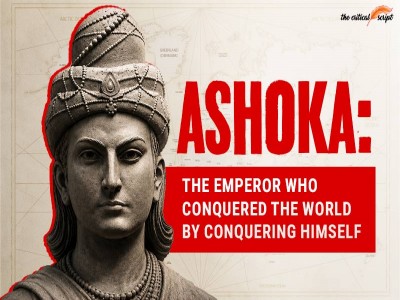
After Kalinga, Ashoka embraced Buddhism and developed a governing philosophy known as Dhamma.
Contrary to simplistic portrayals, Ashoka did not abandon governance or dissolve the empire.
Instead, he attempted something unprecedented:combining imperial authority with moral responsibility.
His policies emphasized religious tolerance, compassion, public welfare, ethical conduct, animal protection, and the development of public infrastructure, including medical facilities, roads, tree plantations, wells, and rest houses for travelers.
Ashoka communicated directly with his people through inscriptions carved on rocks and pillars across the empire.
The Edicts of Ashoka remain among the most important historical sources from ancient India.
They reveal not mythology, but the emperor’s own voice.
Buddhism and the Global Mauryan Legacy
Ashoka transformed Buddhism from a regional spiritual tradition into an international force.
Under Ashoka’s patronage, Buddhist missionaries traveled to regions such as Sri Lanka, Central Asia, and Southeast Asia, helping transform Buddhism from a regional spiritual tradition into a major global religion.
According to tradition, Ashoka’s son Mahinda and daughter Sanghamitta carried Buddhism to Sri Lanka.
Over centuries, Buddhism spread across Asia - to China, Japan, Tibet, Myanmar, Thailand, Cambodia, and beyond.
In many ways, Ashoka became one of the earliest rulers to consciously use soft power and cultural influence beyond military expansion.
Economy, Trade, and Prosperity
The Mauryan economy rested upon a strong foundation of agriculture, irrigation, taxation, trade, craft production, and mining, all of which were carefully regulated and supervised by the state to sustain the empire’s vast administrative and military structure.
Road networks connected distant regions.
Trade routes linked India to Central Asia and the Mediterranean world.
The state regulated weights, measures, commerce, forests, and natural resources.
Some historians argue that the Mauryan Empire represented one of the ancient world’s earliest large-scale command-administrative economies.
The Decline Begins
After Ashoka’s death, the empire gradually weakened.
Several factors contributed to the decline of the Mauryan Empire, including administrative overstretch, succession disputes, economic strain, regional fragmentation, and the emergence of weak rulers unable to maintain centralized control over the vast empire.
The empire’s enormous size became increasingly difficult to govern effectively.
Provincial powers gained autonomy and the central authority weakened.
Around 185 BCE, the last Mauryan ruler, Brihadratha, was assassinated by Pushyamitra Shunga during a military parade. The Mauryan Empire ended. But its legacy did not.
The Mauryan Legacy in Modern India
Few ancient dynasties have shaped modern India as profoundly as the Mauryas. The Lion Capital of Ashoka was adopted as India’s national emblem, the Ashoka Chakra occupies the center of the national flag, Chanakya continues to influence Indian political thought, and Ashoka himself remains a timeless symbol of moral leadership and ethical governance.
Even modern Indian ideas about political unity often trace symbolic roots back to the Mauryan vision of a connected subcontinent.
The Mauryas demonstrated for the first time that much of India could be governed within a single political framework.
That idea would echo through later empires, and eventually into modern nationhood itself.
The Mauryan Empire was not simply a dynasty of kings. It was the moment India entered imperial history.
It produced one of the ancient world’s greatest strategists, one of history’s most powerful empires, and one of humanity’s most remarkable political and moral transformations.
From Chanakya’s ruthless realism to Ashoka’s moral introspection, the Mauryan story contains both the harshness of power and the possibility of ethical governance.
It was an empire built through conquest, sustained through administration, and remembered through ideas.
And more than two thousand years later, the shadow of the Mauryas still stretches across the Indian imagination.
Disclaimer: The opinions expressed in this article are those of the author's. They do not purport to reflect the opinions or views of The Critical Script or its editor.
History And Facts Related Posts





Newsletter!!!
Subscribe to our weekly Newsletter and stay tuned.
Related Comments