


 INDIA ASIAN GAMES MEDAL MONITOR
·
India: 🥇 0
| 🥈 0
| 🥉 0
| Total: 0
INDIA ASIAN GAMES MEDAL MONITOR
·
India: 🥇 0
| 🥈 0
| 🥉 0
| Total: 0
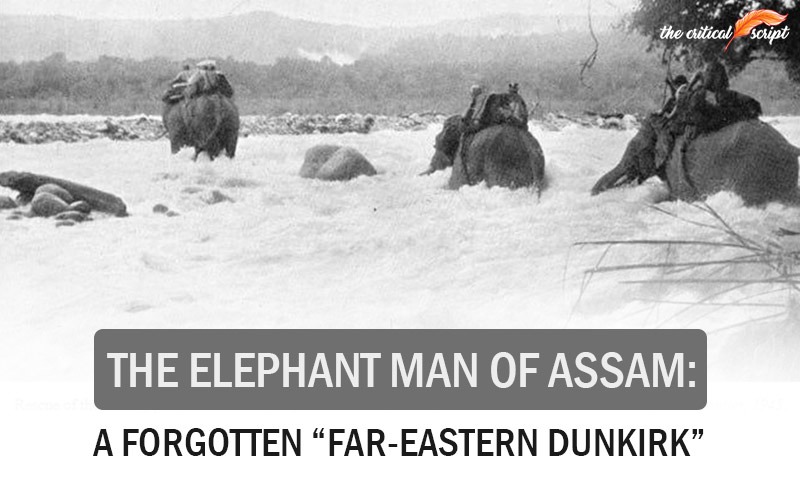
The Elephant Man of Assam: A Forgotten “Far-Eastern Dunkirk”
War, Wilderness, and an Unlikely Lifeline
In 1942, as the Japanese army swept
through Southeast Asia during World War II, the fall of Rangoon triggered one
of the most desperate civilian evacuations in the eastern theatre of the war.
Tens of thousands of refugees, British personnel, Indian laborers,
Anglo-Burmese families, and local civilians began a harrowing journey on foot
from Burma toward India. Their route cut through dense forest, steep mountain
passes, and disease-ridden terrain, forming what historians now recognize as
one of the most brutal overland retreats of the war.
For many, the final barrier to survival
was not the enemy, but nature itself. Along the Indo-Burma frontier, rivers
such as the Dapha swelled violently under monsoon rains, cutting off escape
routes and trapping exhausted refugees on remote riverbanks. With limited
military capacity in the region, relief efforts were minimal, with occasional
air-dropped supplies offering temporary survival, but no reliable means of
evacuation.
It was in this moment of crisis that an
unlikely figure emerged: GylesMackrell, a British tea planter based in Assam.
Assam, Elephants, and Local Knowledge
Mackrell, then in his early fifties, had
spent much of his life in Assam working with Steel Brothers, a major tea
exporting firm. Like many in the plantation economy, he had access to trained
elephants, animals long used in the region for transport, logging, and
navigating difficult terrain.
On 4 June 1942, Mackrell received urgent
news from a small group of evacuees who had managed to cross the Dapha River
under dangerous conditions. Behind them, they reported, were hundreds more,
starving, stranded, and unlikely to survive without immediate help.
Drawing on his familiarity with the land
and resources at hand, Mackrell devised a plan that was both simple and
extraordinary: he would use elephants to ferry refugees across the flooded
rivers.
The Rescue Operations
Mackrell quickly assembled a small group
of elephants and handlers and set out toward the border. The conditions were
extreme with relentless rain, strong currents, and the constant threat of
disease.
His first major success came when he
rescued 86 soldiers stranded on a mid-river island. Using elephants as living
bridges, he transported them one by one across the torrent. Over the following
weeks and months, he repeated this dangerous process, ultimately saving around
200 people.
The operation was physically and mentally
exhausting. Mackrell himself fell ill with fever and was forced to return
briefly to Assam to recover. Yet he returned to the rescue zone, continuing his
efforts despite the risks.
These missions required not only courage
but coordination with local mahouts (elephant handlers), knowledge of river
behavior, and the ability to navigate rapidly changing situations. In many
cases, elephants were the only viable means of crossing as boats could not
withstand the currents, and bridges did not exist.
A “Far-Eastern Dunkirk”
Historians have since compared Mackrell’s
efforts to the Dunkirk evacuation, a moment when improvisation and civilian
initiative saved lives under dire circumstances. Yet, unlike Dunkirk, which
became a defining narrative of wartime Britain, the rescue in the eastern
Himalaya remained largely overlooked.
Archival materials such as letters,
diaries, and rare film footage, later preserved at the University of Cambridge,
have helped reconstruct this episode. Testimonies from survivors reveal the
depth of suffering endured by those stranded. Some were reduced to eating wild
vegetation such as fern fronds, stretching minimal rations while waiting for a
rescue that might never come
Recognition and Reluctance
For his actions, Mackrell was awarded the
George Medal, one of Britain’s highest honors for civilian bravery.
Contemporary assessments suggested that the risks he faced carried a
probability of death as high as 50 to 80 percent.
Yet Mackrell himself remained notably
modest. According to later researchers, he was uncomfortable with recognition
and even worried that his return to the rescue zone might be misinterpreted as
a pursuit of further honors. His actions, by all accounts, were driven not by
ambition but by a sense of duty and urgency.
Historical Significance and Legacy
GylesMackrell’s story occupies a unique
place in the history of Assam and the broader eastern front of World War II. It
highlights the often-overlooked role of frontier regions and civilian actors in
wartime survival.
His rescue efforts demonstrate how local
knowledge, indigenous resources, and adaptive thinking can become decisive
in moments when formal systems fail. The use of elephants, deeply embedded in
the ecological and cultural landscape of Northeast India, was not merely a
logistical solution but a reflection of regional expertise.
Mackrell died in 1959, and for decades
his story faded into obscurity. Today, renewed scholarly interest and archival
discoveries are restoring his place in history, not as a conventional war hero,
but as a figure of quiet courage whose actions bridged the gap between survival
and catastrophe.
The rescue led by GylesMackrell reminds
us that history is often shaped far from battlefields but in remote valleys,
among ordinary individuals responding to extraordinary crises. In the flooded
rivers along the Indo-Burma frontier, where hope was rapidly diminishing, one
man’s initiative and the strength of a few elephants altered the fate of
hundreds.
It is a story not only of wartime
endurance, but of human ingenuity, compassion, and the enduring power of acting
when action seems impossible.
Disclaimer: The opinions expressed in this article are those of the author's. They do not purport to reflect the opinions or views of The Critical Script or its editor.
History And Facts Related Posts








Newsletter!!!
Subscribe to our weekly Newsletter and stay tuned.
Related Comments