


 INDIA ASIAN GAMES MEDAL MONITOR
·
India: 🥇 0
| 🥈 0
| 🥉 0
| Total: 0
INDIA ASIAN GAMES MEDAL MONITOR
·
India: 🥇 0
| 🥈 0
| 🥉 0
| Total: 0
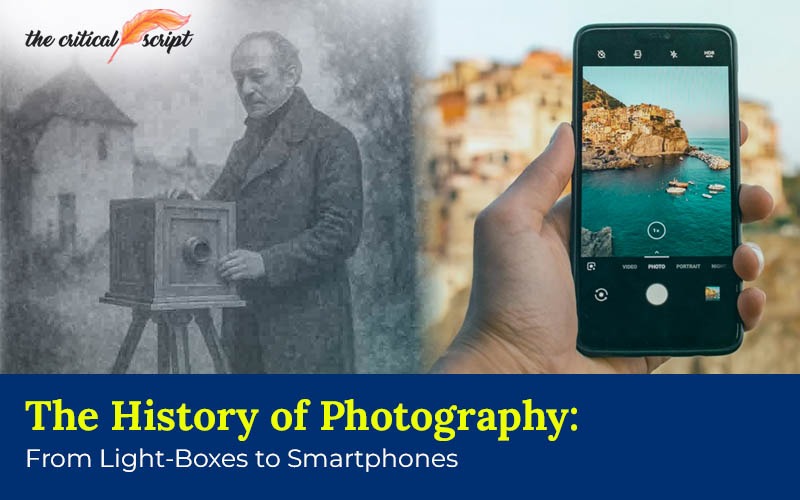
The History of Photography: From Light-Boxes to Smartphones
For nearly all of human history, images had to be made by hand -
painted, drawn, or carved. Then, in the early 19th century, a handful of
inventors figured out how to make light itself do the drawing. What followed
was one of the most transformative technological and cultural revolutions in
modern history: the invention and evolution of
photography.
The First Photograph
The story begins with Joseph
NicéphoreNiépce, a French inventor experimenting with ways to
permanently capture an image projected by a cameraobscura, a simple optical
device known since antiquity that projects an image of its surroundings onto a
screen. Around 1826 or 1827, Niépce produced what is widely regarded as the
world's first permanent photograph: a grainy, sun-bleached view from the window
of his estate at Le Gras, captured on a pewter plate coated with a
light-sensitive substance called bitumen of Judea. The exposure took several
hours, possibly days.
Niépce's process, which he called heliography (literally "sun
writing"), was slow and impractical, but it proved the core idea: light
could be used to fix an image permanently.
Daguerre and the Birth of a Public Sensation
Niépce partnered with a Parisian painter and showman named Louis Daguerre, who continued refining
the process after Niépce's death in 1833. In 1839, Daguerre unveiled the daguerreotype, a process that used a
silver-coated copper plate, sensitized with iodianevapor, exposed in a camera,
and then developed using mercury fumes. The result was a strikingly sharp,
one-of-a-kind image with remarkable detail.
The French government purchased the rights to the process and gave it to
the world for free, and 1839 is now generally regarded as photography's
official birth year. Daguerreotypes became an instant sensation across Europe
and America. Portrait studios sprang up in every major city, though early
exposure times, often several minutes, meant sitters had to remain rigidly
still, sometimes with the help of hidden neck braces.
Talbot's Negative and the Path to Reproducibility
Around the same time, in England, William Henry Fox Talbot was developing a rival process he called
the calotype. Unlike the daguerreotype, which produced a single unique image,
Talbot's method created a paper
negative, from which any number of positive prints could be made. This
negative-to-positive principle became the foundation of photographic technology
for the next century and a half, right up until the digital era.
Faster, Sharper, More Accessible
The following decades brought a rapid succession of technical
improvements:
- The wet
collodion process, introduced in 1851, offered sharper images and
shorter exposure times than either the daguerreotype or calotype, though
it required photographers to coat, expose, and develop glass plates while
the chemicals were still wet - often necessitating a portable darkroom
tent in the field.
- Dry plate processes, developed in the 1870s,
freed photographers from having to develop images on the spot, making photography
far more practical for travel and journalism.
- Exposure times continued to shrink, from
minutes to seconds, opening the door to candid and action photography.
Photography also proved its power as a documentary tool during this
period. Photographers like Roger Fenton and Mathew Brady brought cameras to the
battlefields of the Crimean War and the American Civil War, giving the public
unprecedented, unvarnished visual access to the realities of war.
Photography for Everyone
The turning point that transformed photography from a specialized craft
into a mass-market activity came in 1888, when George Eastman founded Kodak and introduced roll film alongside a
simple box camera, sold under the slogan: "You press the button, we do the
rest." Consumers could take photographs without any knowledge of chemistry
- they simply mailed the entire camera back to Kodak for processing.
In 1900, Kodak released the Brownie,
an inexpensive, easy-to-use camera aimed squarely at ordinary consumers,
including children. Photography was no longer the domain of professionals and
the wealthy; it had become a hobby available to nearly anyone.
Photography Claims Its Place as Art
As photography became widespread, a parallel debate emerged: was it
merely a mechanical recording process, or could it be true art? The Pictorialist movement of the late 19th
and early 20th centuries argued for the latter, producing soft-focus, painterly
images that deliberately echoed fine art traditions.
Later, photographers such as Alfred
Stieglitz pushed back against this imitation of painting, championing
what became known as "straight photography" - images that celebrated
the camera's own unique capacity for sharp detail, tonal range, and unmediated
observation of the world. This tension between photography as document and
photography as art has continued to shape the medium ever since.
The 1930s brought some of photography's most enduring documentary work,
as photographers employed by the U.S. Farm Security Administration, most
famously Dorothea Lange, whose
"Migrant Mother" became an iconic image of the Great Depression,
using the camera to record social and economic hardship with lasting emotional
power.
Color, Portability, and the Golden Age of Photojournalism
Kodachrome,
introduced in 1935, made color photography commercially practical for the first
time, though black and white remained dominant in journalism and art
photography for decades afterward due to cost and printing limitations.
Meanwhile, the rise of the 35mm
format, popularized by German-made Leica cameras, gave photographers a
compact, quiet, and highly portable tool. This portability fueled the golden
age of photojournalism from the 1930s through the 1960s, as magazines like Life
and National Geographic built their identities around powerful photo
essays capturing news, culture, and everyday life around the world.
The Digital Turn
Ironically, the company that had done the most to democratize film
photography also built the first digital camera. In 1975, Kodak engineer Steven Sasson created a prototype
digital camera - a toaster-sized device that recorded black-and-white images to
a cassette tape at a resolution of just 0.01 megapixels.
Digital sensor technology improved steadily through the 1980s and 1990s,
and by the early 2000s digital cameras had become affordable and capable enough
to challenge film seriously. Consumers embraced the convenience of instant
results, no film costs, and easy sharing. By the mid-2000s, digital photography
had overtaken film in the consumer market. Kodak, despite having invented the
core technology decades earlier, failed to adapt its business quickly enough and
filed for bankruptcy in 2012 - a widely cited case study in disruptive
innovation and corporate inertia.
The Smartphone Era
The most recent, and arguably most sweeping, transformation came with
the smartphone. The launch of the iPhone in 2007, followed by a wave of
camera-equipped smartphones, merged high-quality image capture with instant
editing and global sharing in a single pocket-sized device. For the first time,
billions of people carried a capable camera with them at all times.
This shift also ushered in the age of computational photography - techniques like HDR imaging, night
mode, and AI-assisted processing that use software algorithms, not just optics,
to construct the final image. Modern smartphone cameras often combine multiple
exposures and machine learning models to produce results that would have been
unimaginable with a single optical exposure.
Social media platforms, particularly Instagram, further reshaped
photography's cultural role, turning it from an occasional, deliberate act into
a constant, everyday form of personal expression and communication.
Conclusion
From Niépce's hours-long exposure of a French rooftop to a smartphone
capturing dozens of frames in a fraction of a second and blending them with
artificial intelligence, photography's 200-year history is a story of continual
acceleration - in speed, accessibility, and reach. What began as a painstaking
chemical process available to a select few has become one of the most universal
forms of human expression, with billions of images captured and shared every
single day. Yet the core impulse behind it all remains unchanged since 1839:
the desire to fix a fleeting moment of light into something permanent.
Disclaimer: The opinions expressed in this article are those of the author's. They do not purport to reflect the opinions or views of The Critical Script or its editor.
History And Facts Related Posts











Newsletter!!!
Subscribe to our weekly Newsletter and stay tuned.
Related Comments