


 INDIA ASIAN GAMES MEDAL MONITOR
·
India: 🥇 0
| 🥈 0
| 🥉 0
| Total: 0
INDIA ASIAN GAMES MEDAL MONITOR
·
India: 🥇 0
| 🥈 0
| 🥉 0
| Total: 0
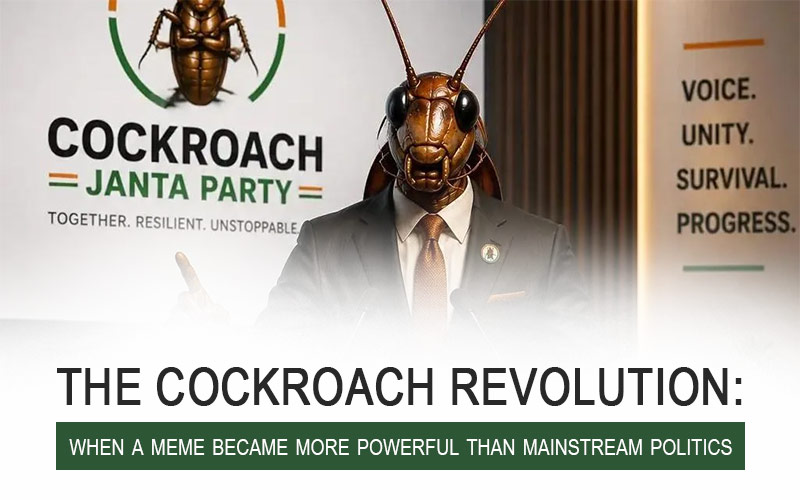
THE COCKROACH REVOLUTION: WHEN A MEME BECAME MORE POWERFUL THAN MAINSTREAM POLITICS
India has seen political movements.
India has seen protests.
India has seen revolutions built on ideology, religion, caste, language and nationalism.
But perhaps for the first time, India is witnessing something far stranger and far more uncomfortable for the establishment:
a political-cultural uprising born entirely from internet satire.
The Cockroach Janata Party was supposed to be a joke.
Instead, it exposed a national mood.
What began as a meme movement spiralled into one of the most viral political phenomena on Indian social media. Within days, the Instagram page of the Cockroach Janata Party reportedly crossed the follower counts of established political giants like the BJP and the INC on the platform. Think about the symbolism of that for a second.
A parody account.
A digital insect.
A movement built on absurdity.
Outperforming parties that have ruled the world’s largest democracy.
That is not normal political behaviour.
That is public frustration finding a new language.
And that language is not speeches anymore.
It is sarcasm.
It is dark humour.
It is memes used as emotional survival.
The movement gained momentum after controversial public remarks allegedly comparing struggling youth to “cockroaches.” But what the political class failed to understand is this:
history has always shown that the moment people reclaim an insult, the insult loses its power.
That is exactly what happened here.
The word “cockroach” stopped being abuse and became identity.
Not because people enjoy humiliation, but because they recognised themselves in the metaphor.
A creature surviving toxic systems.
Surviving neglect.
Surviving economic pressure.
Surviving unemployment.
Surviving institutional failure.
Surviving while being hated by the very structures it lives under.
That is why this movement spread with terrifying speed.
Not because people suddenly became politically aware overnight, but because people finally saw a movement that reflected their exhaustion honestly instead of packaging it behind rehearsed slogans and polished speeches.
The establishment laughed at first.
Then came the follower counts.
Then came the nationwide replication.
Soon, different states started creating their own versions of the movement with local manifestos, local demands and local satire pages. What started as a central meme ecosystem began multiplying across digital spaces like a decentralized protest organism.
Which, ironically, mirrors the biology of the creature they chose as their symbol.
You can crush one cockroach.
You can spray chemicals.
You can burn the nest.
And yet somehow, they return in larger numbers.
That metaphor alone may be the most politically intelligent piece of branding India has seen in years.
Because unlike traditional political movements that rely on hierarchy, this movement thrives on replication. It does not need headquarters. It does not need massive funding. It does not even need physical offices.
It only needs public anger and internet access.
That is why attempts at suppression have only amplified it further.
Reports emerged that associated accounts and discussions faced restrictions and visibility issues on X. Simultaneously, discussions also surfaced online alleging threats and intimidation targeted towards individuals associated with the movement and its founders. Whether one supports the movement or not, the optics of suppression only ended up strengthening the mythology around it.
Because every attempt to silence satire accidentally proves the satire right.
And that is where mainstream politics seems completely unprepared.
Traditional political systems still operate as if narrative control belongs to television studios, press conferences and spokespersons.
But the internet changed power forever.
Today, relatability defeats authority.
Virality defeats hierarchy.
Memes travel faster than manifestos.
And perhaps the most dangerous part for the establishment is this:
people are no longer emotionally connecting with political perfection.
They are connecting with shared frustration.
The Cockroach Janata Party may never contest elections.
It may disappear tomorrow.
It may fragment into hundreds of local internet communities.
But that would still not erase what it already revealed.
It revealed how deeply alienated millions feel from institutional politics.
It revealed how humour has become a coping mechanism for political despair.
And most importantly, it revealed that modern resistance no longer arrives wearing revolutionary uniforms.
Sometimes it arrives as a meme page.
History often ignores the early signs of change because they initially look ridiculous.
But then again, every generation laughs at the beginning of a revolution before realising the joke was never actually funny.
And maybe that is the real fear surrounding this movement.
Not the cockroach.
Not the meme.
Not even the politics.
The fear is that people have stopped pretending everything is okay.
You can ban accounts.
You can threaten individuals.
You can ridicule a movement.
But what happens when the emotion behind the movement has already entered millions of minds?
You can kill a person.
But how do you kill an idea once people begin seeing themselves inside it?
Disclaimer: The opinions expressed in this article are those of the author's. They do not purport to reflect the opinions or views of The Critical Script or its editor.
National Related Posts








Newsletter!!!
Subscribe to our weekly Newsletter and stay tuned.
Related Comments