


 INDIA ASIAN GAMES MEDAL MONITOR
·
India: 🥇 0
| 🥈 0
| 🥉 0
| Total: 0
INDIA ASIAN GAMES MEDAL MONITOR
·
India: 🥇 0
| 🥈 0
| 🥉 0
| Total: 0
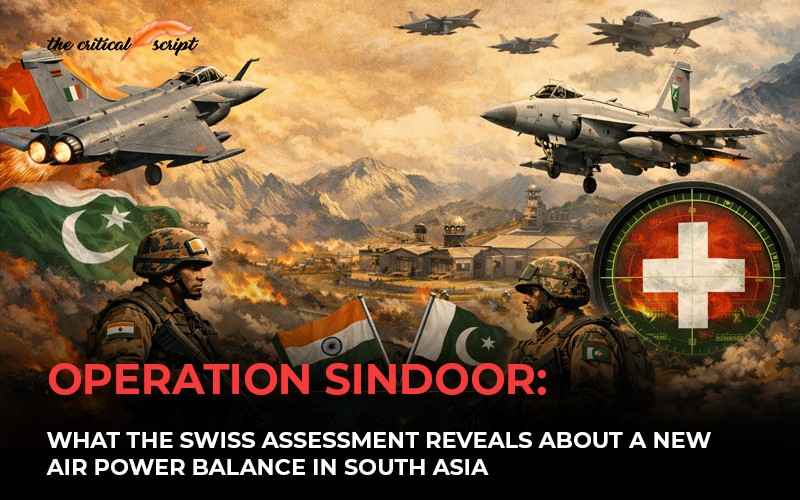
Operation Sindoor: What the Swiss Assessment Reveals About a New Air Power Balance in South Asia
A year after the four-day aerial
conflict between India and Pakistan in May 2025, an authoritative and
independent assessment has emerged from Europe. The Centre d’Histoire et de
Prospective Militaires (CHPM), a Swiss institution known for rigorous military-historical
analysis, has published an exploratory study titled Operation Sindoor: The
India-Pakistan Air War (7–10 May 2025).
Authored by military historian
Adrien Fontanellaz, the report offers one of the most detailed reconstructions
yet of the conflict. Beyond claims and counter-claims, it situates Operation
Sindoor as a watershed moment in modern air warfare between two nuclear-armed
states, revealing how technology, doctrine, and escalation control shaped the
outcome.
From
Terror Attack to Air War
The crisis was triggered by the
Pahalgam terror attack of 22 April 2025, in which 26 civilians were killed.
Indian intelligence attributed the attack to Pakistan-based terror groups
Jaish-e-Mohammed (JeM) and Lashkar-e-Taiba (LeT). According to CHPM, India’s
political leadership authorised a response that was deliberately broader and
more forceful than previous limited strikes, while granting the armed forces
operational autonomy to manage escalation.
On the night of 7 May 2025, Indian
forces launched coordinated strikes against terror infrastructure in Bahawalpur
and Muridke. This marked the opening of Operation Sindoor, which rapidly
escalated into one of the most intense air confrontations in South Asia since
1971.
The
Night of 7 May: A Tactical Setback
The Swiss report does not shy away
from uncomfortable facts. It assesses that during the first night of
operations, the Indian Air Force (IAF) suffered a serious tactical setback.
Based on open-source intelligence,
wreckage imagery, and missile debris analysis, CHPM confirms:
● The loss of at least one Rafale fighter jet
● The likely loss of one Mirage 2000
● A probable additional loss involving either a MiG-29UPG or Su-30MKI
● Several “mission kills”, where Indian aircraft were forced to abort missions after long-range missile engagements
Pakistan’s use of PL-15 long-range
air-to-air missiles, cooperative targeting through AEW&C platforms, and
integrated data links surprised Indian planners. The report notes that Indian
pilots may have underestimated the effective range and engagement envelope of
these systems.
However, the CHPM analysis is clear:
this tactical success did not translate into operational or strategic advantage
for Pakistan.
Akashteer,
S-400, and the Defence That Held
One of the most significant findings
of the Swiss study concerns India’s air-defence architecture. Pakistan
attempted a saturation strategy involving drones and missile attacks aimed at
overwhelming Indian defences and degrading command-and-control.
Here, India’s indigenous Akashteer,
integrated with the S-400 Sudarshan Chakra, proved decisive.
The report highlights:
● No confirmed damage to S-400 batteries, despite Pakistani claims
● Successful interception or neutralisation of hundreds of drones
●
Effective sensor fusion that allowed
Indian units to remain electronically silent until engagement
Satellite imagery examined by CHPM
showed no penetration of Indian airbases or collapse of defensive coverage.
Instead, Pakistan’s aircraft were forced to operate at extended ranges,
reducing strike effectiveness by an estimated 60–70%.
The
88-Hour Turnaround
Following the initial setback, the
conflict entered a decisive phase. Between 8 and 10 May, the IAF leveraged its
network-centric warfare backbone, particularly the Integrated Air Command and
Control System (IACCCS), supported by Netra and Phalcon AWACS platforms.
Indian aircraft employed SCALP-EG,
BrahMos, and Rampage stand-off munitions to strike:
●
Nur Khan
●
Murid
●
Rahim Yar Khan airbases
According to CHPM, these strikes
degraded Pakistan’s air-defence network, cratered runways, and grounded large
portions of the Pakistan Air Force’s operational fleet.
By the morning of 10 May, Pakistan
faced the prospect of losing effective control of its airspace. The Swiss
report notes that by 5 pm, Pakistan’s DGMO requested a ceasefire.
Escalation
Dominance, Not Total War
Perhaps the most consequential
insight of the CHPM study is its articulation of “escalation dominance.” India
demonstrated the ability to:
●
Inflict escalating conventional
costs
●
Maintain the conflict below the
nuclear threshold
●
Offer a credible off-ramp to
de-escalation
This directly challenges long-held
assumptions that Pakistan’s nuclear posture would deter deep Indian
conventional action. Operation Sindoor, the report argues, broke the paradigm
of nuclear blackmail without triggering catastrophic escalation.
A
Strategic Inflexion Point
The Swiss authors conclude that
Operation Sindoor represents:
●
A shift in India’s counter-terrorism
doctrine
●
The maturation of indigenous defence
technologies
●
A new model for limited,
high-intensity conflict between nuclear-armed states
India’s losses, while real, were
absorbed without loss of initiative or strategic control. The decisive factor
was not the absence of setbacks, but the speed, resilience, and integration
with which India recovered and prevailed.
Operation Sindoor was not a flawless
victory, but it was a decisive one.
As the CHPM report makes clear,
modern warfare rewards systems, networks, and escalation management more than
isolated tactical wins. In that equation, India emerged with a strengthened
deterrence posture and a clear message: future terror attacks will be met not
only with resolve, but with calibrated, technologically superior force.
Disclaimer: The opinions expressed in this article are those of the author's. They do not purport to reflect the opinions or views of The Critical Script or its editor.
World Related Posts












Newsletter!!!
Subscribe to our weekly Newsletter and stay tuned.
Related Comments