


 INDIA ASIAN GAMES MEDAL MONITOR
·
India: 🥇 0
| 🥈 0
| 🥉 0
| Total: 0
INDIA ASIAN GAMES MEDAL MONITOR
·
India: 🥇 0
| 🥈 0
| 🥉 0
| Total: 0
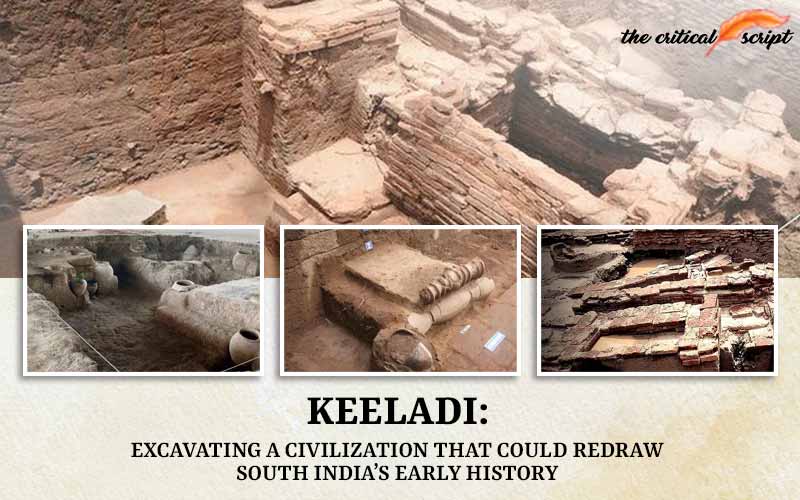
Keeladi: Excavating a Civilization That Could Redraw South India’s Early History


On the quiet banks of the Vaigai
River, not far from the coconut groves of Tamil Nadu’s Sivagangai district,
lies Keeladi, an archaeological site that has become the centre of one
of India’s most compelling historical debates. Over the past decade, Keeladi
has yielded thousands of artefacts: terracotta ring wells, carnelian beads,
brick structures, spindle whorls, graffiti marks, and most significantly, potsherds
inscribed with Tamil-Brahmi script. Together, they paint a picture of a
sophisticated urban settlement flourishing during the Early Historic period,
contemporary with cities in the Gangetic plains yet rooted deeply in Tamil
culture.
But Keeladi is more than a dig site.
It is a flashpoint in the larger conversation about how India’s early history
is constructed, interpreted and sometimes contested.
A Settlement Hidden in Plain Sight
Although excavations began only in
2015, the site spans roughly 110 acres. Less than five per cent of this
area has been excavated, but even that has transformed our understanding of
ancient South India.
Findings include:
●
Elaborate brick structures,
indicating planned urban habitation.
●
Ring wells,
a distinctive water-management system associated with ancient towns.
●
Fine pottery, metal tools and beads
that point to craft specialization and trade.
●
Large quantities of faunal
remains, showing dietary patterns and domestication.
The sheer volume of artefacts
suggests a vibrant settlement with a level of sophistication previously
associated primarily with North Indian sites like Ujjain, Mathura or
Pataliputra.
The discovery of Tamil-Brahmi
script etched onto everyday pottery is one of Keeladi’s most important
contributions. Unlike royal inscriptions on rocks or pillars common in northern
India, these were inscriptions made by ordinary people. Personal names
scratched onto pots point to a society where literacy had filtered into common
life.
The Tamil-Brahmi Puzzle: Rethinking Literacy in the South


Archaeologist K. Amarnath
Ramakrishna, who directed the first two seasons of the ASI-led excavation,
has argued that the widespread presence of Tamil-Brahmi on household items
suggests a literate society long before the commonly accepted dates of
the Sangam era.
This contrasts sharply with northern
India, where Brahmi inscriptions appear almost exclusively on large rock edicts
or pillars issued by emperors, especially Ashoka. Northern inscriptions tend to
be more formal, administrative and religious in tone, suggesting a
state-sponsored script used for governance or doctrinal instruction.
In the South, however, Tamil-Brahmi
appears on:
●
Potsherd
●
Graffiti marks
●
Cave inscriptions
●
Donation records by Jain traders
These patterns hint at a grassroots
spread of literacy, likely linked to trade networks, artisan guilds and
evolving social structures.
Ramakrishna and other scholars argue
that the evolution of Brahmi in the South may have been independent, or
at least parallel, rather than solely borrowed from northern India, a
proposition that challenges long-held assumptions in Indian historiography.
Indus Connections: A Controversial yet Fascinating Question
Archaeologist K. Rajan has observed symbolic
similarities between Indus Valley glyphs and graffiti marks found across
Tamil Nadu, including Keeladi. While this does not mean the Indus script
has been deciphered, it suggests:
●
A continuity of symbolic traditions
●
The possibility of cultural memory
surviving in proto-Dravidian regions
●
A need for far deeper excavation and
cross-regional comparison
Scholars caution that no definitive
conclusion can be drawn without bilingual inscriptions, but the hypothesis
supported by nearly 60% symbol overlaps adds an exciting dimension to
the debate.
The Unreleased Report and the Archaeological Debate
Keeladi’s significance took a
dramatic turn when Ramakrishna’s final archaeological report, spanning 982
pages, remained unpublished for years. After court-directed submission in
2023, the ASI requested that he “rework” the chronology, citing insufficient
justification for early dating.
Ramakrishna refused, stating that:
●
The stratigraphy and material
culture support his conclusions.
●
AMS (Accelerator Mass Spectrometry)
dating aligns with an early urban phase.
●
No archaeologist can alter dates
without fresh excavation.
He maintains that his duty ends with
documentation, and any reinterpretation must be evidence-based. The broader
academic community has echoed concerns about transparency and the need for open
publication of findings.
What Keeladi Reveals About Ordinary Life
One of the richest insights from
Keeladi is its portrayal of commoners, rather than kings. Archaeology
here uncovers:
●
Household items
●
Pots with personal markings
●
Agricultural tools
●
Jewelry pieces
●
Waste pits
●
Animal bones indicating diet and
domestication
Unlike the grand narratives of kings
and wars, Keeladi provides a window into the lived world of ancient Tamils,
their homes, crafts, trade, literacy and rituals.
This aligns with Ramakrishna’s
central argument: History must be constructed from material evidence, not
myth-making or political reinterpretation.
The Need for Continued Excavation
Despite its significance, only a
fraction of Keeladi has been investigated. Ramakrishna argues that the site
demands:
●
Multiple seasons of systematic excavation
●
Collaboration between ASI,
universities and state agencies
●
Protection of unexcavated areas from
urban encroachment
●
Transparent, peer-reviewed
publication of all findings
Tamil Nadu's state government has
since taken over excavation responsibilities in many phases, but Ramakrishna
insists that the ASI, as India’s premier archaeological institution, should
remain involved for methodological rigour and national integration of findings.
Why Keeladi Matters
Keeladi is not merely about pottery
or inscriptions. It is about rewriting or at least re-examining India’s early cultural
map. Its findings indicate:
●
An urban settlement thriving in
Tamil Nadu as early as the 6th century BCE (based on AMS dates)
●
Literacy among common people
●
A local script adapting or evolving
in southern India
●
Craft production linked to trade
networks
●
A cultural continuum that may bridge
prehistoric symbols and Early Historic writing
If future excavations reinforce
current evidence, Keeladi could reposition the South as a parallel centre of
early urbanism rather than a periphery to the Gangetic plains.
A Civilization Waiting to Be Fully
Unearthed
Keeladi remains, in many ways, the
beginning of a story rather than its conclusion. It challenges established
narratives, empowers material-based historical inquiry and calls for sustained
scientific engagement. Only five per cent of the site has been excavated, yet
it has already reshaped understandings of early South Indian civilization.
The real history of Keeladi, rooted
in earth, artefacts and evidence, awaits the next generation of archaeologists
who will uncover not only bricks and beads, but the living past of a people who
left more beneath the soil than written on stone.
Disclaimer: The opinions expressed in this article are those of the author's. They do not purport to reflect the opinions or views of The Critical Script or its editor.
History And Facts Related Posts









Newsletter!!!
Subscribe to our weekly Newsletter and stay tuned.
Related Comments