


 INDIA ASIAN GAMES MEDAL MONITOR
·
India: 🥇 0
| 🥈 0
| 🥉 0
| Total: 0
INDIA ASIAN GAMES MEDAL MONITOR
·
India: 🥇 0
| 🥈 0
| 🥉 0
| Total: 0
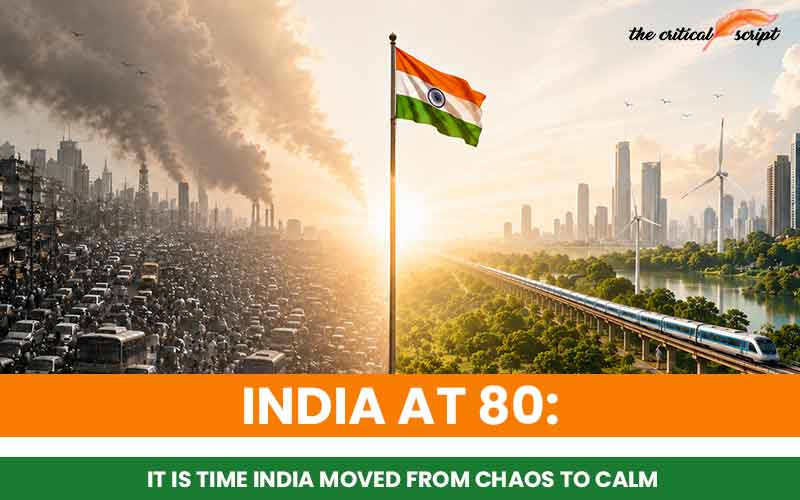
India at 80: It Is Time India Moved from Chaos to Calm
On 15 August 2027, India will complete 80 years of
independence. It will be an occasion of enormous national significance, and
rightly so. Few countries have travelled as far as India has since 1947, when a
newly independent nation emerged from colonial rule, Partition, poverty,
illiteracy and institutional weakness and chose the difficult path of
constitutional democracy. Eight decades later, India is a major economy, a
nuclear power, a spacefaring nation, a global technology hub and an
increasingly influential voice in international affairs. The scale of that
transformation should neither be underestimated nor apologized for.
Yet an 80th anniversary should be more than a
celebration of everything that has gone right. It should also be an opportunity
to ask whether the country has developed the institutional maturity, social
cohesion and quality of life that should accompany its economic and
geopolitical ambitions. India has become larger, louder and more visible, but
the next stage of its journey cannot simply be about becoming more of
everything. It has to be about becoming more stable, more efficient, more
liveable and more confident in its ability to solve problems without constantly
being consumed by them.
It is time India moved from chaos to calm.
The phrase is not a criticism of India's energy or
diversity. Those are among its greatest strengths. It is a recognition that a
country of India's size and ambition cannot continue to operate as though every
problem requires a crisis, every disagreement requires a confrontation and
every achievement requires a campaign. A mature India must learn to replace
noise with institutions, reaction with planning, political theatre with
governance and short-term excitement with long-term execution.
The India of 1947 had no choice but to build under
extraordinary pressure. The India of 2027 has fewer excuses for failing to
plan.
We have become an economic power, but the quality of life must now catch up
India's economic transformation is one of the
strongest arguments in favour of the country since independence. The World Bank
estimates that India's GDP reached approximately $3.96 trillion in 2025, while
the economy grew by 7.6 per cent that year. India has moved from an economy
struggling with food security and industrial capacity to one that is expected
to remain among the world's fastest-growing major economies.
But national wealth is meaningful only when it
improves individual lives.
India's GDP per capita remains around $2,700, and this
gap between the size of the economy and the economic circumstances of the
average citizen is perhaps the most important issue India must confront as it
approaches its eighth decade. A country can have billion-dollar companies, record
stock-market valuations, sophisticated digital infrastructure and an expanding
middle class while millions of families remain vulnerable to unemployment,
medical expenses, poor housing and inadequate public services.
The next phase of India's economic journey therefore
has to be less obsessed with the question of how quickly the economy is growing
and more concerned with how effectively that growth is being converted into
higher living standards. The measure of a successful India should increasingly
be whether a young person can find productive employment, whether a family can
access good healthcare without financial distress, whether children receive an
education that actually prepares them for the future and whether people can
live in cities that are safe, clean and reasonably affordable.
India does not need to choose between growth and
welfare. It needs to understand that sustainable growth ultimately depends on
the quality of the people and institutions that support it.
The education crisis is not solved by putting children in classrooms
India has made enormous progress in expanding access
to education, but the country still faces a serious learning challenge. The
Annual Status of Education Report 2024 found that only 27.1 per cent of rural
children in Class III could read a Class II-level text, while only 48.8 per
cent of Class V children could do so. In mathematics, just 30.7 per cent of
Class V children could solve the basic division problem assessed by the survey.
These numbers should change the way India talks about
education.
For decades, the national conversation has focused
heavily on school construction, enrolment, examinations and degrees. All of
these are important, but they cannot substitute for learning. A child spending five years in school without acquiring basic reading and
numeracy skills is not an administrative success simply because the attendance
register is full.
The problem is especially serious because India is
simultaneously talking about artificial intelligence, advanced manufacturing,
global technology leadership and a knowledge economy. Those ambitions require a
population capable of learning, reasoning and adapting. India cannot build the
workforce of the future while large sections of its children struggle with the
foundations of education.
The country therefore needs to move from an education
system that measures how many children enter schools to one that measures what
they actually learn there.
India's demographic advantage will become a liability if we waste it
India is often described as the world's most important
demographic opportunity, but population size is not an economic strategy.
According to UNFPA, India's population was approximately 1.46 billion in 2025,
while its fertility rate had fallen to around 2.0, close to replacement level.
The demographic reality is therefore changing faster than much of the political
conversation acknowledges.
The challenge is no longer simply to reduce population
growth. India must manage the consequences of having a very large population
while ensuring that those people are healthy, educated, skilled and
productively employed. It must also prepare for the gradual ageing of the
population that will follow the fertility decline.
This makes human capital the central issue of
India@80.
A population of more than a billion people can be
India's greatest strength if it possesses the education, health, skills and
employment opportunities necessary to generate prosperity. The same population
can become an enormous source of pressure if millions of young people compete
for inadequate employment, overcrowded cities and weak public services.
India therefore needs to stop treating population
merely as a numerical problem and start treating it as a human-capital
challenge.
The objective should not simply be fewer people. The
objective should be better lives for the people we already have.
Manipur is a reminder that national integration cannot be taken for granted
The violence in Manipur should occupy a central place
in any serious assessment of India at 80. The conflict has involved deaths,
displacement, destruction of homes and a profound deterioration of trust
between communities. The fact that a crisis of such magnitude can continue to
shape the lives of citizens while receiving inconsistent national attention
raises difficult questions about India's ability to respond to internal
conflicts with patience, institutional credibility and political imagination.
Manipur cannot be treated as a problem that disappears
whenever television cameras leave.
The restoration of order is only the beginning.
Genuine peace requires the rebuilding of trust, the return of displaced people
in conditions of safety and dignity, credible institutions and a political
process capable of addressing grievances without allowing them to become
permanent divisions. India's national unity cannot depend solely on the ability
of the state to maintain order. It must also depend on citizens believing that
the state is fair, responsive and capable of protecting them.
The Northeast has repeatedly been told that it is an
integral part of India. At 80, India must ensure that this is not merely a
constitutional statement but an everyday experience.
If Guwahati cannot handle rain, what does that say about urban India?
Guwahati, the largest city in the Northeast, offers
another example of the distance between India's ambitions and the reality of
its public infrastructure. Every year, heavy rainfall exposes weaknesses in
drainage, land-use planning, waste management and urban development, leaving large
parts of the city waterlogged and disrupting ordinary life.
This cannot simply be described as a problem caused by
excessive rain. Rain is a natural phenomenon. The responsibility of a modern
city is to design infrastructure that can accommodate the climate and geography
in which it exists.
Guwahati is not an isolated case. Bengaluru has
struggled with flooding, Delhi with air pollution, Mumbai with flooding and
congestion, and numerous Indian cities face increasingly severe problems with
heat, water, waste and transport.
India cannot call itself a future developed economy
while its largest cities remain unable to guarantee basic urban functionality.
The next infrastructure revolution therefore needs to
be less about impressive structures and more about liveability. A city should
be judged by how efficiently people can move, how reliably water and
electricity are supplied, how effectively waste is managed, how resilient the
drainage system is and whether ordinary citizens can afford to live reasonably
close to their work.
The India of the future must build cities that
function even when there is no ribbon-cutting ceremony.
India wants the Olympics, but it still has work to do as a sporting nation
India's ambition to host the Olympic Games is entirely
legitimate. A country of India's size, economic importance and sporting
potential should aspire to host the world's greatest sporting event.
But hosting the Olympics should not become a
substitute for developing a sporting culture.
India has never qualified for the men's FIFA World Cup
through sporting qualification, despite football being arguably the most
popular sport in the world. The point is not to mock Indian football or dismiss
the progress that has been made. It is to highlight the gap between India's enormous
population and its ability to consistently produce athletes and teams capable
of competing at the highest global level across major sports.
The country needs stronger school sports, better
grassroots coaching, more professional academies, improved sports science,
better scouting and greater opportunities for children outside the traditional
sporting centres.
India should absolutely dream of hosting the Olympics.
But it should dream even bigger about making sport
part of everyday life for millions of Indian children.
India has become very good at producing the appearance of progress
One of the more peculiar features of modern India is
the speed with which every achievement is converted into content. Roads are
filmed from drones, buildings are presented through cinematic montages, schemes
become reels, inaugurations become social-media campaigns and political
disagreements are compressed into thirty-second videos.
There is nothing wrong with communication. Governments
and institutions have every right to explain their work, and citizens have
every right to celebrate genuine achievement.
The problem begins when communication becomes a
substitute for performance.
India cannot solve urban flooding through a reel about
urban transformation. It cannot solve unemployment through an inspirational
video. It cannot improve education through a graphic celebrating enrolment. It
cannot build national cohesion through hashtags.
A country that spends too much time documenting
progress can eventually become less interested in measuring it.
India@80 needs to become more interested in outcomes
than optics.
Kashmir requires more than normalisation; it requires trust
India has made major political, administrative and
infrastructure changes in Jammu and Kashmir, and the region has experienced
significant changes in security and economic conditions. Yet the deeper
question of trust cannot be answered through development statistics alone.
The long-term success of India's approach to Kashmir
will ultimately depend on whether people feel that they possess a meaningful
and secure place within the country's political future. Roads, tourism and
investment matter enormously, but national integration is ultimately a question
of belonging.
A stable Kashmir cannot simply be one in which there
is less violence. It must be one in which political institutions have
credibility, citizens have confidence in their future and alienation is
steadily replaced by participation.
That process takes patience, not slogans.
India's neighbourhood still demands strategic maturity
India's relationship with China remains complicated by
strategic competition and the unresolved border question, while its
relationship with Bangladesh has also faced significant political strain in
recent years. For a country seeking a larger role in global affairs, this is a
reminder that power does not eliminate geography.
India will always have China as a major neighbour.
Bangladesh will remain central to India's interests because of geography,
trade, connectivity, migration and shared environmental systems.
The objective should therefore be neither naïve
friendship nor permanent confrontation. India needs the confidence and
diplomatic maturity to protect its interests while keeping channels of
engagement open.
A country becomes a serious power not merely when
others listen to it, but when it knows how to manage difficult relationships
without allowing every disagreement to become a crisis.
India's greatest challenge may be internal cohesion
The country is increasingly comfortable with political
disagreement, but it should be much more concerned about the possibility that
political competition could harden into permanent social fragmentation.
Bengal is deeply contested politically. The southern
states increasingly articulate distinct views on language, federalism,
taxation, representation and cultural identity. Kashmir continues to carry
layers of historical and political distrust. The Northeast has its own
complicated relationship with the national mainstream.
None of this is necessarily a threat to India.
Diversity of political opinion is a natural feature of a democracy.
The danger emerges when citizens begin to regard
people from another region, language group or political camp as fundamentally
alien to the national project.
India does not need uniformity to remain united. It
needs a political system in which difference does not produce insecurity.
That is why the relationship between the Centre and
the states will be one of the defining questions of India's next two decades.
Mumbai represents both India's extraordinary ambition and its extraordinary inequality
Mumbai is one of the world's great cities, but it also
represents one of India's most visible contradictions. It is a global financial
centre, home to some of the country's wealthiest citizens and institutions,
while millions of people live in informal settlements and struggle with
housing, commuting and the cost of urban life.
The city sometimes appears to belong to a different
economic universe from the India outside it.
That is not an accusation against Mumbai. It is an
indictment of the unequal distribution of opportunity.
The people who build the towers, clean the offices,
drive the taxis, work in restaurants and keep the city functioning should have
a reasonable chance of living with dignity in the city they help sustain.
A successful city cannot be one in which prosperity is
visible everywhere but accessible to relatively few.
Delhi cannot afford to become a country obsessed with politics
Delhi is the political centre of India, and politics
is indispensable to democracy. Yet the national capital can sometimes appear
consumed by political combat to an extent that overshadows the less glamorous
work of administration.
India's citizens do not experience government through
parliamentary speeches or television debates. They experience it through
schools, hospitals, roads, police stations, municipal services, electricity,
water and employment opportunities.
Political competition is necessary, but it should
ultimately produce better governance.
If politics becomes an end in itself, the country
begins to confuse the intensity of debate with the effectiveness of government.
India at 80 needs institutions that work quietly and
consistently, even when nobody is making a reel about them.
The real national project is raising the standard of living
This should be the central mission of India@80.
The country needs to become richer, but wealth must be
translated into higher living standards. It needs better public healthcare,
stronger schools, more productive employment, greater female participation in
the workforce, safer cities, cleaner air, more reliable water systems and
housing that ordinary people can actually afford.
The World Bank and UNDP figures tell us that India has
made significant progress, but they also show why averages are insufficient.
India's human-development progress remains constrained by inequality, and the
UNDP estimates that inequality reduces India's HDI by 30.7 per cent.
That is the challenge India must confront.
The country cannot become genuinely developed if
prosperity remains concentrated while opportunity remains uneven.
From chaos to calm
The phrase "chaos to calm" should not be
interpreted as a call for silence or conformity. India should remain noisy in
its democracy, argumentative in its public discourse and diverse in its
culture.
What needs to disappear is avoidable chaos.
There is a difference between democratic disagreement
and institutional dysfunction. There is a difference between political debate
and permanent political warfare. There is a difference between a vibrant city
and a city that cannot manage its drainage. There is a difference between a
country producing information and a country producing knowledge. There is a
difference between development being announced and development being
experienced.
India has reached a stage where its greatest challenge
is no longer proving that it can do big things.
It needs to prove that it can do ordinary things
exceptionally well.
It needs schools where children actually learn,
hospitals where citizens receive dependable care, cities that remain functional
during extreme weather, courts and institutions that inspire confidence, public
transport that saves rather than consumes people's time, jobs that allow young
people to build independent lives and political institutions capable of
resolving disagreements before they become crises.
This is what maturity looks like.
India@80 should be an audit, not a victory lap
India has every right to celebrate the journey from
1947 to 2027. The country has survived circumstances that could have broken
many nations, and it has built democratic, economic and technological
capabilities that deserve genuine recognition.
But the purpose of independence was never simply to
create a powerful state.
It was to create a society in which people could live
with freedom, dignity and opportunity.
That is why India's 80th anniversary should be treated
as an audit of the republic rather than merely a celebration of its
achievements.
We should ask whether the child in a remote village
receives an education good enough to compete with the child in a metropolitan
city. We should ask whether a woman can participate fully in the economy
without having to negotiate a series of social and institutional barriers. We
should ask whether a young person can find meaningful work without abandoning
their home state. We should ask whether a family can afford healthcare without
fearing financial ruin. We should ask whether our cities can withstand the
climate we have already created. We should ask whether people in Kashmir,
Manipur, the Northeast and every other region of the country feel that the
national project includes them equally.
And we should ask whether our politics is helping
answer these questions or merely keeping us permanently occupied with the next
controversy.
India does not need to become quieter. It needs to
become calmer in the way a confident country is calm: capable of disagreement
without hatred, ambition without anxiety, growth without chaos and power
without insecurity.
The next twenty years should be about turning India's
extraordinary potential into ordinary prosperity.
By the time India reaches 100 in 2047, the country
should not merely be able to say that it became one of the world's largest
economies. It should be able to say that its citizens became healthier, better
educated, more secure and more confident about their future.
That should be the real ambition of India@80.
There is one final, uncomfortable measure of India's progress: how Indians themselves feel when they carry the country's identity abroad. For some, saying “I am from India” can still come with hesitation because of stereotypes surrounding pollution, overcrowding, poor civic behaviour, scams, harassment and disorder. A country of India's ambition must aspire to a point where its citizens carry their identity not defensively, but with quiet confidence.
India@80 should therefore be about more than becoming richer or more powerful. It should be about becoming cleaner, calmer, safer, more dignified and more liveable.
India has spent 80 years building a powerful nation. It is time to build a better one.
It is time India moved from chaos to calm.
Disclaimer: The opinions expressed in this article are those of the author's. They do not purport to reflect the opinions or views of The Critical Script or its editor.
National Related Posts







Newsletter!!!
Subscribe to our weekly Newsletter and stay tuned.
Related Comments