


 INDIA ASIAN GAMES MEDAL MONITOR
·
India: 🥇 0
| 🥈 0
| 🥉 0
| Total: 0
INDIA ASIAN GAMES MEDAL MONITOR
·
India: 🥇 0
| 🥈 0
| 🥉 0
| Total: 0
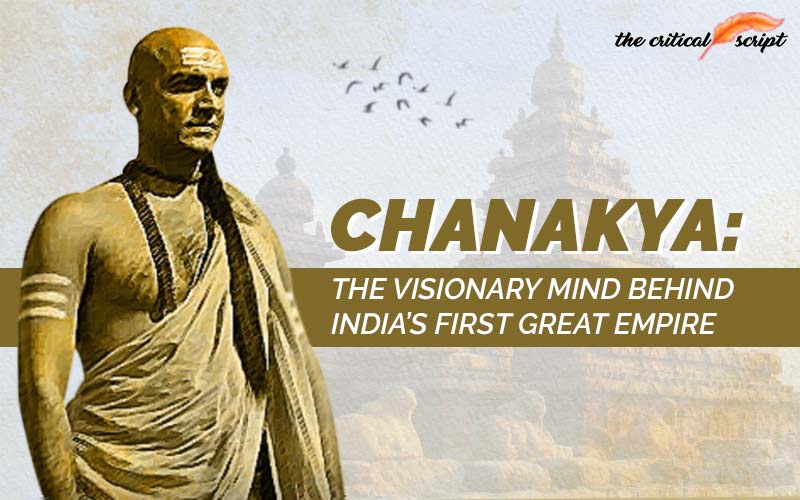
Chanakya: The Visionary Mind Behind India’s First Great Empire
In the vast landscape of Indian history, few names command as much respect and fascination as Chanakya. Known variously as Kautilya and Vishnugupta, Chanakya was not merely a scholar or philosopher; he was a master strategist, economist, political thinker, teacher, and nation-builder whose ideas shaped one of the greatest empires in ancient India.
More than two thousand years after his lifetime, Chanakya’s teachings continue to influence political science, economics, administration, diplomacy, military strategy, and leadership studies worldwide.
The Historical Context
Chanakya lived during the 4th century BCE, a period marked by political instability and regional fragmentation in the Indian subcontinent. Northern India was divided into numerous kingdoms and republics, while the powerful Nanda dynasty ruled Magadha, amassing immense wealth but facing growing public dissatisfaction.
At the same time, the invasion of Alexander the Great into northwestern India exposed the political vulnerabilities of the region. The need for strong and unified leadership became increasingly urgent.
It was during this turbulent era that Chanakya emerged as one of the most influential minds in Indian civilization.
Early Life and Education
Although details about Chanakya’s birthplace remain debated among historians, many scholars believe he was born in the region of Takshashila, an ancient center of learning located in present-day Pakistan.
Chanakya was associated with the famed Takshashila University, where he studied and later taught subjects such as political science, economics, warfare, diplomacy, and philosophy.
Historical accounts describe him as exceptionally intelligent, sharp-minded, disciplined, and deeply committed to statecraft. Despite not being physically imposing, Chanakya possessed an extraordinary intellect and unmatched strategic vision.
The Rise of Chandragupta Maurya
Chanakya’s most defining contribution was his role in the rise of Chandragupta Maurya.
According to traditional narratives, Chanakya was insulted at the court of the Nanda rulers of Magadha. Determined to overthrow what he saw as corrupt and ineffective governance, he began searching for a capable leader who could unite the fragmented kingdoms of India.
He found that leader in Chandragupta Maurya, a young man of exceptional courage and leadership potential.
Chanakya became Chandragupta’s mentor, political guide, and strategist. Through military planning, diplomacy, alliances, and administrative reforms, they successfully defeated the Nanda dynasty and laid the foundation of the Mauryan Empire around 321 BCE.
The empire eventually grew into one of the largest political entities in Indian history, stretching across vast parts of the subcontinent.
The Arthashastra: A Timeless Political Treatise
Chanakya is widely credited as the author of the Arthashastra, one of the world’s earliest and most sophisticated works on governance and political economy.
The Arthashastra was far more than a political treatise; it was a sophisticated blueprint for statecraft that explored governance, economic policy, taxation, agriculture, trade, law, military strategy, diplomacy, espionage, foreign relations, and public welfare with remarkable depth and realism.
The text reveals Chanakya’s practical and often realist approach to governance. He believed that the stability and prosperity of the state depended on capable leadership, strong institutions, economic strength, and internal security.
Many scholars compare Chanakya’s political realism with thinkers such as Niccolò Machiavelli, although Chanakya’s work predates Machiavelli’s writings by nearly 1,800 years.
Chanakya’s Philosophy of Governance
Chanakya viewed the king not as an absolute ruler, but as a guardian of the people’s welfare. One of his core beliefs was that the happiness of the subjects determined the strength of the kingdom.
He famously emphasized discipline, strategic thinking, education, and self-control as essential qualities of leadership.
His governance philosophy balanced pragmatism with ethical responsibility. While he supported strong political measures when necessary, he also stressed justice, accountability, and economic prosperity for the people.
Chanakya advocated a model of governance rooted in efficient administration, merit-based appointments, economic strength, national security, strategic diplomacy, robust intelligence networks, and a welfare-oriented state committed to stability and public prosperity.
Many of these principles remain relevant in modern governance and management studies.
Intelligence and Diplomacy
One of Chanakya’s most remarkable contributions was his sophisticated understanding of intelligence gathering and diplomacy.
The Arthashastra describes elaborate systems of espionage, counter-intelligence, and strategic alliances. Chanakya recognized that information was one of the greatest tools of statecraft.
He developed the “Mandala Theory” of foreign policy, which analyzed relationships between neighboring kingdoms, allies, and enemies. This strategic framework continues to attract interest among scholars of international relations.
Chanakya’s Influence on Modern Thought
Chanakya’s ideas continue to resonate far beyond ancient India, influencing modern disciplines such as political science, public administration, economics, military strategy, business management, and leadership studies through their sharp understanding of power, governance, and human behavior.
His quotes on discipline, wisdom, secrecy, leadership, and human behavior are frequently cited in modern discussions on governance and success.
Institutions, policymakers, entrepreneurs, and management experts continue to draw inspiration from his strategic thinking and administrative insights.
Legacy of a Nation Builder
Chanakya’s greatest achievement was not merely helping establish an empire, it was shaping a vision of governance that prioritized stability, prosperity, and long-term national strength.
He transformed political thought in ancient India and demonstrated how intellect, planning, and determination could alter the course of history.
More than two millennia later, Chanakya remains a symbol of wisdom, strategy, resilience, and visionary leadership.
His life stands as a reminder that ideas, when guided by purpose and conviction, possess the power to shape civilizations.
Disclaimer: The opinions expressed in this article are those of the author's. They do not purport to reflect the opinions or views of The Critical Script or its editor.
History And Facts Related Posts










Newsletter!!!
Subscribe to our weekly Newsletter and stay tuned.
Related Comments