


 INDIA ASIAN GAMES MEDAL MONITOR
·
India: 🥇 0
| 🥈 0
| 🥉 0
| Total: 0
INDIA ASIAN GAMES MEDAL MONITOR
·
India: 🥇 0
| 🥈 0
| 🥉 0
| Total: 0
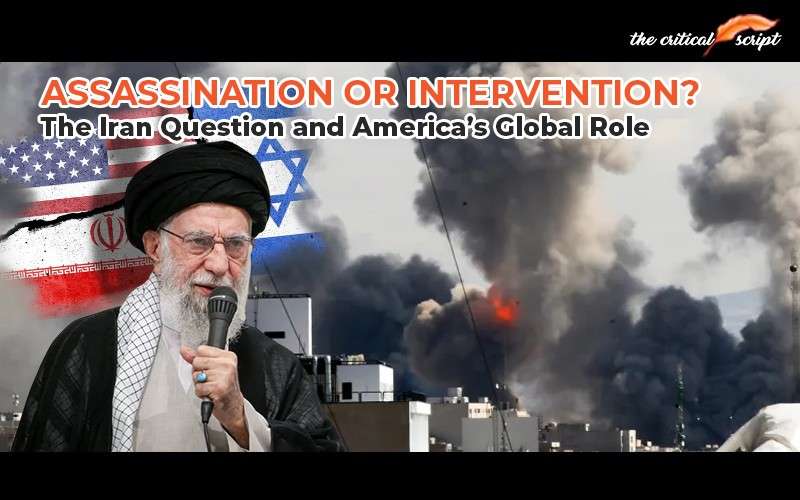
Assassination or Intervention? The Iran Question and America’s Global Role
The debate is not about whether Ayatollah Ali Khamenei was an
authoritarian leader. Many critics of Iran’s political system, both inside and
outside the country, have long described his rule as repressive. Nor is it
about denying Iran’s regional posture, including its support for groups such as
Hamas in its confrontation with Israel.
The deeper question is this: Does any external power have the
moral or legal authority to eliminate the leader of a sovereign state?
Iran is an independent nation. Its internal political future,
however contested, ultimately belongs to its people. In recent years, the
country has witnessed significant unrest and public protests, signaling frustration
and erosion of public trust in its leadership. History shows that entrenched
regimes often face change not through foreign intervention but through internal
pressure, generational transition, and the gradual shift in political currents.
When a global power chooses direct force against the leadership
of another sovereign state, it reshapes more than a political equation. It sets
a precedent. International law, the United Nations framework, and the principle
of sovereignty were built precisely to prevent powerful nations from acting as
arbiters of who governs weaker ones.
The United States has often justified interventions as necessary
for global stability, counterterrorism, or regional security. Yet the aftermath
of such actions frequently raises uncomfortable questions. Military strikes may
remove individuals, but they rarely remove the underlying tensions. Instead,
they can intensify nationalist sentiment, harden ideological positions, and
create cycles of retaliation that spiral beyond their original scope.
Critics argue that such actions reinforce the perception of
American hegemony, a superpower exercising force far from its own borders while
remaining insulated from the immediate humanitarian consequences. Instability
in the Middle East does not remain regional; it affects energy markets,
migration flows, diplomatic alignments, and global security frameworks.
Supporters of intervention might counter that inaction in the
face of regional aggression also carries risks. However, the principle at stake
remains critical: Is regime change, whether direct or indirect, a legitimate
instrument of foreign policy?
If a leadership is already facing declining legitimacy at home,
external force can paradoxically prolong its narrative of victimhood. Internal
reform movements may be overshadowed by nationalistic backlash. The space for
organic political evolution narrows when geopolitics dominates domestic
discourse.
History repeatedly demonstrates that imposed solutions seldom
yield stable democracies. Durable political transformation typically emerges
from within societies themselves, through civic pressure, institutional reform,
and generational change.
The central issue is not admiration for a regime, nor
indifference to its policies. It is about preserving the fragile architecture
of international order. When sovereignty becomes conditional upon the approval
of more powerful states, the global system shifts from rules to might.
In a world already strained by proxy conflicts and strategic
rivalries, the path toward long-term peace demands restraint as much as
resolve. The consequences of force often echo far beyond the battlefield,
shaping perceptions, alliances, and grievances for decades.
The Iran question, therefore, is not simply about one leader or
one country. It is about whether global stability is better secured through
power projection or principled diplomacy.
Disclaimer: The opinions expressed in this article are those of the author's. They do not purport to reflect the opinions or views of The Critical Script or its editor.
World Related Posts







Newsletter!!!
Subscribe to our weekly Newsletter and stay tuned.
Related Comments