


 INDIA ASIAN GAMES MEDAL MONITOR
·
India: 🥇 0
| 🥈 0
| 🥉 0
| Total: 0
INDIA ASIAN GAMES MEDAL MONITOR
·
India: 🥇 0
| 🥈 0
| 🥉 0
| Total: 0
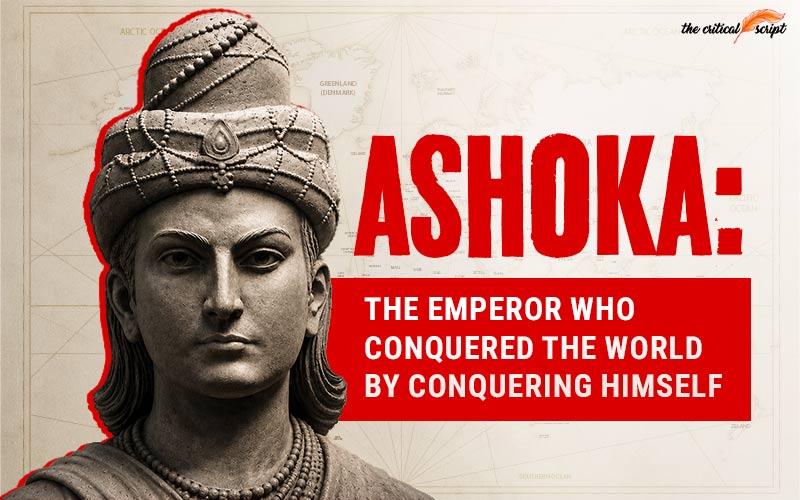
Ashoka: The Emperor Who Conquered the World by Conquering Himself
Few rulers in history transformed as extraordinarily as Ashoka Maurya - a prince remembered first for bloodshed and conquest, and later revered as one of humanity’s greatest symbols of peace, morality, and ethical governance.
History remembers many conquerors, but very few conquerors ever regretted victory. Ashoka’s story stands apart because it is not merely the story of an emperor who built one of the ancient world’s greatest empires, but of a ruler transformed by violence itself. He rose through warfare and imperial ambition, witnessed unimaginable destruction, and eventually emerged with a radically different vision of power and kingship. Before becoming “Ashoka the Great,” he was feared as a ruthless conqueror; after Kalinga, he became revered as a moral emperor whose legacy transcended borders and centuries.
Ashoka was born into the Mauryan Empire during the reign of his grandfather, Chandragupta Maurya, and grew up under the rule of his father, Emperor Bindusara. By then, the Mauryan Empire had already become the dominant political force across much of the Indian subcontinent. The imperial capital of Pataliputra stood among the greatest cities of the ancient world, filled with administrative buildings, military establishments, markets, and royal palaces. Ashoka’s upbringing was shaped not by peace, but by imperial discipline, political rivalry, military ambition, and the constant pressures of court politics.
Ancient traditions portray Ashoka as intelligent, determined, fearless, and at times severe in temperament. Some Buddhist sources even describe him as physically unimpressive yet exceptionally capable, a prince who earned authority through military talent and relentless ambition rather than charm alone. Unlike later portrayals of Ashoka as a peaceful ruler, the young prince was very much a product of an empire built through conquest and centralized power.
The Mauryan court, after Bindusara, was marked by intense succession struggles. Historical traditions suggest that Ashoka was not initially the obvious heir to the throne and had to overcome strong political opposition from rival princes and competing factions within the royal court. Though the exact details remain debated, many accounts indicate that Ashoka secured the throne only after a fierce struggle following Bindusara’s death around 273 BCE. Some later legends even claim that several rival brothers were eliminated during the succession conflict, though historians continue to debate the accuracy of such narratives. What remains clear is that Ashoka’s rise to power emerged from political conflict rather than peaceful inheritance.
The early years of Ashoka’s reign reflected the traditional Mauryan model of imperial expansion and centralized authority. He governed through military strength, administrative discipline, and territorial consolidation. Like many rulers of his era, Ashoka believed that imperial greatness depended upon conquest, expansion, and the unquestioned authority of the throne. His reign initially continued the Mauryan tradition established by Chandragupta Maurya and strengthened under Bindusara.
The defining turning point of Ashoka’s life came with the invasion of Kalinga around 261 BCE. Kalinga, located in present-day Odisha, was a prosperous and independent kingdom strategically important for maritime trade and regional influence. Unlike many surrounding territories, Kalinga had resisted Mauryan domination, making it both a political and symbolic target for imperial expansion.
Ashoka launched a massive military campaign against the kingdom. The war that followed became one of the bloodiest conflicts in ancient Indian history. According to Ashoka’s own inscriptions, more than one hundred thousand people were killed, many more were wounded, and countless civilians were displaced. Entire communities suffered devastation, and the human suffering caused by the war was immense.
What makes the Kalinga War historically extraordinary is not simply the scale of destruction, but Ashoka’s reaction afterward. Unlike many conquerors who glorified warfare and celebrated victory, Ashoka publicly expressed remorse for the suffering caused by the conflict. His inscriptions describe deep regret over the deaths, displacement, and grief inflicted upon ordinary people. This moment became one of the earliest known examples in world history of a victorious emperor openly questioning the morality of conquest.
The devastation of Kalinga transformed Ashoka profoundly. Instead of becoming harsher after victory, he became introspective. The emperor who once sought glory through conquest gradually embraced Buddhism and adopted a governing philosophy centered around Dhamma, a moral framework emphasizing compassion, ethical conduct, non-violence, religious tolerance, justice, and public welfare.
Importantly, Ashoka did not abandon kingship or dismantle the empire. Rather, he attempted something revolutionary for his time: governing a vast empire through moral authority as much as military power. His administration increasingly focused on the welfare of subjects and the ethical responsibilities of the ruler.
Ashoka’s policies emphasized compassion, public welfare, religious tolerance, and humane governance. He ordered the construction of roads, wells, rest houses, and medical facilities for both humans and animals. Trees were planted along travel routes to provide shade for travelers, and efforts were made to reduce unnecessary animal slaughter. His inscriptions repeatedly stressed respect toward parents, teachers, elders, and followers of all religions.
One of Ashoka’s greatest innovations was his use of inscriptions to communicate directly with the people. Across the empire, messages were carved onto rocks and pillars in local languages and scripts. These edicts discussed morality, justice, compassion, religious harmony, and responsible governance. Unlike many ancient rulers who presented themselves as distant divine figures, Ashoka’s inscriptions reveal a ruler attempting to engage with society in deeply personal and ethical terms.
Although Ashoka embraced Buddhism, he did not impose it aggressively upon the empire. Instead, he promoted coexistence among different religious communities. However, his patronage transformed Buddhism from a regional spiritual movement into a major global religion. Under Ashoka’s support, monasteries expanded, Buddhist councils were organized, and missionaries traveled to Sri Lanka, Central Asia, and Southeast Asia. According to tradition, Ashoka’s own son Mahinda and daughter Sanghamitta helped carry Buddhism to Sri Lanka, from where it later spread further across Asia.
Without Ashoka’s patronage, Buddhism may never have evolved into one of the world’s major religions. His reign helped shape the spiritual and cultural history of much of Asia for centuries to come.
Even today, Ashoka’s legacy remains deeply embedded within modern India. The Lion Capital of Ashoka was adopted as India’s national emblem, while the Ashoka Chakra occupies the center of the Indian national flag. Over time, Ashoka came to symbolize not merely imperial power, but moral leadership and ethical governance.
Yet Ashoka’s story is not entirely simple. Historians continue to debate the depth and nature of his transformation. Some argue that he remained a practical ruler beneath the moral image, while others view him as one of history’s rare examples of genuine ethical change within political power. Questions also remain regarding whether his later policies weakened the military foundations of the Mauryan Empire after his death.
Nevertheless, Ashoka’s journey continues to resonate because it raises timeless questions about power, morality, violence, and leadership. Most emperors are remembered for the territories they conquered. Ashoka is remembered for conquering his own conscience.
In many ways, Ashoka achieved two victories in his lifetime. The first was the conquest of Kalinga through military force. The second was the conquest of himself through moral awakening. The first expanded an empire; the second transformed history.
That is why, more than two thousand years later, Ashoka remains not merely one of India’s greatest rulers, but one of the most extraordinary figures in world history, an emperor who discovered that the highest form of power lies not in domination over others, but in mastery over one’s own humanity.
Disclaimer: The opinions expressed in this article are those of the author's. They do not purport to reflect the opinions or views of The Critical Script or its editor.
History And Facts Related Posts







Newsletter!!!
Subscribe to our weekly Newsletter and stay tuned.
Related Comments