


 INDIA ASIAN GAMES MEDAL MONITOR
·
India: 🥇 0
| 🥈 0
| 🥉 0
| Total: 0
INDIA ASIAN GAMES MEDAL MONITOR
·
India: 🥇 0
| 🥈 0
| 🥉 0
| Total: 0
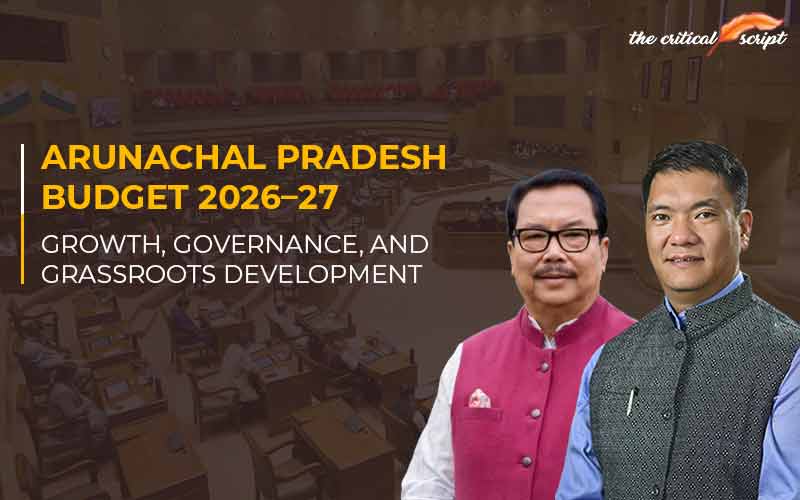
Arunachal Pradesh Budget 2026–27: Growth, Governance, and Grassroots Development
Itanagar, 10th March: The Arunachal Pradesh Budget 2026–27, presented on
10 March 2026 by Deputy Chief Minister Chowna Mein, outlines a
development-oriented fiscal roadmap aimed at accelerating economic growth while
strengthening social infrastructure and governance. The budget reflects the
state government’s attempt to balance economic expansion, human development,
and inclusive growth, aligning with the three broad priorities or “Kartavyas”
outlined in the national budget framework.
With a focus on infrastructure, energy, agriculture, entrepreneurship,
and social welfare, the budget seeks to leverage Arunachal Pradesh’s natural
resources and strategic location while improving quality of life for its
citizens.
Fiscal Position and Economic Outlook
The budget estimates the state’s Gross State Domestic Product (GSDP) at
approximately ₹41,314 crore at current prices, reflecting steady economic
growth over the past decade. The fiscal framework indicates a cautious but
optimistic financial approach.
Total projected receipts for FY 2026–27 are estimated at ₹39,442 crore,
comprising ₹34,125 crore in revenue receipts and ₹5,317 crore in capital
receipts. The State’s own revenue is expected to reach ₹5,208 crore, including
₹3,634 crore from tax revenue and ₹1,575 crore from non-tax revenue.
A significant portion of Arunachal Pradesh’s finances continues to depend
on central transfers. The share of central taxes is projected at ₹20,665 crore
in the 2026–27 budget estimates, slightly lower than the revised estimate of
₹24,475 crore for 2025–26.
The fiscal deficit remains within manageable limits. The revised estimate
for FY 2025–26 stands at ₹650 crore (1.57% of GSDP), while the budget estimate
for FY 2026–27 is projected at ₹701 crore (1.70% of GSDP). This indicates
fiscal prudence and adherence to responsible budget management norms.
Strategic Priorities: The Three “Kartavyas”
The state budget emphasizes three overarching responsibilities aligned
with national development priorities.
The first priority focuses on accelerating economic growth by expanding
infrastructure, industrial activity, and energy generation. The second seeks to
build human capacity and improve social outcomes through investments in
education, health, and youth development. The third emphasizes inclusive
progress, ensuring that development benefits reach remote regions, vulnerable
communities, and emerging economic sectors.
This framework reflects a broader attempt to integrate economic expansion
with social equity and governance reforms.
Strengthening Infrastructure and Economic Foundations
Infrastructure development remains one of the most significant components
of the budget.
Hydropower Expansion
Arunachal Pradesh’s hydropower potential continues to form the backbone
of its long-term economic strategy. The government has announced plans to
commission 19 gigawatts of hydropower capacity, backed by investments of approximately
₹1.9 lakh crore. Three hydropower projects are scheduled to begin construction
during the current fiscal year.
In addition, the government aims to monetize power worth ₹4,520 crore
between 2025 and 2035, indicating a strategic shift toward revenue generation
through energy exports.
A revised Small Hydro Power Policy is also expected to attract private
investment in smaller hydropower projects.
Mining and Energy Security
The Namchick–Namphuk coal block is expected to become the state’s first
operational commercial coal mine. The project could contribute to local
employment while improving the region’s energy security.
The government has also announced initiatives under the Chief Minister’s
Comprehensive State Power Development Programme, including a push toward 100
percent feeder metering to enhance energy efficiency and accountability.
Connectivity and Urban Infrastructure
Connectivity improvements form another central pillar of the budget.
The government plans to allocate ₹500 crore under the Chief Minister’s
State Rural Roads Development Programme to build roads not covered by the
national PMGSY scheme. These projects are expected to strengthen last-mile
connectivity in remote regions.
Additional proposals include the development of an aerocity near Donyi
Polo Airport at Hollongi, along with a state-of-the-art convention centre
integrated with a hotel facility.
The government has also proposed a ₹70 crore off-grid electrification
programme aimed at providing electricity to border villages and remote
settlements.
Environmental Sustainability and Biodiversity Protection
Given Arunachal Pradesh’s ecological significance, the budget also places
emphasis on environmental conservation.
The government has notified four new protected areas, two wildlife
sanctuaries and two community reserves, to safeguard biodiversity and reduce
human–wildlife conflict.
Technological tools such as GIS mapping, camera traps, and drones will be
deployed to strengthen wildlife monitoring and habitat protection.
In addition, a Special Tiger Protection Force will be recruited for major
tiger reserves including Pakke, Namdapha, and Kamlang.
The state will also promote bird and butterfly festivals as official
tourism events, linking conservation efforts with eco-tourism development.
People-Centric Development
A significant portion of the budget is dedicated to social development
and human capital.
Health Infrastructure
The government has announced the creation of new operation theatres,
including cardiovascular facilities, at the TomoRiba Institute of Health and
Medical Sciences (TRIHMS).
New hospitals will be established in Tato and Nafra, while emergency
trauma centres are planned in all districts.
The expansion of digital health initiatives will allow patients to access
electronic health records, improving efficiency and reducing out-of-pocket
healthcare costs.
Education Reforms
Education policy reforms include the introduction of a third-language
policy from Class I to VIII, incorporating local languages into school
curricula.
New initiatives include:
●
Establishment of AVCG (Animation, Visual Effects, Gaming and Comics) labs
in educational institutions
●
Creation of a Centre for Japanese Language Studies at Arunachal Pradesh
University
●
Construction of girls’ hostels in every district
Infrastructure upgrades are also planned for several higher education
institutions across the state.
Youth and Sports Development
The government has announced several initiatives aimed at youth
empowerment.
These include the Chief Minister’s Athletics Coaching and Empowerment
Scheme, the Mission Olympics programme, and the Chief Minister’s School Sports
Programme.
The Arunachal State Games will also be institutionalized as a regular
calendar event.
Agriculture and Rural Economy
Agriculture remains a critical pillar of the state’s economy.
The government plans to expand oil palm cultivation to over 36,000
hectares by 2027 under the National Mission on Edible Oils.
Additional initiatives include:
●
Expansion of the Arunachal Millet and Buckwheat Mission
●
Strengthening of KrishiVigyanKendras (KVKs)
●
Implementation of AI-based agricultural advisory platforms
●
Promotion of kiwi cultivation, mushroom farming, and honey production
Livestock initiatives such as mithun and yak rearing will also receive
support.
A Yak Fibre Processing Facility at Dirang is proposed to strengthen value
chains for indigenous livestock products.
Tourism and Cultural Promotion
Tourism development forms another important economic priority.
The government plans to establish a World War II Heritage Museum linked
to the historical Stilwell Road.
The Siang Adventure and Eco Retreat in Pasighat is expected to become a
major tourism destination, with an estimated project cost of ₹46.48 crore.
The government also plans to promote wine tourism and adventure tourism,
reflecting an effort to diversify the state’s tourism offerings.
Entrepreneurship and Employment
To boost entrepreneurship, the budget introduces several initiatives
aimed at supporting small businesses and startups.
The ARUN MSME Mission will provide annual support to enterprises, while
the Arunachal Pradesh Startup Manch will offer mentorship and funding
opportunities for young entrepreneurs.
The DeenDayalUpadhyayaSwavalambanYojana has received an allocation of
₹200 crore, benefiting more than 2,500 entrepreneurs.
Skill development programmes will also train allied health professionals
and caregivers, preparing youth for emerging employment sectors.
Governance and Institutional Reforms
Administrative reforms are another focus area of the budget.
The government plans to implement electronic Human Resource Management
Systems across all departments, strengthen digital governance, and improve land
record management.
The e-Inner Line Permit (e-ILP) system will be upgraded to enhance
monitoring and streamline travel regulations.
Investments are also planned in forensic laboratories, police
infrastructure, and fire stations to strengthen public safety systems.
Looking Ahead: From Policy to Implementation
The Arunachal Pradesh Budget 2026–27 presents a comprehensive development
agenda combining infrastructure expansion, environmental protection, social
welfare, and governance reforms.
By emphasizing hydropower, agriculture modernization, tourism, and
entrepreneurship, the government aims to leverage the state’s natural resources
while improving economic opportunities for its citizens.
However, the success of the budget will ultimately depend on effective
implementation, sustained fiscal discipline, and the ability to translate
policy announcements into tangible outcomes on the ground.
If executed efficiently, the initiatives outlined in the budget could
play a significant role in transforming Arunachal Pradesh’s economic landscape
over the coming decade.
Disclaimer: The opinions expressed in this article are those of the author's. They do not purport to reflect the opinions or views of The Critical Script or its editor.
Regional Related Posts









Newsletter!!!
Subscribe to our weekly Newsletter and stay tuned.
Related Comments