


 INDIA ASIAN GAMES MEDAL MONITOR
·
India: 🥇 0
| 🥈 0
| 🥉 0
| Total: 0
INDIA ASIAN GAMES MEDAL MONITOR
·
India: 🥇 0
| 🥈 0
| 🥉 0
| Total: 0
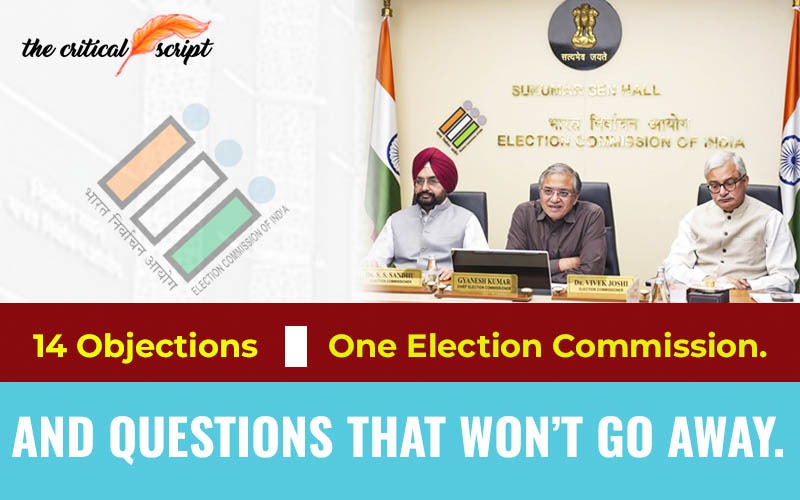
14 Objections. One Election Commission. And Questions That Won’t Go Away.
There is something deeply consequential about what
has now emerged from inside the Election Commission of India. Not simply
because two Election Commissioners disagreed with the Chief Election
Commissioner. Institutions can contain disagreement. In fact, disagreement
within a constitutional body is not, by itself, a crisis.
What makes this episode significant is what those disagreements were about.
According to an investigation by The Indian Express, Election Commissioners Sukhbir Singh Sandhu and Vivek Joshi formally objected at least 14 times over a period of 10 months to decisions and orders which they said were taken without their knowledge. Their objections touched some of the most fundamental functions of the Election Commission: adding and deleting names from electoral rolls, changes to voter registration procedures, access to the electoral database and the functioning of the technology through which voter records are maintained. ([The Indian Express][1])
One of the disputes concerned Form 6, the application used by new voters to register. Joshi had reportedly raised concerns about changes to the form, while Sandhu subsequently recorded that the alteration was unauthorised and should be removed. Another set of objections concerned what the Commissioners described as the gradual centralisation of access to the electoral roll database and whether statutory officials on the ground continued to have the access they were legally supposed to have. ([The Indian Express][1])
Then there was West Bengal.
Sandhu questioned who had authorised appeals filed against voters who had been included by judicial officers during the SIR process, and who had actually filed those appeals on behalf of the Election Commission. These were not questions about political ideology. They were questions about procedure, authority and institutional accountability.
And that brings us to the uncomfortable part.
The Election Commission is not a one-person institution. Article 324 places the conduct of elections in the hands of the Commission, and the 2023 law governing the Chief Election Commissioner and Election Commissioners provides that, as far as possible, the Commission's business should be transacted unanimously. Where its members differ, the law provides for a majority decision.
So disagreement itself is not the problem.
The real question is whether the disagreement was properly heard, documented, resolved and communicated within the institution.
The Indian Express reported that the two Commissioners' objections were copied to CEC Gyanesh Kumar and other officials. It also reported that the full three-member Commission met on September 9, 2026, for the first time in four months. The Election Commission had not responded to detailed questions sent by the newspaper about how the objections were addressed.
There is another layer here that cannot simply be reduced to political accusation.
The ECI has defended differing views within the Commission as part of normal institutional deliberation. Political parties and leaders, meanwhile, have interpreted the reported objections in much stronger terms, with some demanding action against the CEC. Those are political interpretations, not established findings of fact.
But politics aside, the institutional questions remain.
> Who authorised a particular decision?
> Who had access to the electoral database?
> Who could alter voter records?
> Under what authority were procedures changed?
> Were statutory officials being given the access
and oversight contemplated by law?
> And when members of the Commission itself
raised objections, how were those objections dealt with?
These questions matter because an electoral roll is not merely a spreadsheet. Behind every entry is a citizen's right to participate in an election. At the same time, maintaining accurate electoral rolls is itself an essential responsibility of the Election Commission. The challenge is to do both transparently, lawfully and with adequate safeguards.
The credibility of an election does not depend only on what happens inside the polling booth. It also depends on whether citizens can trust the machinery that determines who appears on the electoral roll before they ever reach that booth.
Perhaps that is why the most important part of this entire story is not the existence of disagreement inside the Election Commission.
It is whether the institution can answer the questions raised by its own members, clearly and publicly, with the law and the record in full view.
Because when the guardians of the electoral process start asking questions about the process themselves, those questions deserve answers.
Not because disagreement proves wrongdoing.
But because democracy works best when institutions entrusted with enormous power are willing to explain how that power is being exercised.
Disclaimer: The opinions expressed in this article are those of the author's. They do not purport to reflect the opinions or views of The Critical Script or its editor.
Politics Related Posts








Newsletter!!!
Subscribe to our weekly Newsletter and stay tuned.
Related Comments