


 INDIA ASIAN GAMES MEDAL MONITOR
·
India: 🥇 0
| 🥈 0
| 🥉 0
| Total: 0
INDIA ASIAN GAMES MEDAL MONITOR
·
India: 🥇 0
| 🥈 0
| 🥉 0
| Total: 0
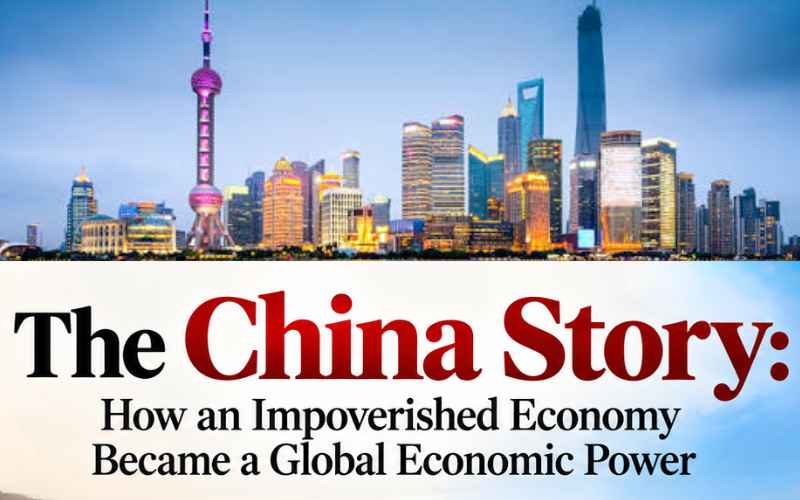
The China Story: How an Impoverished Economy Became a Global Economic Power
There is a tendency to tell the story of China’s rise as though it were inevitable, as if a country of its size was always destined to become an economic giant. It was not. In the 1960s and 1970s, China and India were both poor, predominantly agrarian economies, with broadly comparable levels of income per person. The real divergence came later, particularly after China began its programme of “reform and opening up” in 1978. What followed was not a sudden miracle, but one of the most sustained periods of economic transformation in modern history. Since 1978, China’s real GDP growth has averaged close to 9 percent a year, and its economy has grown almost sixty-fold in real terms.
The significance of the China story lies not simply in the fact that China became richer than it was before. Many countries have grown. What makes China's experience extraordinary is the scale, speed and breadth of the transformation. In the space of a few decades, a largely rural society became an urban and industrial one; millions moved from subsistence agriculture into manufacturing and services; infrastructure was built on an enormous scale; domestic companies entered global markets; and the country gradually moved from producing low-cost goods to competing in increasingly sophisticated technologies.
The starting point was not particularly promising. Before 1978, China's economy was dominated by central planning. Agriculture was organised through communes, state-owned enterprises occupied a dominant position in industry, labour mobility was heavily restricted and the economy was relatively closed to foreign investment and international trade. The economic system had created certain capabilities, particularly in basic education and industrial capacity, but productivity remained low. The reforms that began in 1978 changed the incentives facing farmers, workers, businesses and local governments.
The first major experiment happened in the countryside. China introduced the Household Responsibility System, giving farming households greater control over production and allowing them to retain surplus income. The effect was dramatic. Agricultural productivity improved, rural incomes rose and farmers had stronger incentives to produce more efficiently. Between 1978 and 1990, rural incomes grew by more than 8 percent annually. This was important not only for agriculture; higher productivity meant that millions of workers could gradually move towards manufacturing, construction and urban employment.
China then did something that became characteristic of its development strategy: it experimented before it fully committed. Rather than attempting to transform the entire economy overnight, it created Special Economic Zones where new rules could be tested. Shenzhen became the most famous example. These zones offered more favourable conditions for investment and trade and helped China attract foreign capital, technology and management expertise. The model was gradually expanded as policymakers observed what worked. The World Bank has identified Special Economic Zones and industrial clusters as important engines of China's rapid development, while the IMF has highlighted the incremental and experimental character of the reform process.
This willingness to experiment was perhaps one of the most important features of the Chinese approach. China did not have to decide everything correctly at the beginning. It could try something in one province, city or sector, learn from the outcome and then expand it. This approach allowed market mechanisms to grow without immediately dismantling the entire state economic structure. State-owned enterprises remained important, but private enterprises were given increasing room to operate. Prices were gradually liberalised, foreign investment was encouraged and the banking system was developed to channel savings towards infrastructure and industrial investment.
Then came manufacturing.
China possessed something that global manufacturers desperately needed: a huge labour force, improving infrastructure and an increasingly connected domestic market. The country initially became competitive in labour-intensive industries such as textiles, garments, footwear, toys and basic electronics. But manufacturing did much more than create factories. It created ecosystems. Once one factory arrived, suppliers followed. Once suppliers arrived, skilled workers were needed. Once workers and suppliers clustered together, more companies found it attractive to invest there.
This is how places such as the Pearl River Delta and Yangtze River Delta evolved into enormous industrial ecosystems. Manufacturing stopped being simply about individual factories and became an integrated network of suppliers, logistics companies, ports, research institutions, workers and consumers.
Infrastructure was a critical part of this process. China invested heavily in roads, ports, airports, railways, power generation, telecommunications, industrial parks and urban infrastructure. The result was an economic geography in which factories could access suppliers, workers could move towards employment centres and products could be transported rapidly to domestic and international markets. China's urban population increased by more than 750 million people over five decades, according to the IMF.
This is where the story becomes visible to anyone travelling through China. The transformation can literally be seen in its cities.
Shenzhen is perhaps the clearest example. What was once a relatively modest settlement near Hong Kong became one of the world's major technology and manufacturing centres. Shanghai developed into a global financial and commercial hub. Cities across the country built metro systems, airports, high-speed rail connections, industrial parks and new urban districts at a scale that fundamentally changed the country's physical landscape.
The cities were not simply beneficiaries of economic growth; they became engines of growth themselves.
China's integration into the global economy accelerated further with its accession to the World Trade Organization in 2001. By then, the country had already developed a huge manufacturing base, but WTO membership deepened its integration into international supply chains. Chinese companies gained greater access to global markets while multinational corporations expanded production networks in China.
The result was extraordinary export growth.
China's share of global trade increased from less than 1 percent in 1978 to more than 12 percent in recent years, making it one of the world's largest trading nations and the world's largest exporter.
But perhaps the most important part of China's story is what happened after it became the world's factory.
China could have remained a low-cost manufacturing economy. Instead, it began attempting to move up the value chain.
The country moved from textiles and toys towards machinery, electronics, automobiles, telecommunications equipment, batteries, solar technology, robotics, electric vehicles and advanced industrial equipment. Companies such as Huawei, BYD and CATL emerged from this changing industrial ecosystem, while China's enormous domestic market gave businesses the ability to test and scale products at home before competing internationally.
This transition required something that cheap labour alone could never provide: knowledge.
China invested heavily in education, engineering, scientific research and technological capability. In 2024, China's expenditure on research and experimental development reached 3.613 trillion yuan, equivalent to 2.68 percent of GDP. The country also recorded more than one million authorised invention patents during the year.
This investment is changing the nature of China's economy. The country that once built products designed elsewhere is increasingly developing its own technologies and competing in industries where research, engineering and intellectual property matter.
And this transformation can also be seen in education.
China's development has been accompanied by a huge expansion of universities, technical institutions, research centres and STEM education. The country now has a large pool of engineers and scientists supporting industries ranging from artificial intelligence and robotics to electric vehicles and renewable energy. Education, in this sense, was not treated simply as a social sector; it became part of the country's economic strategy.
The same ambition can be seen in sports.
China's sporting success is not merely about individual athletes winning medals. Behind the results is an extensive system of academies, training centres, sports science, coaching and infrastructure. China has hosted some of the world's largest sporting events, including the 2008 Beijing Olympics, the 2022 Beijing Winter Olympics and the 2022 Asian Games in Hangzhou. Sport became another arena in which China demonstrated its ability to build institutions, infrastructure and long-term capabilities.
Then there is the startup story.
China's technology ecosystem has produced companies that have become global names. Alibaba, Tencent, ByteDance, Huawei, DJI, BYD and CATL emerged in an environment combining a huge domestic market, growing digital infrastructure, engineering talent, investment capital and increasingly sophisticated consumers.
China's startup story is particularly interesting because it shows how economic development can move from imitation to innovation. E-commerce, digital payments, online platforms, electric vehicles and consumer technology expanded rapidly because companies could operate at extraordinary scale inside one enormous market.
The country's 2024 statistics illustrate the scale of this technology ecosystem. China recorded 1,606 state-level technology business incubators and 2,376 national mass makerspaces, while more than 1.04 million invention patents were authorised during the year.
This is why China's transformation cannot be understood simply by looking at GDP.
It can be seen in its cities, its universities, its sporting systems and its startups.
It can be seen in the speed of its trains, the scale of its ports, the density of its industrial clusters, the research being conducted in its universities, the technology being developed by its companies and the ambition of its young entrepreneurs.
In other words, economic growth created resources, but those resources were repeatedly reinvested into capability.
That may be the most important lesson of all.
A country does not become economically powerful merely because it has more money. It becomes powerful when it develops the capacity to produce, innovate, educate, build, export and compete.
China's rise was therefore not based on one policy. It was the result of several mutually reinforcing changes: agricultural reform increased productivity; manufacturing created jobs; infrastructure connected markets; exports created scale; foreign investment brought capital and technology; education created human capital; and research and entrepreneurship gradually pushed the economy towards higher-value activities.
This process also produced enormous social change. The World Bank estimates that almost 800 million people were lifted out of extreme poverty in China since 1978, while China reported the elimination of extreme poverty by 2020.
But it would be wrong to describe China's rise as an unqualified success story without acknowledging the problems that have emerged alongside it.
The very model that drove China's extraordinary growth also created imbalances. Heavy dependence on investment and property, high local-government debt, environmental pressures, demographic ageing and weaker productivity growth have become significant challenges. The World Bank notes that China's investment- and export-led model has reached some of its limits and that the country needs stronger productivity growth and a shift towards consumption and higher-value services.
China's economy is also no longer growing at the extraordinary rates of its earlier decades. Its challenge today is different from the challenge of 1980. Then, the priority was to industrialise and raise basic productivity. Today, the challenge is to sustain growth while moving towards higher productivity, technological sophistication and domestic consumption in an ageing society.
This is important because development is never finished.
The China of 2026 is not the China of 1978, just as India of 2026 is not the India of 1991. The economic environment has changed, technology has changed and the nature of global competition has changed.
This is also where the comparison with India becomes meaningful.
India and China started from broadly comparable levels of income per person. But China began its major economic reform process in 1978, while India's major liberalisation came after the 1991 balance-of-payments crisis. By the time India began dismantling many of its old economic restrictions, China had already spent more than a decade developing manufacturing capacity, attracting foreign investment and building export-oriented industrial clusters.
That historical difference matters because economic growth compounds.
A factory creates suppliers. Suppliers create skills. Skills attract investment. Investment creates more factories. Factories create jobs. Jobs create incomes. Higher incomes create markets. Larger markets attract entrepreneurs. Entrepreneurs create new products. New products create new industries.
After several decades, the difference is no longer marginal.
It becomes structural.
Yet the lesson for India should not be that India must simply copy China. India's political system, federal structure, demographics, institutions and economic strengths are different. India has its own advantages, particularly in services, digital public infrastructure, entrepreneurship, pharmaceuticals, a large domestic market and a young population.
The more useful question is: What can India learn from China's experience?
There are several lessons worth considering—not as a blueprint, but as questions for India's own development. Can India build manufacturing ecosystems rather than isolated factories? Can infrastructure be planned around economic clusters? Can states experiment more aggressively with policies that work? Can education and vocational training be aligned more closely with industry? Can startups move beyond services into deep technology and manufacturing? Can Indian cities become productive economic centres rather than merely expanding residential spaces? And can policy remain sufficiently consistent for businesses to make investments that require ten or twenty years to mature?
These questions matter particularly for regions such as the Northeast.
The Northeast does not need to become another Guangdong or Shenzhen. Its geography, ecology, communities and economic strengths are different. But China's experience demonstrates the importance of identifying local strengths and building an ecosystem around them.
For Arunachal Pradesh, that could mean looking beyond raw-resource extraction and asking how agriculture, horticulture, bamboo, tourism, hydropower, handicrafts, food processing, technology and local knowledge can create complete value chains. A bamboo-growing region should not only sell bamboo; it should have processing, design, manufacturing, branding and markets. A tourism destination should not only attract visitors; it should create local entrepreneurs, skilled employment, hospitality ecosystems and local supply chains. A young population should not only receive degrees; it should acquire skills that connect directly to emerging industries.
That is the deeper lesson from China's transformation.
Economic development is not simply about building projects. It is about building capabilities.
China's rise from a poor, predominantly rural economy to a global economic and industrial power was not accomplished in a decade. It took nearly half a century of experimentation, investment, industrialisation, urbanisation, education and technological development. The process was neither perfect nor without significant costs, and China now faces a new generation of challenges.
But its transformation demonstrates something important for any developing economy: starting poor does not mean remaining poor.
The decisive question is what a country does with the decades that follow.
China used those decades to build factories, cities, infrastructure, universities, research institutions, technology companies and global supply chains. The result is visible not only in its economic statistics but in the physical and institutional landscape of the country.
That is the real China story not simply how China became richer, but how it built the capabilities that allowed one form of growth to create the conditions for the next.
And perhaps that is the question India should ask of itself: what capabilities do we need to build today so that the India of 2047 is not merely a larger economy, but a more productive, innovative and opportunity-rich society?
Disclaimer: The opinions expressed in this article are those of the author's. They do not purport to reflect the opinions or views of The Critical Script or its editor.
World Related Posts











Newsletter!!!
Subscribe to our weekly Newsletter and stay tuned.
Related Comments