


 INDIA ASIAN GAMES MEDAL MONITOR
·
India: 🥇 0
| 🥈 0
| 🥉 0
| Total: 0
INDIA ASIAN GAMES MEDAL MONITOR
·
India: 🥇 0
| 🥈 0
| 🥉 0
| Total: 0
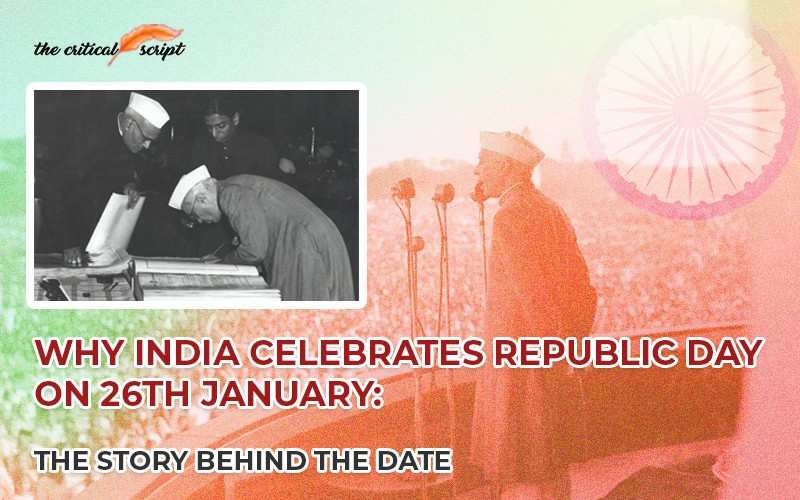
Why India Celebrates Republic Day on 26th January: The Story Behind the Date
Every
year on 26th January, India celebrates Republic Day,
marking the day when the country’s Constitution came into force in 1950,
transforming India into a sovereign, democratic republic.
While India gained Independence from British rule on 15th August 1947,
it was on 26th January 1950 that the nation truly began to
govern itself under a Constitution drafted by its own people.
From Colony to Republic
After
Independence, India did not immediately become a republic. Between 1947
and 1950, the country was still governed largely under the Government
of India Act, 1935, a law framed by the British Parliament. During
this period, India functioned as a Dominion of the British Commonwealth,
with the British monarch as the nominal head of state, represented in India by
the Governor-General.
This
arrangement was temporary. Indian leaders wanted the country to have its own
Constitution, reflecting the aspirations, rights, and responsibilities
of its citizens, and free from colonial legal frameworks.
Framing of the Constitution
To
achieve this, the Constituent Assembly of India was formed in 1946.
It included representatives from different regions, communities, and political
backgrounds.
·
The drafting of the Constitution took 2
years, 11 months, and 18 days.
·
The Drafting Committee was
chaired by Dr. B. R. Ambedkar, who played a central role in
shaping India’s constitutional framework.
·
The Constitution aimed to guarantee justice,
liberty, equality, and fraternity, values later enshrined in the
Preamble.
The
Constituent Assembly adopted the Constitution on 26 November 1949,
a date now celebrated as Constitution Day.
Why 26th January Was Chosen
Although
the Constitution was adopted in November 1949, it was decided that it would come
into effect on 26th January 1950. This was not accidental.
The
choice of 26th January was deeply symbolic and rooted in India’s freedom
struggle.
On
26 January 1930, the Indian National Congress, under the
leadership of Jawaharlal Nehru, declared Purna Swaraj
(Complete Independence) as its goal. Until then, many leaders were
seeking dominion status within the British Empire, but the 1930 declaration
marked a decisive shift toward full independence.
That
day, people across India took a pledge to fight for complete freedom, and 26th
January was observed as Independence Day every year from 1930 to 1947.
To
honour that historic commitment to self-rule, India’s leaders chose the same
date, 26th January to bring the Constitution into effect and
formally establish India as a republic.
What Does ‘Republic’ Mean?
A
republic is a country where the head of state is
elected, not inherited through monarchy.
With
the enforcement of the Constitution on 26 January 1950:
·
The position of Governor-General
was abolished.
·
India got its first President,
Dr.Rajendra Prasad, as the constitutional head of a State.
·
Sovereignty shifted fully to the people
of India, who became the ultimate source of political authority.
This
marked the final step in India’s journey from colonial rule to complete
self-governance.
Republic Day Celebrations and Parade
The
most visible symbol of Republic Day is the grand Republic Day Parade
held at Kartavya Path (formerly Rajpath) in New Delhi.
The
parade showcases:
·
India’s military strength and defence
preparedness
·
Cultural diversity through state tableaux
·
Achievements in science, technology, and
social development
·
Marching contingents of the armed forces and
paramilitary forces
A
foreign head of state or government is traditionally invited as the Chief
Guest, highlighting India’s diplomatic relationships and global
standing.
Republic
Day celebrations are also held across states, districts, schools, and
institutions, reinforcing the importance of constitutional values at every
level of society.
Disclaimer: The opinions expressed in this article are those of the author's. They do not purport to reflect the opinions or views of The Critical Script or its editor.
National Related Posts





Newsletter!!!
Subscribe to our weekly Newsletter and stay tuned.
Related Comments