


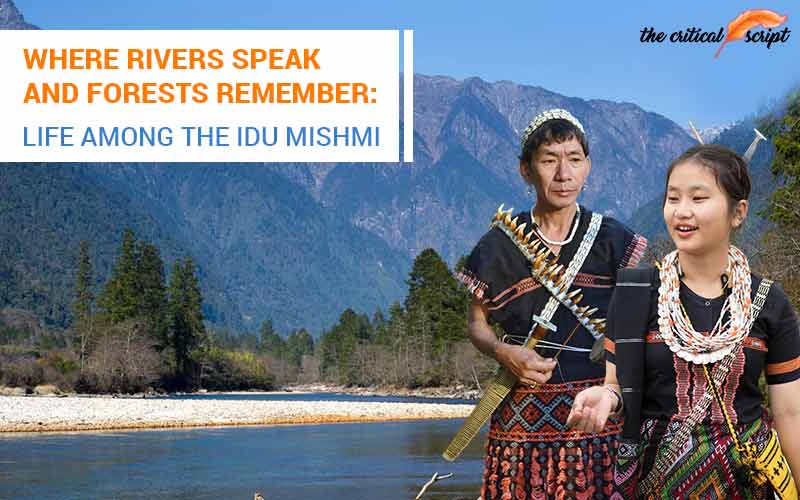
Where Rivers Speak and Forests Remember: Life Among the Idu Mishmi
A Living Civilization in the Eastern Himalaya


In the far eastern reaches of the
Himalaya, where rivers carve through deep valleys and forests stretch into
mist-covered ridges, the Idu Mishmi sustain a way of life that is both ancient
and deeply attuned to the natural world. Living across regions such as Upper
Dibang Valley, Lower Dibang Valley, Lohit, and Anjaw, their presence in this
landscape is not merely historical but ongoing, rooted in memory, ritual, and
ecological understanding.
Oral traditions and linguistic research suggest that the Idu Mishmi trace their origins to migrations from the Tibetan plateau centuries ago. Over time, they adapted to a demanding environment of steep terrain and dense forests, establishing settlements that balanced access to resources with spiritual and strategic considerations. Villages often rise along riverbanks or cling to hillsides, shaped as much by geography as by belief.
The Sacred Geography of Everyday Life


For the Idu Mishmi, the natural world is
neither passive nor separate from human life. Their belief system reflects
Animism, where every element, mountains, rivers, trees, and even stones, possesses
life and intention. The landscape is understood as a network of relationships
rather than a collection of resources.
Within this worldview, creator deities such as Maselo-Zinu and Nani-Intaya anchor cosmological understanding, yet the sacred extends far beyond them into the everyday environment. Ritual practices accompany acts like cultivation, construction, and hunting, functioning as necessary negotiations with unseen forces. The anthropologist Verrier Elwin once observed that for many communities of the Northeast, the earth itself is alive, an idea that remains central to Idu thought and practice.
The Igu and the Language of Spirits


Spiritual life within the community is
guided by the Igu, a ritual specialist who mediates between human and spirit
worlds. The Igu’s role is expansive, encompassing healing, funerary rites,
agricultural blessings, and the restoration of balance during times of crisis.
Through long, rhythmic chants, often drawn from oral epics passed down through
generations, the Igu preserves collective memory while actively engaging with
the unseen.
These ceremonies are not symbolic displays but deeply functional acts. Observers have described them as conversations rather than performances, in which the Igu negotiates with spirits in a manner that reflects both reverence and familiarity. In this sense, ritual becomes a form of dialogue, binding the present to ancestral knowledge.
Kinship Beyond the Human


Among the most profound aspects of Idu
cosmology is the belief that the Tiger is an elder brother. This relationship
extends kinship beyond the human realm, shaping ethical conduct and
environmental practice. The tiger is never hunted, and its death, whether
accidental or unavoidable, requires ritual atonement to restore moral balance.
This worldview has long contributed to the preservation of biodiversity in regions such as the Dibang Wildlife Sanctuary, which also shelters rare species like the Asiatic Golden Cat. In contemporary debates over conservation policy, institutions such as the Idu Mishmi Cultural and Literary Society emphasize that traditional beliefs have already fostered sustainable coexistence between humans and wildlife.
Cloth, Identity, and Meaning


Cultural identity among the Idu Mishmi is
also expressed through material forms, particularly attire. Traditional
garments woven in black, red, and white carry layers of symbolic meaning tied
to fertility, protection, and ritual strength. The geometric patterns that
define these textiles are not merely decorative; they communicate clan
affiliations and social roles, making clothing a visible language of identity.
Headgear crafted from bamboo and cane further reinforces this symbolism. Everyday hats are designed for durability in a wet, mountainous climate, while ceremonial versions incorporate feathers, beads, and tusks to signify rank and ritual importance. The ethnologist Christoph von Fürer-Haimendorf described such expressions as a form of embodied culture, where identity is worn as much as it is lived.
Continuity in a Changing World
The story of the Idu Mishmi is not one of
the past alone. It is an ongoing negotiation between tradition and change,
between inherited knowledge and modern pressures. Their worldview, where rivers
speak, forests remember, and animals are kin, offers a perspective that is
increasingly relevant in conversations about sustainability and coexistence.
To encounter the Idu Mishmi is to engage
with a living philosophy, one that does not separate the human from the natural
but binds them together in a shared existence shaped by respect, memory, and
balance.
Disclaimer: The opinions expressed in this article are those of the author's. They do not purport to reflect the opinions or views of The Critical Script or its editor.
Regional Related Posts











Newsletter!!!
Subscribe to our weekly Newsletter and stay tuned.
Related Comments