


 INDIA ASIAN GAMES MEDAL MONITOR
·
India: 🥇 0
| 🥈 0
| 🥉 0
| Total: 0
INDIA ASIAN GAMES MEDAL MONITOR
·
India: 🥇 0
| 🥈 0
| 🥉 0
| Total: 0
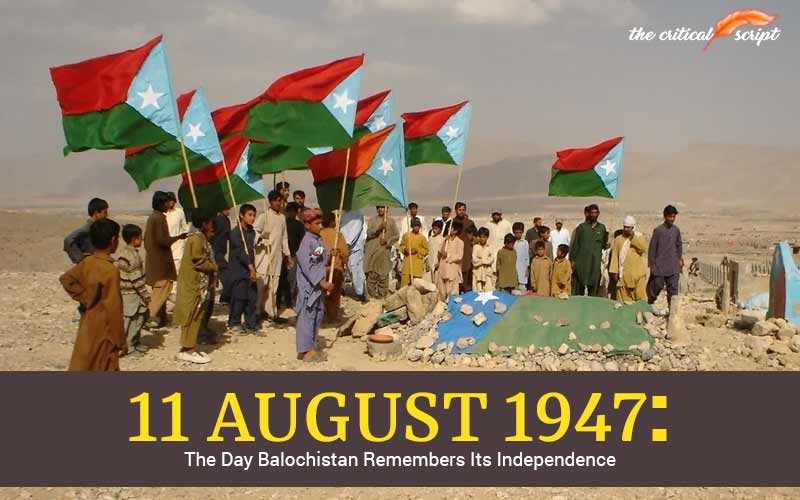
11 August 1947: The Day Balochistan Remembers Its Independence
11 August occupies a deeply significant place in Baloch political memory. For Baloch nationalists, it is not merely another date in the complicated history of the partition of British India. It represents the moment when the Khanate of Kalat was recognised as an independent state and when the possibility of an independent Balochistan briefly stood as a political reality before the upheavals that followed.
The story of Balochistan in 1947 is often reduced to a footnote in the larger narrative of Partition. It deserves far more attention.
When British paramountcy in the Indian subcontinent was coming to an end, the political future of hundreds of princely states and territories became uncertain. The Khanate of Kalat, centred in present-day Balochistan, maintained that it possessed a distinct political status and sought to negotiate its future separately.
On 11 August 1947, shortly before the end of British rule in India, the British authorities and the Khan of Kalat reached an understanding concerning Kalat's status. For Baloch nationalists, this date represents the restoration and recognition of Baloch sovereignty.
Three days later, Pakistan came into existence.
That coincidence is central to the historical memory surrounding 11 August. While the new state of Pakistan sought to consolidate territories within its emerging borders, Kalat's political leadership initially pursued a different course.
The question was no longer simply who would inherit British India.
It was whether Balochistan would have the right to determine its own political future.
A Forgotten Chapter of Partition
The Partition narrative is usually told through the experiences of India and Pakistan. Yet the end of British rule affected numerous smaller political entities whose futures were uncertain.
Kalat was one of them.
The Khanate had its own political institutions and had maintained treaty relations with the British. Its leadership argued that the termination of British paramountcy restored its sovereignty rather than automatically transferring its territory to the newly created Dominion of Pakistan.
The Kalat State National Party and other Baloch political voices also advocated greater political autonomy and, in varying forms, independence.
For Baloch nationalists, therefore, 11 August became a symbol of something larger than a constitutional arrangement.
It became a symbol of self-determination.
What Happened After Independence?
The situation changed rapidly.
Pakistan and Kalat entered into negotiations concerning their future relationship. The two sides disagreed over the political and constitutional status of Kalat and the surrounding territories.
Eventually, in March 1948, the Khan of Kalat signed an Instrument of Accession to Pakistan.
Pakistan considers this accession legitimate and maintains that Kalat became part of Pakistan through a lawful constitutional process.
Baloch nationalist movements have a fundamentally different interpretation.
They argue that the accession did not reflect the freely expressed will of the Baloch people and that military and political pressure played a decisive role in bringing Kalat into Pakistan.
That disagreement has never completely disappeared.
It became one of the foundational grievances underlying subsequent Baloch nationalist movements.
Why 11 August Still Matters
For those who observe Balochistan Independence Day, 11 August is therefore not simply about looking backwards.
It represents a continuing demand for the right of a people to determine their own political destiny.
The date has acquired symbolic importance precisely because the promise associated with it was short-lived.
The idea of Baloch sovereignty existed as a political possibility in 1947. Within months, that possibility had been overtaken by the territorial and political consolidation of the new Pakistani state.
That history continues to influence Baloch political consciousness.
Across decades, Baloch nationalist movements have raised demands ranging from greater provincial autonomy to complete independence. These movements have also faced severe repression, disappearances, displacement and violence, making the question of Balochistan one of the most contentious political issues in the region.
The historical debate cannot be separated from the human consequences that followed.
Independence Is More Than a Date
Every independence movement creates its own calendar of memory.
For India, 15 August represents the end of colonial rule.
For Pakistan, 14 August marks the creation of the country.
For Baloch nationalists, 11 August represents a different historical memory: the brief assertion of a political sovereignty that they believe was subsequently lost.
That is why the date continues to be observed.
It is not simply a celebration of an event from 1947. It is a statement about identity, history and the unresolved question of self-determination.
The significance of 11 August can therefore be understood without reducing it to a simple dispute between competing national narratives.
At its heart lies a question that has shaped modern history:
Who has the right to decide the political future of a people—the state that claims a territory, or the people who inhabit it?
For Baloch nationalists, the answer remains unequivocal.
The memory of 11 August 1947 is a reminder that their demand for self-determination did not begin yesterday. It is rooted in the turbulent final days of the British Empire, when the political map of South Asia was being redrawn and the future of Balochistan briefly stood at a crossroads.
More than seven decades later, that memory remains alive.
11 August is remembered not merely as a date in history, but as a symbol of an unfinished aspiration.
Disclaimer: The opinions expressed in this article are those of the author's. They do not purport to reflect the opinions or views of The Critical Script or its editor.
History And Facts Related Posts








Newsletter!!!
Subscribe to our weekly Newsletter and stay tuned.
Related Comments