


 INDIA ASIAN GAMES MEDAL MONITOR
·
India: 🥇 0
| 🥈 0
| 🥉 0
| Total: 0
INDIA ASIAN GAMES MEDAL MONITOR
·
India: 🥇 0
| 🥈 0
| 🥉 0
| Total: 0
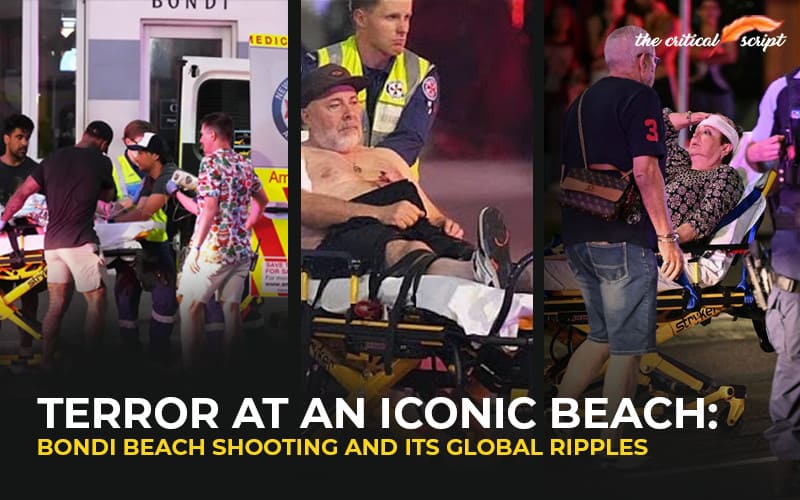
Terror at an Iconic Beach: Bondi Beach Shooting and Its Global Ripples
On
the evening of 14 December 2025, one of Australia’s most recognizable
landmarks, Bondi Beach, became the scene of a devastating terrorist attack at a
Jewish community celebration, fracturing the nation’s sense of safety and
reverberating across the world.
The Attack: Precision and Panicked Chaos
The
assault occurred at Archer Park, adjacent to Bondi Beach, during a large
Hanukkah celebration known as “Chanukah by the Sea,” an event that typically
draws over a thousand attendees, which included families, community members,
and visitors from across Sydney.
At
approximately 18:47 AEDT, two armed men, later identified by New South Wales
Police as a 50-year-old father and his 24-year-old son, Naveed Akram, opened
fire on the crowd with long-barrelled firearms, triggering panic and chaos in
an area usually filled with laughter, music, and the smells of summer by the
sea.
Authorities
later classified the incident as a terrorist attack motivated by antisemitism. At least 16 people were killed, including one of the
attackers, and more than 40 were wounded, many critically. The victims ranged
in age from 10 to 87, and included children, elderly members of the Jewish
community, a Holocaust survivor, a Chabad rabbi, and foreign nationals.
Police engaged the attackers; one shooter was killed at the scene, and the
other was wounded and taken into custody.
Heroism Amid Horror
Amid
the carnage, bystanders intervened. Ahmed al-Ahmed, a local stall owner, became
a focus of global attention after footage and reports showed him tackling and
disarming one gunman, sustaining gunshot wounds in the process, but preventing
further loss of life.
The Suspects: Background and Context
Police
investigations revealed that the father possessed multiple legally registered
firearms and was an active member of a gun club, a perplexing fact given
Australia’s post-Port Arthur gun laws, which are generally considered among the
world’s most stringent.
The
younger attacker, Naveed Akram, was known to Australian intelligence agencies
(ASIO) from a prior assessment in 2019, but was not assessed as an immediate
threat, leaving unanswered questions about intelligence gaps.
Official and Community Reactions
Prime
Minister Anthony Albanese described the attack as “an act of pure evil” and a
targeted act of antisemitic terrorism that struck at the heart of Australia’s
social values. New South Wales Premier Chris Minns echoed the sentiment, urging
national unity and applauding bystanders and first responders who saved lives.
Jewish community leaders expressed profound grief and called for concrete
measures to combat antisemitism in public life, arguing that rising hostility
had not been countered with sufficient force.
International reactions included condemnations from world leaders and amplified
security concerns for Jewish communities abroad.
France Cancels Paris New Year’s Eve Events
In
a broader demonstration of heightened security concerns in Europe, Paris
officials announced the cancellation of the iconic New Year’s Eve open-air
concert on the Champs-Élysées. While fireworks at the Arc de Triomphe are still
expected, authorities opted to replace the live concert with a pre-recorded
broadcast to discourage large crowds due to elevated terror and security fears.
The
move reflects broader concerns about managing massive gatherings in urban
spaces vulnerable to violence, whether from terrorism, mass unrest, or other
high-risk triggers. Although the decision predates the Bondi shooting and does
not appear to be a direct reaction to it, the global climate of threat
awareness, boosted by recent major attacks, played a significant role in
Paris’s precautionary stance.
Broader Implications and Critiques
The
Bondi attack now stands as Australia’s deadliest shooting in nearly three
decades and the most lethal terrorist incident on Australian soil, shattering
long-held assumptions about the country’s insulation from mass-casualty
violence. Beyond the immediate horror, the incident has exposed uncomfortable
questions for policymakers and security agencies alike. Intelligence and
threat-assessment frameworks may have failed to detect warning signs of
radicalization or operational planning, despite prior indicators linked to the
perpetrators. Equally troubling is the role of legally acquired firearms in
enabling a mass-casualty attack, prompting renewed scrutiny of gun licensing,
monitoring, and enforcement mechanisms that were once considered global
benchmarks.
At
a societal level, the attack has reignited debate over the rise of global and
domestic antisemitism, and the extent to which political minimization or denial
of its severity has allowed hostility to normalize in public discourse. When
hate is treated as a rhetorical excess rather than a security risk, it creates
an ecosystem where violence can incubate unnoticed, until it erupts with
devastating consequences.
Yet
defenders of existing policies urge restraint. They argue that such incidents
remain exceptionally rare in Australia and caution against fear-driven
policymaking that could erode civil liberties or distort threat prioritization.
For them, the challenge lies not in dismantling established frameworks, but in
strengthening precision, intelligence coordination, and early-intervention
capabilities without surrendering the societal openness those frameworks were
designed to protect.
International Aftershocks
The
attack has forced governments and security agencies worldwide to urgently
reassess the safety of high-density public gatherings. In the United Kingdom,
police have intensified patrols around Jewish neighbourhoods, synagogues, and
community centres, reflecting heightened concerns over targeted violence.
Across Europe, a broader debate is unfolding over how to preserve open,
democratic public celebrations while responding to credible terror threats.
These anxieties have directly shaped precautionary decisions such as Paris’s
cancellation of its New Year’s Eve celebrations, signalling a shift from
symbolic openness to security-first governance in an increasingly volatile
global environment.
The
2025 Bondi Beach shooting stands as a grim reminder that terror, hate-driven
violence, and the targeting of minority communities remain potent threats even
in countries with strict gun control and robust security apparatuses. Its
ripple effects, from public grief and political debates to pre-emptive security
measures thousands of kilometres away in Paris, underscore a world grappling
with how to preserve open, communal celebration in an era of heightened
uncertainty.
Disclaimer: The opinions expressed in this article are those of the author's. They do not purport to reflect the opinions or views of The Critical Script or its editor.
World Related Posts








Newsletter!!!
Subscribe to our weekly Newsletter and stay tuned.
Related Comments