


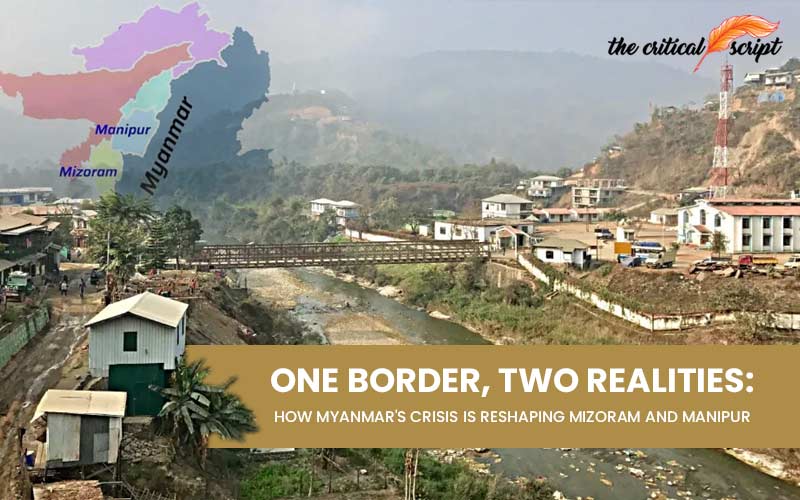
One Border, Two Realities: How Myanmar's Crisis Is Reshaping Mizoram and Manipur
The continuing conflict in Myanmar
has pushed thousands across India's eastern border, placing Manipur and Mizoram
at the intersection of humanitarian responsibility, border security, ethnic
ties, and administrative challenges. As displacement continues, the Northeast
faces difficult questions about refugee management, local resources, national
security and the future of its border communities.
The political and military crisis in
Myanmar, which intensified following the military coup of February 2021, has
evolved into a major regional concern for India. What began as an internal
political crisis has increasingly spilled across international borders,
affecting neighbouring countries, particularly India's Northeastern states of
Manipur and Mizoram.
Sharing a 1,643-kilometre
international boundary with Myanmar, the Northeast has historically maintained
close ethnic, cultural and economic connections with communities across the border.
These relationships have shaped cross-border movement for generations. However,
the prolonged conflict in Myanmar has added a new dimension to these
connections, creating significant humanitarian, administrative and security
challenges.
Thousands of people fleeing violence
and instability have sought shelter in Indian border states. While the response
has been shaped by humanitarian considerations and longstanding community
relationships, the scale and duration of displacement have raised questions about
India's preparedness to manage prolonged cross-border movements.
Two states, two different realities: Mizoram and Manipur
Although Mizoram and Manipur share
an international border with Myanmar, the refugee influx has produced markedly
different social and political responses in the two states. The difference is
rooted largely in ethnic affiliations, religious connections, and the existing
demographic and political landscape.
Mizoram: An ethnic and religious bond that encourages solidarity
In Mizoram, the response to people
fleeing Myanmar has been shaped significantly by the close ethnic, cultural and
religious connections between the Mizo population and the Chin communities of
Myanmar.
The Mizos and Chins share roots
within the broader Zo ethnic grouping, closely related languages, cultural
traditions and, importantly, a predominantly Christian religious identity.
Colonial-era boundaries divided communities whose family, social and cultural
relationships predate the modern international border.
Consequently, many people in Mizoram
view those arriving from Myanmar not merely as foreign nationals but as members
of closely related communities facing persecution and conflict. Churches, civil
society organisations, particularly the Young Mizo Association, and residents
have played an important role in providing food, shelter, healthcare and other
assistance.
The Mizoram government's
comparatively accommodating approach has also reflected these historical and
humanitarian considerations. However, this solidarity does not mean the
situation is without complications. Prolonged displacement has placed pressure
on local resources, employment opportunities and public infrastructure, while
questions of documentation and border management remain important.
Manipur: Refugee influx amid an already sensitive demographic
landscape
Manipur presents a more complicated
situation. Unlike Mizoram, where ethnic and religious affinities have
facilitated a largely welcoming response, the arrival of Myanmar nationals has
become entangled with the state's existing ethnic tensions and demographic
concerns.
Sections of the Meitei community
have expressed apprehensions that undocumented migration into the hill
districts could alter population patterns and affect the existing balance of indigenous
communities. These concerns are particularly sensitive in the context of the
state's ongoing Meitei-Kuki-Zo conflict, which has already exposed deep
divisions over land, identity, political representation and administrative
arrangements.
Several hill districts have
substantial Kuki-Zo populations, while others have significant Naga
populations. The Meiteis predominantly inhabit the Imphal Valley. This
geographical and demographic distinction makes questions of migration, land
ownership and political representation particularly contentious.
The issue has also acquired an
administrative dimension. On September 7, 2026, Manipur Home Minister Govindas
Konthoujam informed the Assembly that authorities had detected 24,475
undocumented Myanmar nationals. Of these, 14,992 had been pushed back, while
the remaining individuals were reported to be in temporary shelters or under
administrative supervision.
For sections of the Meitei
community, the concern extends beyond the number of people entering the state.
It involves questions about undocumented settlement, verification of
citizenship, indigenous identity and the potential long-term implications for
the demographic composition of the hill districts.
These concerns need to be examined
alongside the rights and security of existing indigenous communities, including
the Kuki-Zo and Naga populations, as well as the humanitarian circumstances of
people fleeing Myanmar. Allegations of demographic change should be
distinguished from independently verified population data.
The larger question: Can India adopt a differentiated
approach?
The contrasting experiences of
Mizoram and Manipur demonstrate why a uniform response to the Myanmar crisis
may not adequately address the realities of India's northeastern borderlands.
In Mizoram, ethnic kinship and
religious solidarity have influenced the willingness of communities to
accommodate displaced Chin populations. In Manipur, the same cross-border
movement has become a more contentious issue because of existing ethnic
conflict, competing demographic concerns and sensitivities surrounding
indigenous land and political representation.
Neither situation can be understood
exclusively through the lens of humanitarian assistance or border security.
Both require an approach that recognises local histories, community
relationships and constitutional protections while maintaining effective
immigration controls.
The central question for New Delhi is
how to protect India's borders and indigenous communities without abandoning
humanitarian responsibilities towards people fleeing violence.
Disclaimer: The opinions expressed in this article are those of the author's. They do not purport to reflect the opinions or views of The Critical Script or its editor.
Regional Related Posts








Newsletter!!!
Subscribe to our weekly Newsletter and stay tuned.
Related Comments