


 INDIA ASIAN GAMES MEDAL MONITOR
·
India: 🥇 0
| 🥈 0
| 🥉 0
| Total: 0
INDIA ASIAN GAMES MEDAL MONITOR
·
India: 🥇 0
| 🥈 0
| 🥉 0
| Total: 0
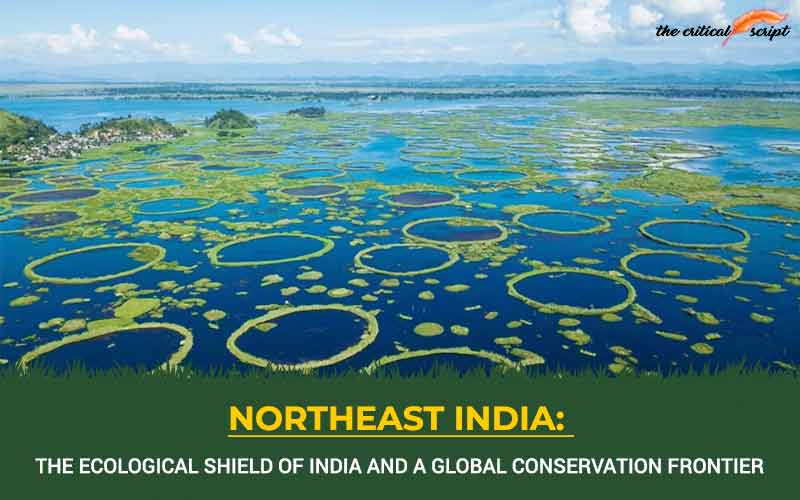
Northeast India: The Ecological Shield of India and a Global Conservation Frontier
As the
world marks World Environment Day, the global conversation increasingly
revolves around biodiversity loss, climate change, deforestation, water
scarcity, and sustainable development. While these challenges affect every
continent, some regions possess an ecological significance that extends far
beyond their geographical boundaries. Northeast India is one such region.
Comprising Arunachal Pradesh, Assam, Meghalaya, Manipur, Mizoram, Nagaland,
Sikkim, and Tripura, Northeast India occupies less than 8 percent of India’s
geographical area. Yet it contains some of the country’s richest forests, most
diverse ecosystems, largest river systems, and highest concentrations of
wildlife. The region forms part of the Eastern Himalaya and Indo-Burma
biodiversity hotspots; two of the most important ecological landscapes on
Earth.
A Global Biodiversity Hotspot
The Eastern Himalaya and Indo-Burma hotspots together support thousands of
plant and animal species. Northeast India is estimated to host nearly 50
percent of India’s bird species, over one-third of its plant diversity, and a
remarkable variety of mammals, reptiles, amphibians, and insects.
The region serves as a meeting point between the Himalayan, Indian, and
Southeast Asian biogeographic realms. This unique location has created an
extraordinary diversity of habitats ranging from tropical rainforests and
bamboo groves to alpine meadows and glacial ecosystems.
Arunachal Pradesh: India’s Green Crown
Arunachal Pradesh is widely regarded as one of India’s last great wilderness
areas. According to the India State of Forest Report (ISFR) 2023, the state
possesses approximately 65,882 square kilometres of forest cover, making it one
of India’s most forested states.
Protected areas such as Namdapha National Park, Mouling National Park, Pakke
Tiger Reserve, Kamlang Tiger Reserve, and Dibang Wildlife Sanctuary support
clouded leopards, red pandas, Mishmi takins, snow leopards, Asiatic black
bears, hornbills, and thousands of plant species.
Scientists continue to discover new species from Arunachal Pradesh. In recent
years, several new amphibians, reptiles, orchids, and insects have been
documented, reinforcing its reputation as one of Asia’s least explored
biological frontiers.
The Forest Wealth of Northeast India
Forests are among the most effective natural tools for combating climate
change. They absorb carbon dioxide, regulate rainfall, prevent soil erosion,
recharge groundwater, and support biodiversity.
The northeastern states collectively contain some of India’s densest forests.
Mizoram has more than 84 percent forest cover, Arunachal Pradesh nearly 80
percent, Meghalaya over 75 percent, and Nagaland more than 70 percent. These
forests act as major carbon sinks and help stabilize regional climate systems.
However, recent assessments have highlighted concerns regarding forest
degradation and land-use change. Conservation efforts must therefore focus not
only on maintaining forest cover but also on improving forest quality and
ecological integrity.
The Brahmaputra Basin: Lifeline of the
Northeast
The Brahmaputra River originates in Tibet before flowing through Arunachal
Pradesh and Assam into Bangladesh. It is one of Asia’s great river systems and
supports millions of people through agriculture, fisheries, transportation, and
ecosystem services.
The river’s floodplains sustain wetlands, grasslands, and forests that provide
habitat for iconic wildlife including the greater one-horned rhinoceros, Bengal
tiger, wild water buffalo, and numerous migratory birds.
Climate change, however, is altering rainfall patterns and increasing the
frequency of extreme weather events. Combined with riverbank erosion and changing
sediment loads, these factors pose growing risks to communities and ecosystems.
Ramsar Sites and Wetlands
Wetlands play a critical role in water storage, flood mitigation, carbon
sequestration, and biodiversity conservation.
The Northeast is home to several internationally important Ramsar Sites. Deepor
Beel in Assam serves as a habitat for migratory birds and an important
flood-control system. Loktak Lake in Manipur is famous for its floating phumdis
and the KeibulLamjao National Park - the world’s only floating national park.
Rudrasagar Lake in Tripura and Pala Wetland in Mizoram further enrich the
region’s freshwater heritage.
These wetlands support fisheries, tourism, agriculture, and livelihoods while
acting as buffers against floods and droughts.
Wildlife Conservation Success Stories
Northeast India has produced some of the world’s most inspiring conservation
achievements.
Kaziranga National Park in Assam is internationally celebrated for protecting
the largest population of the greater one-horned rhinoceros. Once on the brink
of extinction, the species has recovered significantly due to dedicated
conservation measures.
Pakke Tiger Reserve in Arunachal Pradesh has emerged as a model for
community-based conservation. Local participation in hornbill protection
programs has helped safeguard nesting habitats and reduce hunting pressures.
Community conservation areas in Nagaland have transformed former hunting
grounds into safe havens for migratory birds and wildlife, demonstrating how
local stewardship can reverse ecological decline.
Indigenous Communities and Traditional
Knowledge
The environmental history of Northeast India cannot be separated from its
indigenous communities. For centuries, tribal societies have developed
sophisticated systems of natural resource management.
The sacred groves of Meghalaya preserve old-growth forests and rare species
through customary protection. Community-managed forests in Nagaland and
Arunachal Pradesh illustrate how local governance can effectively conserve
biodiversity while supporting livelihoods.
The Apatani landscape of Arunachal Pradesh is internationally recognized for
its sustainable agricultural practices that integrate farming, water
management, and ecological conservation.
Today, traditional ecological knowledge is increasingly acknowledged as an
essential component of climate resilience and biodiversity protection.
Climate Change and Emerging Threats
The Eastern Himalayan region is among the most climate-sensitive areas in the
world. Rising temperatures, changing rainfall patterns, glacial retreat, and
extreme weather events are already affecting ecosystems and livelihoods.
Communities across the Northeast face increasing risks from flash floods,
landslides, riverbank erosion, and changing agricultural conditions. Mountain
ecosystems are particularly vulnerable because many species have limited
options for migration as temperatures rise.
Plastic pollution, habitat fragmentation, invasive species, and unsustainable
land-use practices add to these environmental pressures.
A Living Laboratory of Scientific
Discovery
Despite decades of research, Northeast India continues to reveal new species.
Scientists have recently documented new frogs, reptiles, fish, insects, and
plant species across Arunachal Pradesh, Meghalaya, and other northeastern
states.
Such discoveries highlight the urgent need for continued scientific exploration
and habitat protection. Species cannot be conserved if they disappear before
they are even documented.
The Way Forward
The future of Northeast India depends on balancing development with
environmental sustainability. Investments in renewable energy,
climate-resilient infrastructure, eco-tourism, biodiversity research,
sustainable agriculture, and community-led conservation can help ensure that
economic growth complements ecological security.
Strengthening protected areas, restoring degraded ecosystems, expanding wetland
conservation, and empowering indigenous communities must remain central to
environmental policy.
Northeast India is far more than a geographical region. It is one of the world’s
great ecological treasures - a repository of biodiversity, a climate regulator,
a water tower, and a living example of humanity’s relationship with nature.
Its forests absorb carbon. Its rivers sustain millions. Its wetlands buffer
floods. Its wildlife enriches global biodiversity. Its indigenous communities
preserve generations of ecological wisdom.
On this World Environment Day, protecting Northeast India must be viewed not merely
as a regional responsibility but as a national and global imperative. The
environmental future of India will depend significantly on how effectively this
extraordinary region is conserved for generations to come.
Disclaimer: The opinions expressed in this article are those of the author's. They do not purport to reflect the opinions or views of The Critical Script or its editor.
Earth Science Related Posts












Newsletter!!!
Subscribe to our weekly Newsletter and stay tuned.
Related Comments